

What is a Roth IRA is probably the most Googled retirement question in the US. And most of the answers out there are written for people who already understand tax accounts.
This one isn’t.
What is a Roth IRA, exactly?
A Roth IRA is a retirement savings account where you pay taxes on your money before it goes in. Everything it earns after that grows completely tax-free. When you retire and pull the money out, you owe the IRS nothing.
IRA stands for Individual Retirement Account. The “Roth” part is named after Senator William Roth, who created it in 1997.
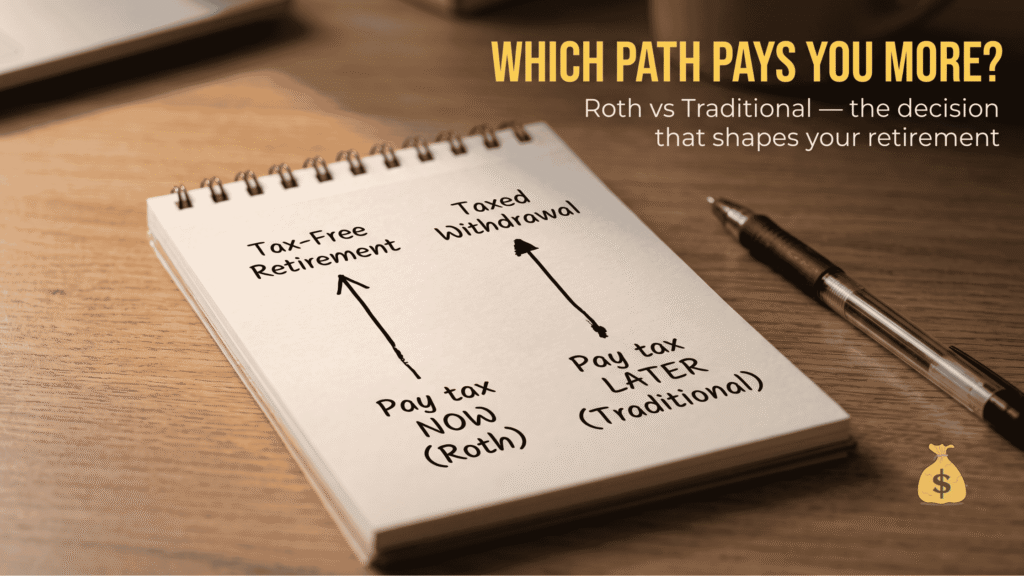
The core deal: pay tax now, never pay tax on the growth later.
For most people starting out in their 20s or 30s, that’s a genuinely good deal.
How it works — a simple example
Say you put $5,000 into a Roth IRA today. You’ve already paid income tax on that money. You invest it in an index fund, leave it alone, and over 30 years it grows to $50,000.
That $45,000 in growth? Tax-free. Every dollar.
In a regular brokerage account, you’d owe capital gains tax on those earnings when you sell. In a traditional IRA, you’d owe income tax on the full $50,000 at withdrawal. The Roth IRA skips both bills entirely, because you settled up with the IRS at the start.
Roth IRA vs traditional IRA: the actual difference
| Question | Roth IRA | Traditional IRA |
|---|---|---|
| When you pay tax | Now (after-tax contributions) | Later (taxed at withdrawal) |
| Tax deduction today? | No | Yes, if eligible |
| Tax-free in retirement? | Yes | No |
| Income limits? | Yes | No |
| Forced withdrawals at 73? | No | Yes |
The deciding question is simple: will your tax rate be higher now or in retirement?
If you’re early in your career, earning a modest income, your rate today is probably the lowest it’ll ever be. Pay it now, let the account grow tax-free for 30 years.
If you’re in peak earning years with a high salary, your rate now might be higher than it’ll be in retirement. A traditional IRA could make more sense take the deduction now, pay taxes later when your income drops.
For most beginners in their 20s or 30s, the Roth wins. You’re likely in a lower bracket now than you’ll ever be again.
2026 Roth IRA contribution limits
The 2026 limit is $7,500 if you’re under 50, and $8,600 if you’re 50 or older.
To max it out monthly, that’s about $625 a month for under-50s. Roughly the cost of a car payment which is a useful way to think about it.
A few rules that matter:
- Only earned income counts. Wages, salary, freelance pay, self-employment income. Investment returns don’t qualify.
- You can’t contribute more than you actually earned. Made $4,000 this year? Your max contribution is $4,000.
- The deadline for 2026 contributions is April 15, 2027. You get until mid-April of the following year.
- The $7,500 limit is combined across all your IRAs. Roth plus traditional together can’t exceed it.
Income limits for 2026
The IRS phases out eligibility at higher incomes.
In 2026, single filers with a MAGI under $153,000 can make the full contribution. The phase-out runs from $153,000 to $168,000. Above $168,000, you can’t contribute directly at all.
For married couples filing jointly, the full contribution applies up to $242,000. Phase-out runs to $252,000.
MAGI is Modified Adjusted Gross Income basically your total income before certain deductions. For most people, it’s close to your W-2 number.
If you’re above the upper limits, there’s a legal workaround called the Backdoor Roth IRA. You contribute to a traditional IRA first, then convert it. Widely used, completely legitimate. Most beginners won’t need it, but worth knowing exists.
What can you actually invest in inside a Roth IRA?
This confuses a lot of people. A Roth IRA is the account, not the investment.
Think of it as a container with tax-free status stamped on it. Once money is inside, you choose what to buy. Options include index funds, ETFs, individual stocks, bonds, and mutual funds.
For most beginners, the cleanest starting point is a single broad market index fund. Fidelity’s FZROX has a 0% expense ratio and no minimum. Vanguard’s VTI covers the entire US stock market. Either works. You own a slice of hundreds of companies, pay almost nothing in fees, and let it grow tax-free.
Don’t overthink the investment choice. Picking Fidelity vs Vanguard matters far less than actually opening the account.
When can you take the money out?
There are 2 types of money inside a Roth IRA: contributions and earnings.
Contributions (the money you put in) can come out any time, at any age, with no tax and no penalty. You already paid tax on it. It’s yours.
Earnings (the growth) have rules. To withdraw earnings tax-free and penalty-free, the account needs to have been open at least 5 years, and you need to be at least 59½.
Pull earnings out early and you’ll owe income tax on them plus a 10% penalty. There are exceptions — first home purchase up to $10,000, disability, certain education costs but treat earnings as untouchable until retirement.
The contributions flexibility is actually one of the Roth IRA’s underappreciated advantages. If something goes seriously wrong in life, you can access what you put in. You don’t get that with most retirement accounts.
The advantage most people overlook: no forced withdrawals
Traditional IRAs and 401(k)s require you to start pulling money out at age 73. These are called Required Minimum Distributions. The government wants its tax money eventually.
A Roth IRA has no RMDs during your lifetime.
The money can keep growing tax-free for as long as you live. And when you pass it on to heirs, they inherit a tax-free account. That’s why financial advisors often push Roth IRAs even when clients have access to other options it’s useful both as a retirement account and as a way to pass wealth forward.
How to open a Roth IRA step by step
Takes about 15 minutes.
Step 1: Pick a brokerage. Fidelity, Charles Schwab, and Vanguard are the 3 most popular for beginners. All have no account minimums, no annual fees, and solid index fund options. Any of them works. Pick one and move on.
Step 2: Open the account. Go to their website, select Roth IRA, and fill in your details. You’ll need your Social Security number, bank account info, and basic personal details.
Step 3: Transfer money in. Link your bank account and move your starting amount. $500 is enough to begin.
Step 4: Buy your investment. This is the step people miss. Money sitting in a Roth IRA but not invested in anything does nothing. After your transfer lands (1-3 business days), log back in and buy your chosen fund.
Step 5: Automate a monthly contribution. Set up a recurring transfer from your bank account into the Roth IRA. Even $100 a month. Automation removes the decision entirely.
What does a Roth IRA actually grow to?
Max out $7,500 a year for 30 years at a 7% real return and you’re looking at roughly $750,000. All of it tax-free.
You contributed $225,000. The Roth turned it into $750,000. The IRS gets none of the $525,000 in growth.
Smaller contributions still build real money:
| Monthly contribution | After 20 years (7%) | After 30 years (7%) |
|---|---|---|
| $100/month | $52,000 | $121,000 |
| $300/month | $156,000 | $363,000 |
| $625/month (max) | $325,000 | $756,000 |
A regular brokerage account growing to the same numbers would owe 15-20% in capital gains tax on every dollar of profit. The Roth IRA owes nothing.
Mistakes to avoid
Leaving the money in cash. A surprising number of people open a Roth IRA, transfer money in, and leave it sitting there as cash. The account does nothing until you actually buy an investment. Log back in and buy your fund.
Contributing more than the limit. The IRS charges a 6% penalty on excess contributions for every year they stay in the account. Track what you put in.
Pulling out earnings early. Contributions come out any time, no problem. Earnings before 59½ and before the 5-year rule cost you income tax plus a 10% penalty. Keep that distinction clear.
Waiting until you can max it out. $1,000 in a Roth IRA today beats $0 while you wait to afford the full $7,500. The clock on that tax-free growth starts the day you open the account.
Frequently asked questions
What is a Roth IRA in simple terms?
A retirement savings account where you pay taxes before the money goes in. Everything it earns after that grows tax-free, and you owe nothing on it when you withdraw in retirement.
How much can I put in a Roth IRA in 2026?
<cite index=”6-1″>The Roth IRA contribution limit for 2026 is $7,500 for those under 50, and $8,600 for those 50 and older.</cite> You can’t contribute more than your total earned income for the year. Deadline is April 15, 2027.
Can I lose money in a Roth IRA?
Yes. The Roth IRA is the account, not the investment. If you invest in stocks and the market drops, your balance drops too. The tax-free status protects your growth from the IRS, not from market risk. Broad index funds reduce that risk considerably compared to individual stocks.
What happens if I need the money before retirement?
The contributions (what you put in) come out any time without tax or penalty. The earnings are a different story. Withdrawing earnings before 59½ and before the account has been open 5 years triggers income tax plus a 10% penalty. Some exceptions apply, like a first home purchase up to $10,000.
Is a Roth IRA better than a 401(k)?
They do different things. Your 401(k) comes through your employer and often includes matching contributions. Always contribute enough to get the full match it’s free money. After that, max out a Roth IRA. Then go back to the 401(k) if you have more to invest. Use both.
What is the income limit for a Roth IRA in 2026?
Single filers with a MAGI under $153,000 can make the full contribution in 2026. Married couples filing jointly, the limit is $242,000. Above those upper limits, look into the Backdoor Roth IRA strategy.
1 thought on “What Is a Roth IRA? A Plain English Guide for Beginners”