What is an index fund for beginners is the question that should come before everything else in investing. Before stock picking. Before crypto. Before anything.
Most people skip it. That’s why most people underperform.
What is an index fund for beginners?
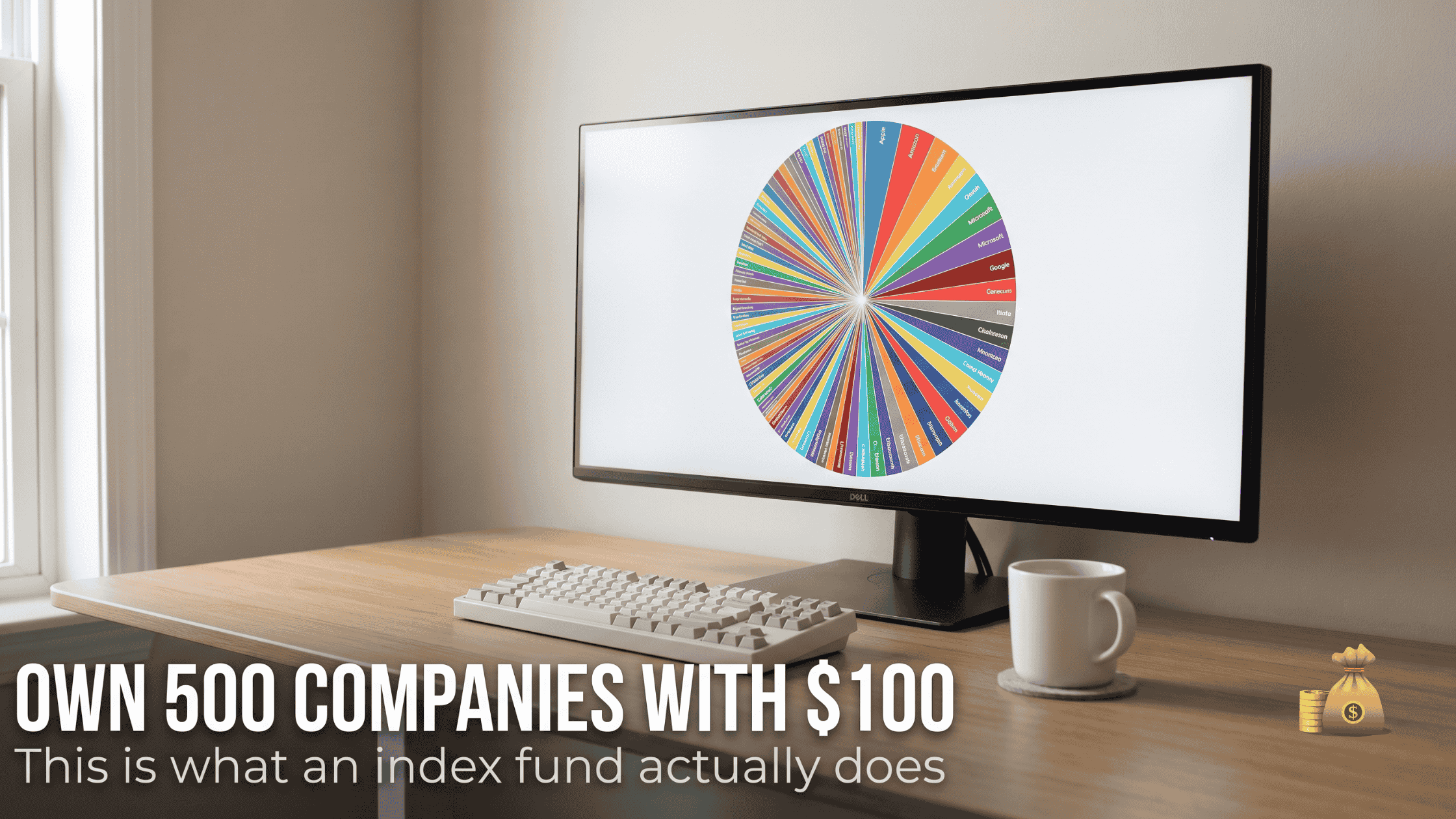
An index fund is a fund that owns a piece of every company in a market index. The S&P 500 is an index — a list of the 500 largest publicly traded US companies. Buy an S&P 500 index fund and you own a slice of all 500 at once. Apple, Microsoft, Amazon, JPMorgan. One purchase.
The fund doesn’t try to beat the market. It mirrors it. S&P 500 up 10%? Your fund is up roughly 10%. Down 15%? Same story.
That’s the whole design.
Why index funds beat most professional managers
Warren Buffett once bet $1 million that a simple S&P 500 index fund would outperform a basket of professionally managed hedge funds over 10 years.
He won easily. The index fund returned 7.1% annually. The hedge funds averaged 2.2%.
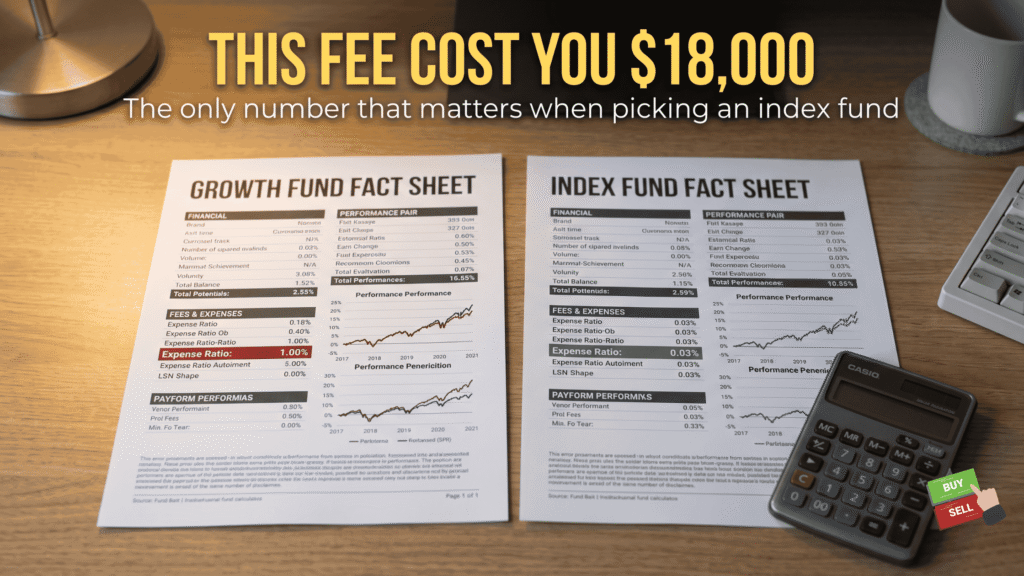
The reason is fees. An actively managed fund has a manager, analysts, a trading desk. All of that costs money, passed to you as an expense ratio typically 0.5% to 1% per year. The fund has to beat the market by that much just to match the index fund. Over a decade, almost nobody does it.
A typical S&P 500 index fund charges 0.03% annually. Fidelity’s FZROX charges 0%.
On a $10,000 investment over 30 years at 7% returns: the 0.03% fund grows to $76,123. The 1% fund grows to $57,435. That $18,688 gap went to the fund manager, not you.
Index fund vs individual stocks: the real difference
Say you have $1,000. You could buy shares in 1 or 2 companies. Or put that $1,000 into a total market index fund and own a fraction of 3,700 companies.
One bad earnings report tanks your portfolio if that company is all you own. When you own 3,700, one bad quarter at one company barely registers.
That’s diversification. Index funds build it in automatically, from day 1, with $100.
Do index funds actually beat professional managers?
Yes. Consistently.
Most actively managed funds underperform their benchmark index over any 10-year period. This gets worse over 20 years. The managers who beat the market one year rarely beat it the next. The ones who do usually can’t sustain it.
Warren Buffett famously bet $1 million that a simple S&P 500 index fund would outperform a basket of hedge funds over 10 years. He won. The index fund returned 7.1% annually. The hedge funds averaged 2.2%.
The reason is fees. A fund charging 1% annually has to outperform the market by at least 1% just to break even with the index fund. That’s hard. Over long periods, almost nobody does it consistently.
What is an index fund for beginners: the types worth knowing
Not all index funds track the same thing. A few that matter for beginners:
Total US market funds. These track every publicly traded company in the US around 3,700 stocks. VTI (Vanguard) and FSKAX (Fidelity) are the two most popular. One purchase, entire US stock market.
S&P 500 funds. These track the 500 largest US companies. VOO (Vanguard), FXAIX (Fidelity), and IVV (iShares) are the main options. Slightly less diversified than total market, but 500 companies is still a lot.
International funds. These track companies outside the US. VXUS (Vanguard) and FZILX (Fidelity) cover developed and emerging markets globally. Adding international exposure protects you if the US market underperforms for a stretch.
Bond index funds. These track bond markets instead of stocks. Less return potential, lower volatility. BND (Vanguard) is the most common. Useful as a stabiliser as you get closer to retirement.
For most beginners, 1 total market US fund and 1 international fund is enough to start. That covers thousands of companies across dozens of countries in 2 purchases.
Index fund vs ETF: is there actually a difference?
You’ll hear both terms used almost interchangeably. Here’s the distinction:
An index fund is defined by what it does (tracks an index). An ETF (Exchange-Traded Fund) is defined by how it trades (like a stock, on an exchange, throughout the day).
Most ETFs are index funds. Most index funds are available as ETFs.
The practical difference for beginners: ETFs trade like stocks you can buy and sell at any point during market hours. Traditional index mutual funds trade once per day at the closing price.
For a long-term investor buying and holding for 20+ years, this distinction barely matters. Buy either. VTI is an ETF. FSKAX is a mutual fund. Both track the total US market. Both work.
What does an expense ratio actually mean?
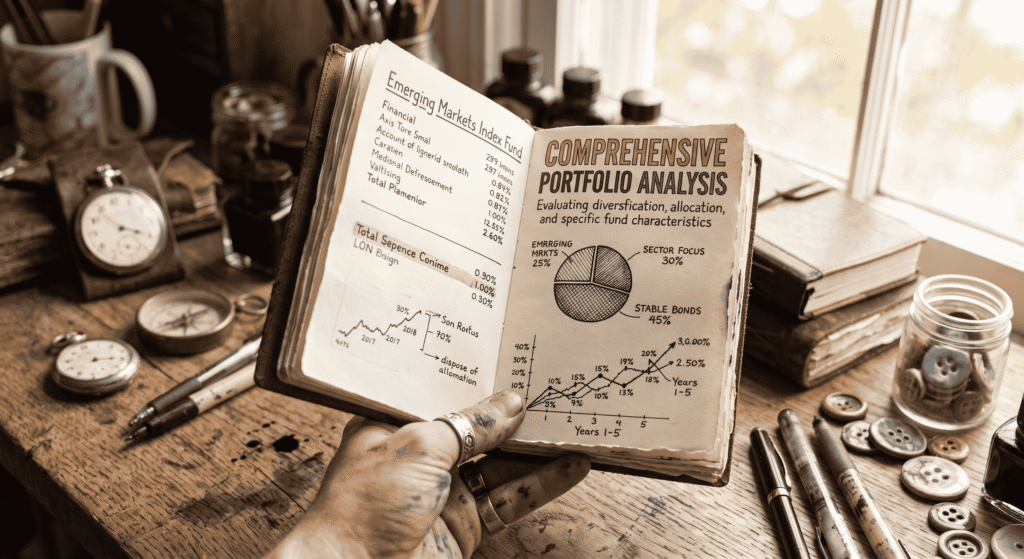
The expense ratio is the annual cost of owning a fund, expressed as a percentage of your investment. It’s taken out automatically you never see a bill.
At 0.03%, you pay $3 per year on every $10,000 invested. At 0%, you pay nothing (Fidelity’s FZROX and FZILX both charge 0%).
This is the only number worth comparing when choosing between similar index funds. Ignore the fund name. Ignore which brokerage markets it. Just look at the expense ratio.
How to buy your first index fund step by step
Step 1: Open an account.
A Roth IRA is the best account for most beginners in the US your investments grow tax-free. If you’ve already opened one from our Roth IRA guide, skip ahead. If not, open one at Fidelity, Schwab, or Vanguard. All have $0 minimums and no account fees.
Step 2: Transfer money in.
Link your bank account and deposit your starting amount. $100 is enough. $500 is better. There’s no wrong starting point.
Step 3: Search for your fund.
Inside your account, use the search bar to find your fund by ticker symbol. FZROX at Fidelity. VTI if you’re at Schwab or Vanguard. FXAIX for the S&P 500 version at Fidelity.
Step 4: Buy it.
Select the fund, enter the dollar amount you want to invest, confirm. Done. You now own a fraction of thousands of companies.
Step 5: Automate monthly contributions.
Set up a recurring transfer from your bank into the account on the same day each month. This is dollar cost averaging you buy more shares when prices are low, fewer when prices are high. Automatically. Without thinking about it.
That’s the entire system. Open an account, buy a total market index fund, add to it every month, leave it alone.
What happens when the market drops?
Your index fund drops with it.
This is the part that catches people off guard. An index fund mirrors the market the good and the bad. The S&P 500 fell about 34% during the COVID crash of 2020. Index fund holders saw their balances drop 34%.
Most of them did nothing. By the end of 2020, the market had fully recovered. By 2021, it had made new highs.
The investors who sold during the drop locked in real losses. The ones who held or kept buying came out ahead.
Over any 20-year period in US stock market history, patient investors have made money. The data on this is remarkably consistent. Short-term drops are the price of long-term gains.
If you’re investing money you might need in the next 3 years, index funds probably aren’t the right vehicle for that portion. Keep short-term money in a high-yield savings account. Index funds are for money you can leave alone.
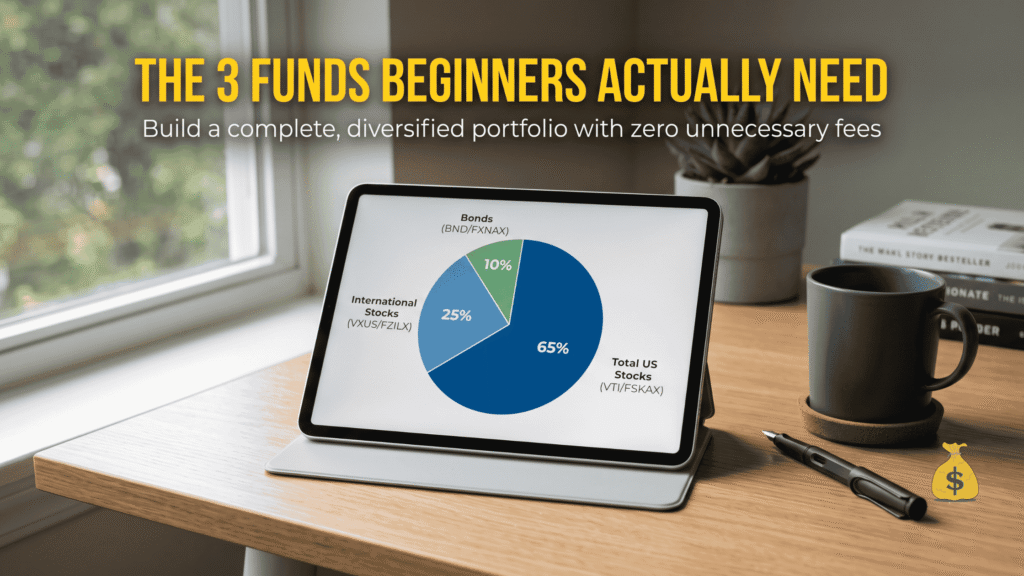
The 3 funds most beginners actually need
You can build a complete, diversified portfolio with 3 funds:
- VTI or FSKAX — total US stock market (60-70% of portfolio)
- VXUS or FZILX — total international stocks (20-30% of portfolio)
- BND or FXNAX — US bond index (10% of portfolio, optional if you’re under 40)
That’s it. Three funds, entire global stock and bond market, total annual cost around $3-$30 per $10,000 invested.
Professional financial advisors call this a 3-fund portfolio. Some of them charge $500 an hour to recommend exactly this. Now you don’t need to.
One last thing don’t confuse index funds with sector funds
Index funds tracking the total market or S&P 500 are what this article is about. But there are also index funds that track specific sectors technology only, healthcare only, energy only.
Those are a different animal. They concentrate risk in one part of the economy. A tech sector fund dropped over 30% in early 2022 when interest rates rose. The total market fund dropped about 20%.
Sector funds are fine for experienced investors who want specific exposure. For beginners, stick to total market and international. Let the broad market do the heavy lifting.
Frequently asked questions
What is an index fund in simple terms?
A fund that owns a little bit of every company in a specific market index. Buy 1 share of an S&P 500 index fund and you own a tiny fraction of all 500 companies in that index. The fund grows when the market grows and drops when the market drops.
Are index funds safe for beginners?
They’re one of the lower-risk ways to invest in stocks, because you’re spread across hundreds or thousands of companies rather than betting on one. But they’re not risk-free. When the stock market drops, index funds drop with it. They’re best for money you can leave invested for 5 years or more.
How much money do I need to start investing in index funds?
As little as $1 through fractional shares at Fidelity or Schwab. Fidelity’s FZROX has a $0 minimum and a 0% expense ratio. In practice, most people start with $100 to $500 and add a fixed amount monthly. Check our guide on how much money you need to start investing for a full breakdown.
What’s the difference between an index fund and a mutual fund?
All index funds are a type of mutual fund (or ETF). The difference is that a mutual fund can be actively managed — someone picking the stocks while an index fund is passive. It just tracks an index mechanically. Index funds are almost always cheaper and often outperform active mutual funds over 10+ years.
Which index fund is best for a beginner?
VTI (Vanguard Total Stock Market ETF) or FZROX (Fidelity Zero Total Market Index Fund) for US exposure. Both cover thousands of US companies. FZROX has a 0% expense ratio. VTI charges 0.03%. Either is a solid first purchase.
Can I lose all my money in an index fund?
You’d need virtually every major company in the index to go bankrupt simultaneously. For a total market index fund, that would mean the entire US economy collapsing. In that scenario, your money in a savings account wouldn’t be safe either. The realistic risk is a market drop of 20-40%, not total loss.