

What is a 401(k) and how does it work is the question most employees quietly Google after their first HR onboarding session. The pamphlet gets handed out, the benefits coordinator talks fast, and you nod along understanding maybe 40% of it.
This is the version that fills in the other 60%.
What is a 401(k)?
A 401(k) is a retirement savings account your employer sets up for you. You contribute money from each paycheck before taxes, it grows inside the account, and you pay taxes when you withdraw it in retirement.
The name comes from the IRS tax code section that created it. Section 401, subsection (k). Not exciting, but there it is.
What makes it powerful is the combination of 3 things: pre-tax contributions, tax-deferred growth, and employer matching. Most people understand the first two. The third one is where the real money is.
How a 401(k) actually works
Every pay period, a percentage of your paycheck goes into your 401(k) before income taxes are taken out. If you earn $5,000 a month and contribute 6%, $300 goes into the account. You only pay income tax on the remaining $4,700.
That $300 then gets invested in whatever funds you’ve selected inside the plan. It grows. You don’t pay taxes on the gains each year. The whole thing compounds untouched until you retire and start pulling money out.
At withdrawal, you pay income tax on whatever you take out. The idea is that you’ll be in a lower tax bracket in retirement than you are during your working years, so you end up paying less tax overall.
That’s the basic mechanics. Pre-tax in, tax-deferred growth, taxed on the way out.
What is a 401(k) employer match and why does it matter?
If your employer offers a match, this is the first thing you should care about. Before the investment options, before the expense ratios, before everything else.
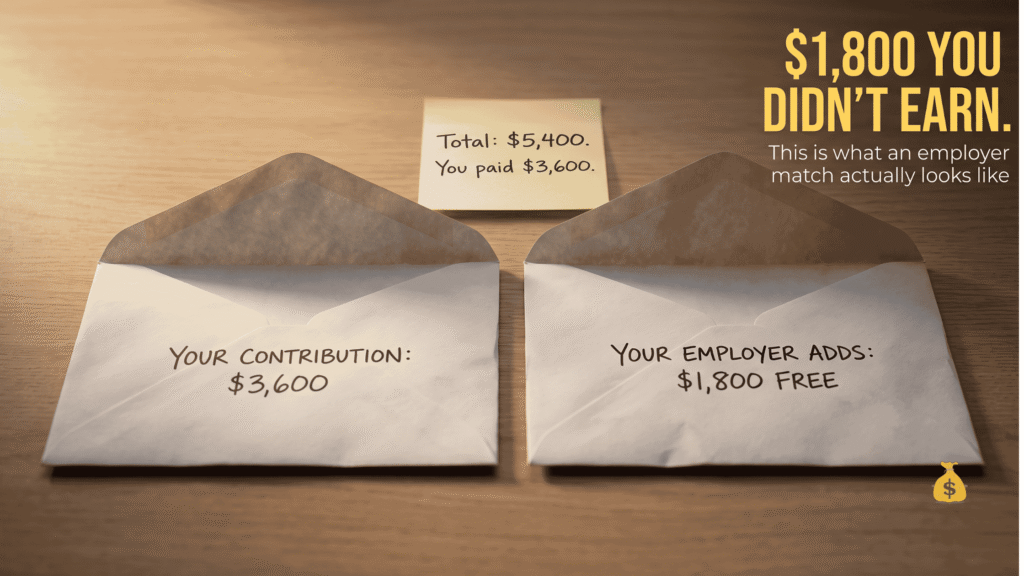
A typical match looks like this: your employer contributes 50 cents for every dollar you put in, up to 6% of your salary. So if you earn $60,000 and contribute 6% ($3,600), your employer adds another $1,800.
That’s a guaranteed 50% return on $3,600. Immediately. Before the market does anything.
If you contribute less than 6% at this employer, you’re leaving money in the envelope. Not taking the full match is one of the most expensive mistakes a new employee can make, and it’s completely avoidable.
Find out your employer’s match formula and contribute exactly enough to capture all of it. At minimum. Always.
2026 contribution limits
The IRS sets a cap on how much you can put in each year.
For 2026, the employee contribution limit is $24,500, up from $23,500 in 2025. The IRS confirmed this increase in late 2025. If you’re 50 or older, you can add a catch-up contribution of $8,000, bringing your total to $32,500.
There’s also a super catch-up for ages 60 to 63: $11,250 instead of the standard $8,000, giving those employees a total of $35,750 if their plan allows it.
The combined employee and employer limit (all contributions together) is $72,000 for 2026.
Most people won’t max out at $24,500. That’s fine. The match is the priority. After that, contribute what you can and increase it 1% per year, or whenever you get a raise.
Traditional 401(k) vs Roth 401(k)
Many employers now offer both. Here’s the actual difference.
Traditional 401(k): contributions come out of your paycheck pre-tax. You get a tax break now. You pay taxes when you withdraw in retirement.
Roth 401(k): contributions come out of your paycheck after tax. No tax break now. But withdrawals in retirement are completely tax-free, including all the growth.
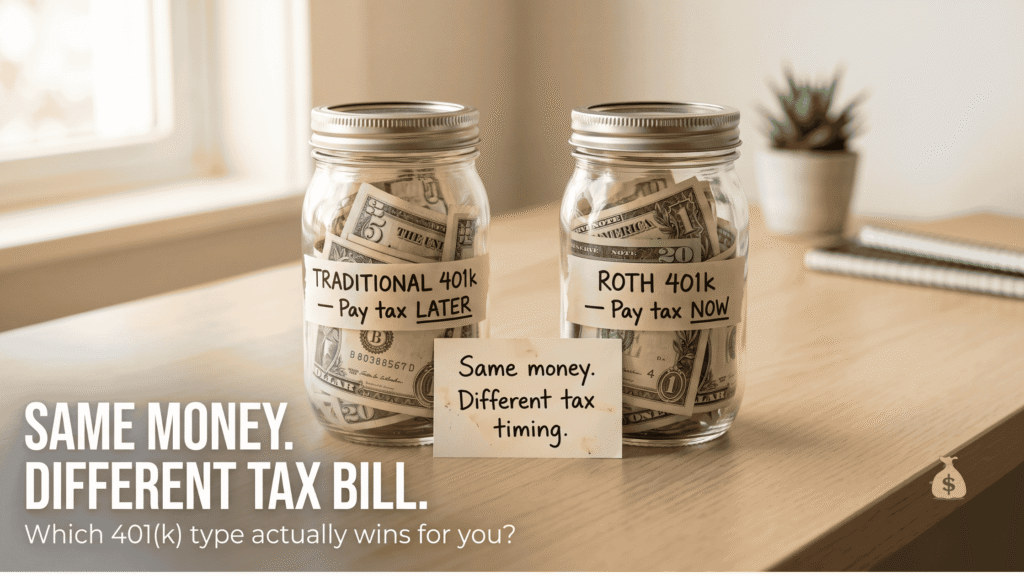
Same contribution limits apply to both. If you’re under 50, the $24,500 cap covers both combined.
Which one makes more sense depends on where you expect your tax rate to be in retirement. Early in your career, earning a modest income, the Roth 401(k) often wins. You’re probably in a low bracket now. Pay the tax today, take everything out tax-free later. If you’re a high earner in your peak years, the traditional 401(k)’s upfront deduction saves more now.
When you’re not sure, splitting contributions between both is a reasonable hedge.
What happens to the money inside a 401(k)?
Understanding what is a 401(k) and how does it work means knowing the account is just the container. You still have to choose what goes in it.
Most plans offer a lineup of mutual funds. Index funds, actively managed funds, target-date funds, maybe some company stock. The options vary by employer.
For most people, the simplest and most effective choice is a target-date fund. These are designed to do the work for you. You pick the fund closest to your expected retirement year (a “Target 2050 Fund” if you plan to retire around 2050), and the fund automatically holds a mix of stocks and bonds, then gradually shifts more conservative as that date approaches.
Target-date funds aren’t perfect. They tend to have slightly higher expense ratios than plain index funds. But for someone who doesn’t want to think about asset allocation, they’re a clean, good-enough solution.
If your plan includes low-cost index funds (expense ratio under 0.1%), those are worth considering. An S&P 500 index fund inside a 401(k) is essentially the same product as one inside a Roth IRA. Same fund, different account wrapper.
Check your plan’s fund lineup and look for the lowest expense ratios on the broadest market funds. That’s your starting point.
When can you take the money out?
You can withdraw without penalty at age 59½.
Pull money out before that and you’ll owe income tax on the amount plus a 10% early withdrawal penalty. There are exceptions: permanent disability, certain medical expenses, separation from service after age 55, and a few others. But as a general rule, treat the 401(k) as a locked box until you’re nearly 60.
At age 73, the IRS requires you to start taking money out whether you want to or not. These are Required Minimum Distributions (RMDs). The amount is calculated based on your account balance and your life expectancy. You pay income tax on each withdrawal.
One thing a lot of people don’t know: if you’re still working at 73, you don’t have to take RMDs from your current employer’s 401(k). The rule applies to old 401(k)s at previous employers and traditional IRAs, not your active plan.
What happens if you leave your job?
4 options.
Leave it where it is. Most plans allow this if your balance is above $5,000. The money keeps growing. You just can’t contribute anymore. Fine if the plan has good investment options and low fees.
Roll it into your new employer’s 401(k). If your new employer accepts incoming rollovers, you can move the old balance into the new plan. One account, simpler to manage.
Roll it into an IRA. This is often the best option. An IRA gives you access to any investment you want, not just the limited menu in an employer plan. Roll it into a traditional IRA if it was a traditional 401(k). Roll it into a Roth IRA if it was a Roth 401(k) (note: you’ll owe taxes on this conversion). We covered how to open a brokerage account and what a Roth IRA actually is if you want the full setup.
Cash it out. The worst option for most people. You pay income tax on the full amount plus a 10% penalty if you’re under 59½. On a $30,000 balance, that can cost you $10,000 or more depending on your tax bracket. Leave it invested.
Vesting: the part of the match people miss
Your contributions are always yours. 100%, immediately.
The employer match might not be. Many employers use a vesting schedule, which means you earn the right to the matching contributions over time.
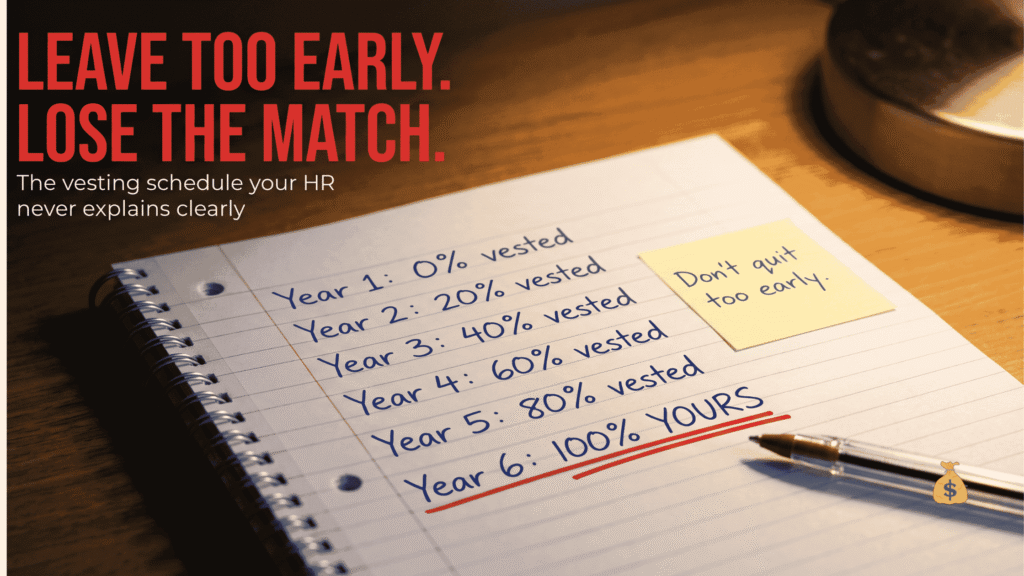
A typical cliff vesting schedule: after 3 years of service, 100% of the employer match is yours. If you leave before year 3, you walk away with nothing from the match. A graded schedule might give you 20% after year 1, 40% after year 2, and so on up to 100%.
This matters most when you’re thinking about leaving a job. If you’re 6 months from being fully vested in a meaningful employer match, that’s real money worth factoring into your decision.
Ask HR for your plan’s vesting schedule. Read it. Know where you stand.
401(k) vs Roth IRA: which comes first?
Both are worth having. The order matters.
- Contribute to your 401(k) up to the full employer match. Always first.
- Max out a Roth IRA ($7,500 in 2026 if you’re under 50). More investment flexibility, potentially better long-term tax treatment.
- Go back to the 401(k) and increase contributions toward the $24,500 limit.
The logic: employer match is free money, so you grab all of it first. The Roth IRA often beats the 401(k) on investment flexibility and tax treatment for younger earners, so it comes next. Then more 401(k) if you have more to invest.
Most people never get past step 2. That’s fine. Steps 1 and 2 alone, run consistently for 30 years, build serious retirement wealth.
How much should you actually contribute?
The standard recommendation is 15% of gross income, including the employer match.
If your employer matches 3%, you need 12% from your own paycheck to hit 15% total.
That’s a target, not a requirement. If 15% is too much right now, start with whatever gets you the full employer match and increase by 1% per year. Most people don’t feel a 1% increase because it’s small enough to absorb. Over 5 years, you’ve added 5 percentage points without a single painful sacrifice.
Automate the increases if your plan allows it. Some 401(k) platforms have an auto-escalation feature that bumps your contribution by 1% annually on a date you set. Set it and forget it.
A real look at what consistent 401(k) contributions build
Say you start contributing $500 a month at 25, your employer adds $250 (50% match), and the combined $750 earns an average of 7% per year.
By 65, that’s around $3.7 million.
You contributed $240,000 over 40 years. The market and compounding added the rest.
Cut it to starting at 35 instead of 25 and the same math produces around $1.8 million. That 10-year delay costs nearly $2 million in final balance. Compounding is ruthless in both directions.
The employer match makes this dramatically better. That $250/month from your employer is $3,000 a year you contributed nothing to earn. Over 40 years at 7%, that match alone grows to around $1.5 million.
Common 401(k) mistakes worth avoiding
Not contributing enough to get the full match. Already said this. Worth saying twice. The match is the highest-return, lowest-risk money available to you. Take all of it.
Cashing out when you change jobs. Taxes plus penalty on a $30,000 balance can cost $10,000 or more in a single year. Roll it over instead.
Picking funds with high expense ratios. An actively managed fund charging 1% annually vs an index fund at 0.05% sounds like a tiny difference. Over 30 years on a $200,000 balance, that gap compounds to tens of thousands of dollars in fees.
Forgetting to rebalance. If stocks have a great year, your allocation drifts heavier on equities than you planned. Once a year, check the split and adjust back to your target. Takes 10 minutes.
Ignoring the account entirely. Some people set up their 401(k) in year 1 and never look at it again. Check the investment options annually. Plans sometimes add better, cheaper funds. You might want to switch.
Leaving old 401(k)s scattered everywhere. Every job, another account. Rolling them into a single IRA gives you one place to manage, one fee structure, and a cleaner picture of your total retirement savings.
Frequently asked questions
What is a 401(k) in simple terms?
A retirement savings account your employer sets up. You contribute money pre-tax from each paycheck, it grows tax-deferred inside the account, and you pay income tax on withdrawals in retirement. Many employers add matching contributions on top of what you put in.
How much should I contribute to my 401(k)?
At minimum, enough to get the full employer match. After that, the standard target is 15% of gross income total (including the match). If you’re not there yet, start where you can and increase by 1% per year.
What is a 401(k) employer match?
When your employer contributes money to your 401(k) based on how much you contribute. A common formula: 50% match on up to 6% of salary. Contribute 6%, get 3% from your employer free. If you contribute less than the threshold, you leave free money unclaimed.
What happens to my 401(k) if I quit my job?
You keep everything you contributed. The employer match depends on your vesting schedule. If you’re not yet fully vested, you may forfeit some or all of the match. You can leave the balance in the old plan, roll it to your new employer’s plan, or move it into an IRA. Cashing it out triggers taxes and a 10% penalty if you’re under 59½.
What is the 401(k) contribution limit for 2026?
$24,500 for employees under 50. If you’re 50 or older, you can add a $8,000 catch-up contribution for a total of $32,500. Ages 60 to 63 get a higher catch-up of $11,250, for a total of $35,750. The combined employee and employer limit is $72,000.
Can I have a 401(k) and a Roth IRA at the same time?
Yes. These are separate accounts with separate limits. You can max out a 401(k) at $24,500 and also contribute up to $7,500 to a Roth IRA in the same year, as long as your income is under the Roth IRA limits ($153,000 for single filers in 2026).