

Investing beliefs that cost you money are rarely the obvious ones. Nobody loses their retirement account because they thought the stock market was a casino. They lose it because they believed something plausible, something their broker probably agreed with, something that had been repeated so often it became invisible as an assumption.
Not myths like “investing are only for the rich” those have been debunked a thousand times. The costly investing beliefs are the ones that sound true, backed by intuitive logic but never actually tested against data.
This article covers the ones that actually matter.
Why Investing Beliefs That Cost You Money Are So Hard to Spot
The investing beliefs that cost you money most are the ones nobody questions including you.
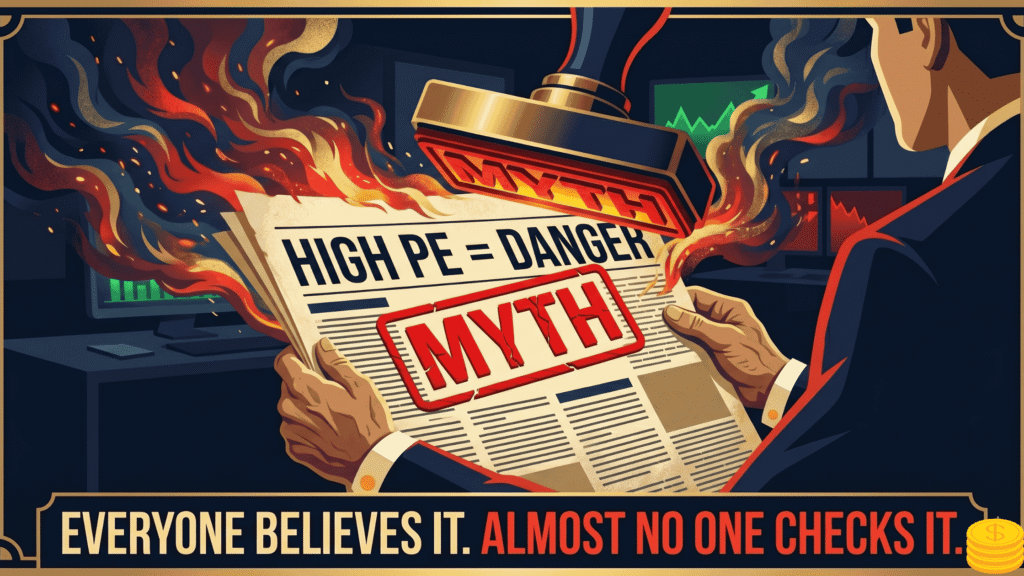
Here’s how false beliefs survive in markets: people don’t check them. If your car mechanic told you to change your oil every 500 miles, you’d Google it. But if a financial pundit on TV says “high P/E markets are risky,” almost no one pulls the data. The belief sounds logical, so it passes through unchallenged.
Most commonly accepted investing truths were never statistically validated. They were asserted by smart-sounding people, then repeated until they felt true.
The fix starts with one genuinely uncomfortable question: what do I believe about investing that might actually be false?
Myth 1: High P/E Markets Are Dangerous
This is probably the most widespread investing belief that costs investors money, and one of the most statistically flawed.
The logic goes: if a stock market’s price-to-earnings ratio is high, stocks are overvalued and a crash must be coming. Sounds reasonable. Markets do eventually crash. The problem is the P/E ratio has almost nothing to do with when or how much.
The data tells a different story. In 1996, the S&P 500’s P/E crossed 20 a level that made analysts nervous. The market then gained roughly 23% that year, 33% in 1997, 28% in 1998, and 21% in 1999. Meanwhile, research from DALBAR consistently shows that retail investors who act on valuation fear underperform the index by 3 to 5 percentage points annually.
When P/Es are high, investors get scared. They pull back. That fear gets priced in. And when fear is already baked in, there’s often less downside than people expect.
The actionable takeaway: stop using P/E as a signal for market direction. It’s not one. See our deeper breakdown in P/E Ratios Explained: Why Valuation Doesn’t Predict Returns.
Myth 2: The Yield Curve Always Predicts a Recession
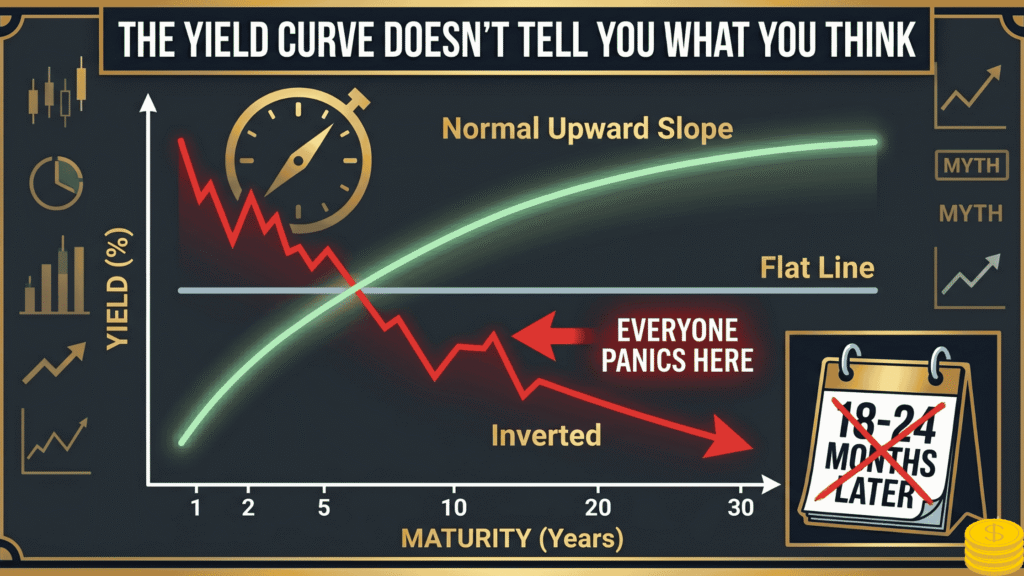
The inverted yield curve is treated like an oracle. When short-term rates rise above long-term ones, financial media immediately declares a recession is coming.
Sometimes it is. But the relationship is far messier than the breathless coverage implies.
The yield curve inverted in 1998 no recession followed. It inverted before the 2001 recession, but the lag was 18 to 24 months, during which the market recovered from an initial dip and then fell again. In 2006, inversion showed up; the recession didn’t arrive until late 2007. Investors who fled stocks at the first sign of inversion missed 15 months of gains. The Federal Reserve itself has published research questioning the curve’s reliability as a predictive tool.
What actually matters about the yield curve is what it tells you about banking sector profitability banks borrow short and lend long, so when the curve flattens or inverts, their margins compress. That matters for credit availability, which then matters for the economy. Follow the mechanism, not the mythology.
Myth 3: Trade Deficits Hurt the Stock Market
The US trade deficit shows up in the news constantly, paired with commentary about economic weakness or financial vulnerability. This is one of the investing beliefs that cost money through manufactured panic.
Here’s the reality: countries running large trade deficits often have the strongest stock markets. The US has run persistent deficits for decades during some of the best sustained bull markets in history.
Why? A trade deficit means foreign goods are flowing in, requiring dollars to flow out. Those dollars come back to the US as capital investment foreign entities buying US stocks, bonds, and real estate. The capital account surplus offsets the trade deficit almost exactly by definition. For more context, the Bureau of Economic Analysis tracks this relationship in its international transactions data.
A trade deficit is partly a signal that foreigners want to invest in your country. Every time the deficit widens, a predictable media panic follows and investors who react to it sell into manufactured fear. Related: Global Diversification: Why US-Only Investors Leave Money Behind.
Myth 4: A Strong Economy Means a Strong Stock Market
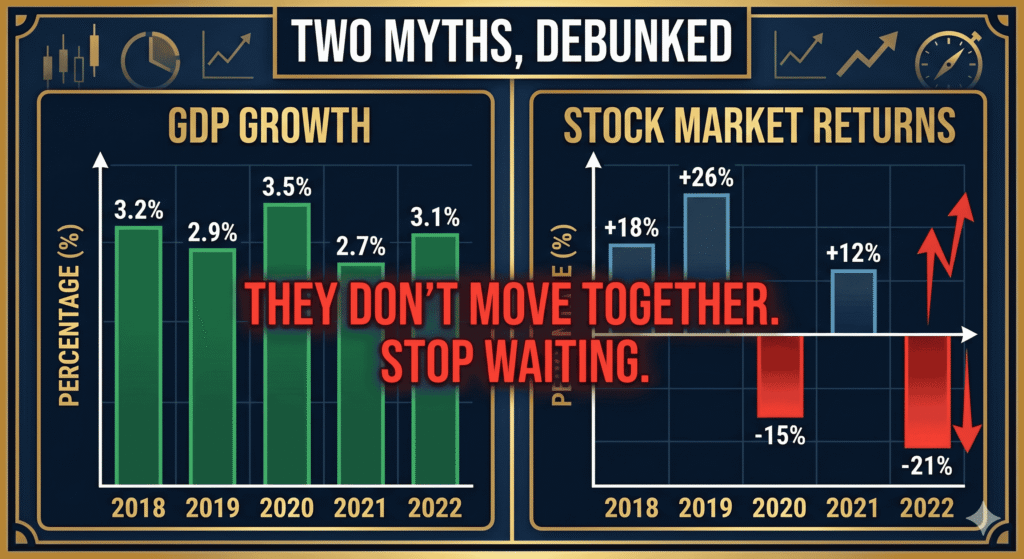
This one feels ironclad. When GDP grows, companies make money, stocks go up. The problem: stocks don’t price today’s economy. They price what investors expect the economy to do next.
By the time GDP data looks great, the market has already moved. Stocks are a leading indicator, not a lagging one. The economy and the stock market are often running on completely different timelines.
Some of the worst stock market years followed robust economic data. Some of the best years happened during slow-growth or contracting economies because investors were pricing in a recovery that hadn’t happened yet.
This is why “I’ll invest when things look better” is one of the most expensive strategies available. By the time things look better, the market has already reflected it.
Myth 5: Bear Markets Are Caused by Overvaluation
Ask someone what causes bear markets and they’ll point to high P/Es or speculative excess. Sometimes those are present. But they’re not the cause.
The most consistent drivers of bear markets are:
- A sharp rise in inflation that forces central banks to raise rates aggressively, compressing valuations
- Credit contractions that reduce capital availability across the economy
- Policy errors regulations, tariff regimes, or fiscal tightening that damage corporate earnings expectations
A market can look “expensive” by traditional metrics for years without falling. What pushes it over the edge is almost always one of those 3 mechanisms not the valuation itself. Staying aware of which investing beliefs cost you money here means watching credit conditions and inflation trends, not just P/E levels. See Bear Market Causes: The Real Triggers Behind Market Crashes for a full breakdown.
Investing Beliefs That Cost You Money Live Inside Your Head Too
Here’s the section most investing articles skip entirely. All the market analysis in the world doesn’t help if your brain sabotages every decision you make.
Human brains weren’t built for capital markets. They were built for an environment where immediate threat-response was the difference between surviving and not. That wiring causes specific, repeatable errors.
Loss Aversion: The Investing Belief That Costs You Most
Behavioral research from Kahneman and Tversky consistently shows that the pain of a $10,000 loss registers roughly twice as intensely as the pleasure of a $10,000 gain. This isn’t weakness it’s evolution. Avoiding loss mattered more than capturing gain when you were hunting for food.
In markets, this means investors sell good positions too quickly when they’re slightly down (to stop the pain), and hold losing positions too long (to avoid “locking in” the loss). The practical result: investors systematically buy high and sell low. The exact opposite of the stated goal. For more on this, read How Loss Aversion Is Quietly Destroying Your Portfolio.
Pattern Confusion: Seeing Signal Where There’s Only Noise
The brain is a pattern-recognition machine. After 3 down Mondays in a row, it treats “Monday” as meaningful data. After a hot sector outperforms for 2 years, it extrapolates forward indefinitely.
This is how seasonal investing myths survive: “Sell in May and go away,” the “January Effect,” the “Santa Claus Rally.” These patterns have existed. But their predictive reliability, tested statistically across multiple decades, falls apart. A pattern that held 6 out of 10 times in a small historical window is noise the brain turned into a trading rule.
Overconfidence: An Investing Belief That Costs Everyone Eventually
Overconfidence isn’t a character flaw. It was survival equipment. Stone Age humans who accurately assessed the odds of attacking a mammoth would have starved the rational calculation is “this is suicide.” Overconfidence let them charge anyway.
Applied to investing, it produces catastrophic results. People overestimate how much they understand about a company, sector, or macro trend. They take positions they can’t justify. They hold them past the point of reason.
The solution: before any investment decision, write down exactly why you think you know something other investors don’t. If you can’t articulate a specific edge, the trade is pure speculation.
How to Actually Use This
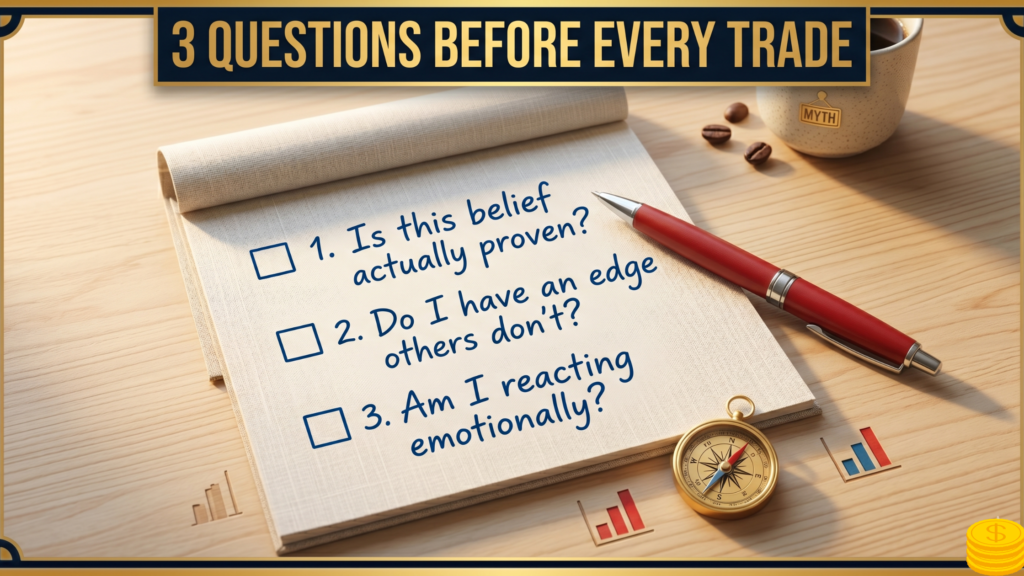
The 3 questions worth asking before any investment decision:
- What am I believing that might actually be false? Take the specific thing driving your decision a macro narrative, a valuation concern, a news story and ask whether you’ve ever tested it statistically or just accepted it as common knowledge.
- What am I seeing that others aren’t? There has to be something the market has priced incorrectly for a trade to have an edge. If your reason to buy is the same reason everyone else would buy, the information is already in the price.
- What is my brain doing right now that I should override? Identify whether you’re reacting to short-term pain, pattern matching noise into signal, or being overconfident. Name the bias before you make the trade.
These aren’t complicated. But almost nobody does them consistently.
How to Stop Investing Beliefs That Cost You Money From Running Your Portfolio
3 questions worth asking before any investment decision:
- What am I believing that might actually be false? Take the specific thing driving your decision a macro narrative, a valuation concern, a news story and ask whether you’ve ever tested it statistically or just accepted it as common knowledge.
- What am I seeing that others aren’t? There has to be something the market has priced incorrectly for a trade to have an edge. If your reason to buy is the same reason everyone else would buy, the information is already in the price.
- What is my brain doing right now that I should override? Identify whether you’re reacting to short-term pain, pattern-matching noise into signal, or being overconfident. Name the bias before you make the trade.
These aren’t complicated. But almost nobody does them consistently.
What Actually Works Long-Term
A few things that hold up under scrutiny:
Global diversification matters more than most US investors think. Concentrating entirely in US stocks ignores that markets cycle globally. Countries that lag for a decade often outperform for the next one. Benchmarking only against the S&P 500 creates blind spots. See Global Diversification: Why US-Only Investors Leave Money Behind.
Knowing when to sell matters as much as knowing what to buy. Most investors have an entry process and no exit process. A position you hold forever is a hope. Define exit conditions before you enter.
Beating the market requires knowing something the market doesn’t. If your edge is “this company seems good,” you don’t have an edge — millions of other investors share that impression and it’s already in the price.
The market’s job is to humiliate as many participants as possible. When a trade seems obvious and safe, that consensus is exactly why it might not work. Obvious opportunities get crowded. Crowded trades get messy.
FAQ
What are the most common investing beliefs that cost you money?
The most damaging ones are: believing high P/E markets predict crashes, treating yield curve inversions as precise recession signals, assuming trade deficits harm stock markets, and acting on seasonal patterns like “Sell in May.” Each sounds logical but fails statistical scrutiny when tested against long historical data.
Does a high P/E ratio mean a stock market crash is coming?
No. Statistical analysis shows P/E ratios have very little predictive power over market direction on their own. A high P/E market can keep climbing for years. What actually matters is whether there’s a macro catalyst rising inflation, credit contraction, or policy error that could trigger a real correction.
What actually causes bear markets?
The most reliable causes are sharp inflation increases that force aggressive central bank tightening, significant credit contractions that reduce capital availability, and policy mistakes that damage corporate earnings expectations. Overvaluation alone rarely triggers a bear market without one of these mechanisms.
How does investor psychology affect stock market performance?
A lot. Research shows that emotional decision-making particularly loss aversion and pattern-seeking cause most retail investors to consistently underperform indexes they could simply hold. The brain’s threat-response wiring, useful in other contexts, systematically produces bad investment decisions.
Is it true that a good economy means good stock returns?
Not reliably. Stocks price future expectations, not current conditions. By the time economic data looks strong, the market has usually already moved. Some of the best market years happen during or just after economic contractions, when forward expectations are being revised upward.
How do I stop letting emotions drive my investment decisions?
Write down your thesis for any investment before you make it. Include what you believe the market has priced incorrectly and why. When you’re tempted to deviate from fear or greed go back and read what you wrote. Articulating the thesis forces rational engagement and creates a reference point against emotional reactions.
Final Verdict
Most investing advice is either generic (diversify, invest for the long term) or dangerously confident about things that haven’t been statistically validated. These are the investing beliefs that cost you money quietly, over years, in ways that never show up as a single obvious mistake.
The edge available to individual investors isn’t about access to information. It’s about thinking more carefully about which widely-held beliefs are actually wrong, staying aware of how the brain manufactures false confidence, and having the discipline to act on that clarity instead of gut reactions.
The market will always find ways to surprise the consensus. Investors who question their own assumptions first will be surprised less often.
Expert Tip
Before your next investment decision, spend 10 minutes trying to disprove your own thesis. Search for credible arguments against the trade. Find the best data that contradicts your position. If the thesis survives that process, act on it. If it doesn’t, you just saved yourself from an expensive mistake and you’ll be sharper for the next one.
2 thoughts on “Investing Beliefs That Cost You Money (And What to Do Instead)”