
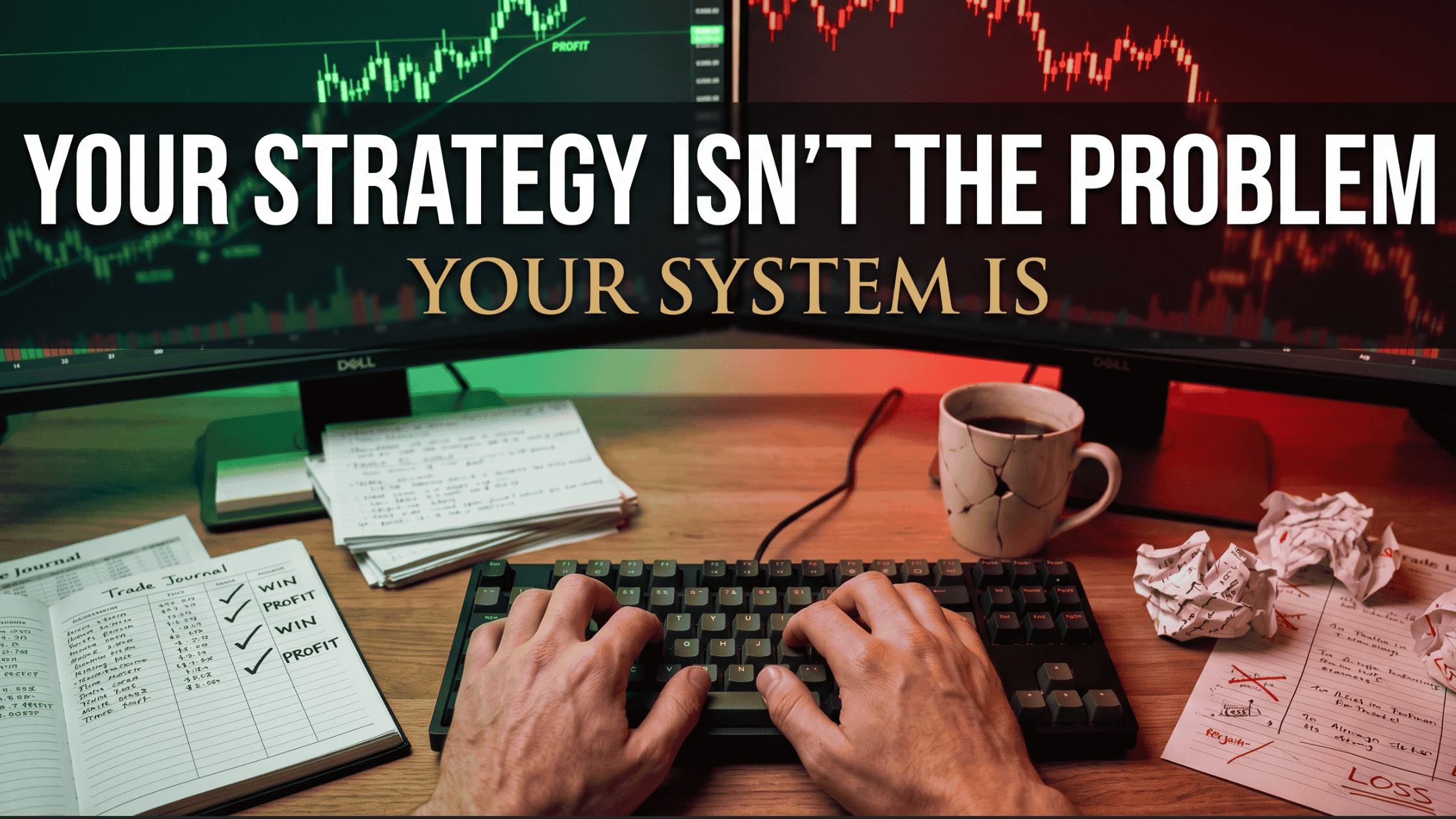
How to build a trading system that actually works is the question most traders never ask correctly. They search for the best strategy, the hottest indicator, the perfect entry signal and completely skip the part that determines whether any of it succeeds.
The system isn’t just the strategy. The system is you, your process, your rules, your mindset, and your daily habits working together. Pull out one piece and the whole thing falls apart.
This guide covers what most trading education skips entirely.
Why Most Trading Systems Fail Before They Start
The failure rate for retail traders is brutal. Estimates consistently put it at 70 to 80% losing money over any meaningful time period. The standard explanation is bad strategies or bad luck.
The real explanation: traders approach markets with a strategy but no system.
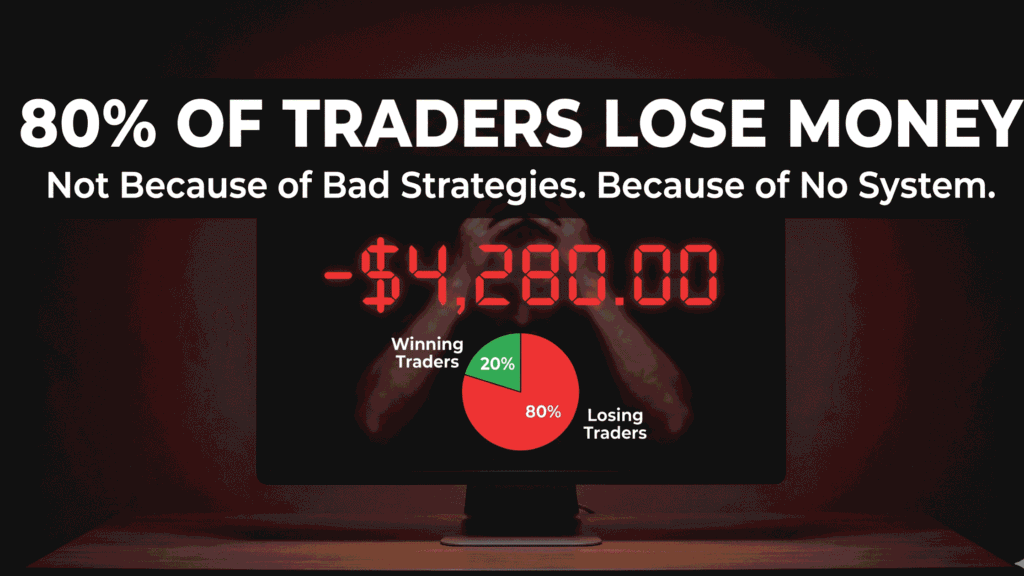
A strategy tells you when to enter and exit. A system tells you how to handle yourself when the trade goes against you, how to review your performance honestly, how to avoid blowing up your account on a bad week, and how to stay consistent when nothing is working.
Most traders learn the strategy. Almost none of them build the system.
How to Build a Trading System That Actually Works: The Foundation
Before any technical strategy matters, you need 3 foundational pieces in place. Think of trading like a human body strategy is just one organ. Without the others functioning, the body fails regardless of how good that one part is.
1. Know What You’re Committing To
Most people start trading because they see potential income. Almost none of them sit down and honestly calculate what becoming profitable will actually cost.
There are 3 real costs to count before you begin:
Time cost Research across skill development consistently shows that true mastery in any complex field requires thousands of hours of deliberate practice. Trading is no different. Not screen time. Not watching videos. Deliberate practice: reviewing trades, testing setups, learning from specific mistakes.
Education cost Books, courses, charting software, market data subscriptions, possibly a mentor or coach. These aren’t optional luxuries. Traders who skip education pay for it through their trading account instead which is a far more expensive classroom.
Capital cost For day trading in the US, the pattern day trader rule requires a minimum of $25,000 in your account. Swing trading and longer-term trading can be started with less, but undercapitalized accounts create pressure that destroys decision-making. Start small enough that a losing month doesn’t threaten your life, but not so small that every tick feels like a crisis.
The point isn’t to scare you off. It’s to make a real decision you can commit to because inconsistent commitment is the single most common reason trading careers end before they begin.
2. Understand That the Market Is an Emotional System
This is the piece most technical trading education completely ignores.
Price doesn’t move because of fundamentals, earnings reports, or macroeconomic data alone. Price moves because human beings are making decisions, and human beings are driven by fear and greed more than logic.
Fear of missing out causes traders to jump into large positions at exactly the wrong time right when a move is already extended. They see price running away from them and can’t stand watching from the sidelines. So, they enter too late, too big, and with no plan.
Pain from losses causes traders to hold losing positions far longer than any rational system would allow. The logic is simple: closing the trade makes the loss real. As long as it stays open, there’s hope. So traders sit in underwater positions for days or weeks, hoping for a reversal that often never comes.
These two emotions fear and pain are the actual market movers. And they affect you just as much as every other trader. The ones who understand this have an edge. The ones who don’t are part of the chaos.

3. Build Your Trading Mindset Before Your Trading Strategy
Here’s the uncomfortable truth: the person sitting in front of the screen is the biggest variable in any trading system. Not the strategy. Not the market. You.
Commitment to the process — not to a profit target or a timeline. Traders who set arbitrary deadlines (“I’ll be profitable in 3 months”) tend to take increasingly reckless risks as the deadline approaches. The better frame is Stockdale’s: absolute conviction you’ll succeed eventually, combined with brutal honesty about where things stand right now.
Taking full responsibility — for every loss, every deviation from the plan, every emotional trade. Traders who blame the market, their broker, or their strategy never identify the actual source of their losses. The source is almost always a failure to execute the system properly.
Developing trading integrity — this means keeping your word to yourself. If your plan says maximum $100 risk per trade and you let a trade run to $300 because you “felt sure,” you’ve broken your own rules. The first time this happens is a warning. The tenth time is a habit. And it’s a habit that will empty your account eventually.
The Shiny Object Problem: Why Strategy-Hopping Destroys Traders
There’s a specific behavior pattern that almost every struggling trader recognizes in themselves eventually: jumping from strategy to strategy, always looking for the system that finally “clicks.”
It feels logical. If a strategy isn’t working, find a better one. But the issue is almost never the strategy.
Richard Dennis who famously taught a group of ordinary people with no trading experience to become consistently profitable traders using a simple trend-following system once said you could publish the exact rules of a successful strategy, and most people still wouldn’t profit from it. Because following rules consistently, especially when you’re losing, is genuinely hard.
A strategy that’s 55% accurate applied with strict consistency beats a 70% accurate strategy applied inconsistently. Every time. Without exception.
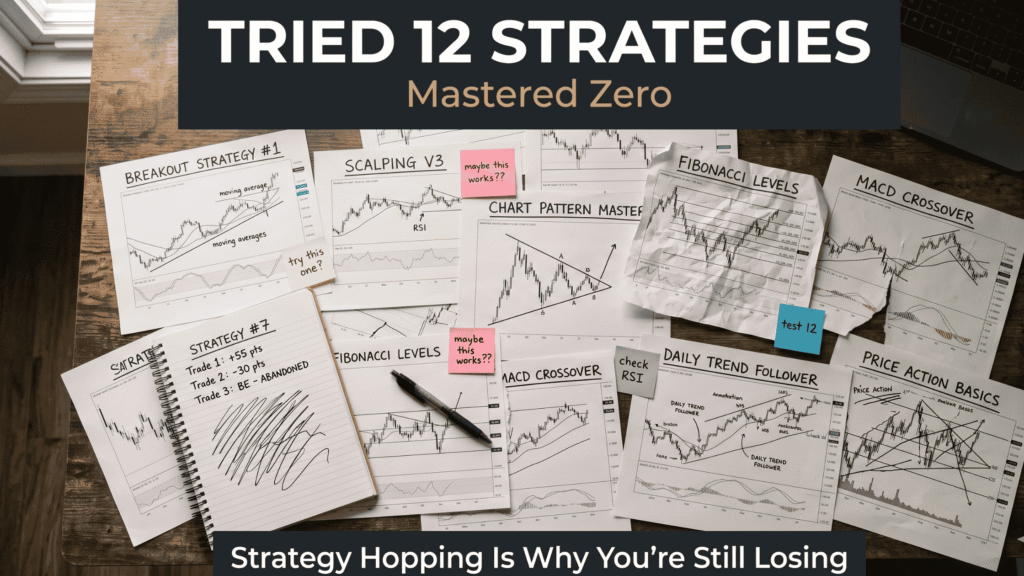
The fix: pick one system and commit to 20 trades before evaluating it. After 20 trades, review them honestly. Categorize each loss:
- Did I follow entry criteria exactly?
- Did I follow my risk rules exactly?
- Do I actually know why I took this trade?
Most traders find they can’t honestly answer these questions because they weren’t following a system. They were making it up as they went.
Technical Trading: The Four Skills You Actually Need
Once the foundation is in place, the technical side becomes straightforward. There are 4 core skills. Learn them in order.
Trend Identification
A trending market is the only market worth trading. When price is moving clearly in one direction, everything else becomes easier entries are more obvious, risk is more manageable, and winning trades can run further.
The simplest way to identify a trend:
- Uptrend: price is making higher highs and higher lows consistently
- Downtrend: price is making lower lows and lower highs consistently
- No trend: price is chopping sideways between two levels
One practical tool is the 10-period exponential moving average (10 EMA). In an uptrend, price stays above it and pulls back to it before continuing higher. In a downtrend, price stays below it and bounces to it before continuing lower. When price crosses back and forth repeatedly, there’s no trend worth trading.
Trade with the trend. Going against a strong trend is like swimming upstream in a river the force of the current overwhelms almost any individual effort.
Support and Resistance Levels
These are the price levels where buying and selling pressure historically concentrate. Support is a price floor where buyers have previously stepped in. Resistance is a price ceiling where sellers have previously overwhelmed buyers.
Why do they work? Because traders all over the world are looking at the same charts. They place orders near the same levels. That creates self-fulfilling clusters of order flow which is exactly what causes price to react at those levels repeatedly.
Understanding support and resistance also explains how markets move in between levels. When a level is decisively broken and all the orders there are filled, price moves like a magnet to the next level where orders are stacking. That movement from level to level is the actual mechanism of price action.
Candlestick and Chart Patterns
Candlesticks are visual representations of the emotional battle between buyers and sellers over a specific time period. A long-bodied bullish candle means buyers completely overwhelmed sellers. A small-bodied candle with long wicks means neither side won indecision.
Key patterns to learn first:
- Pin bars (hammer/shooting star): indicate a sharp rejection of a price level, often at support or resistance
- Engulfing candles: one candle completely swallows the previous one, signaling a potential reversal
- Inside bars: price consolidates within the range of the prior candle, often preceding a breakout
These patterns don’t predict the future. They increase probability at specific locations particularly when they appear at key support or resistance levels with trend confirmation behind them.
Technical Indicators (Used Correctly)
Indicators are tools, not oracles. The mistake most beginners make is stacking 5 or 6 indicators on a chart and waiting for them all to agree. By the time they do, the move is almost always over.
Use indicators to confirm what price is already telling you not to generate signals independently.
The most useful for building a simple, reliable system:
- Moving averages (10 EMA, 20 EMA, 50 SMA): trend direction and dynamic support/resistance
- RSI (Relative Strength Index): identifies overbought and oversold conditions, useful for timing entries during pullbacks
- MACD: helps confirm momentum and potential trend shifts
One indicator that confirms your trend analysis plus a clean price action setup is enough. More is rarely better.
The Daily Trading Process: What Separates Consistent Traders
This is the section that almost no trading education covers because it’s not exciting. But it’s where consistency actually comes from.
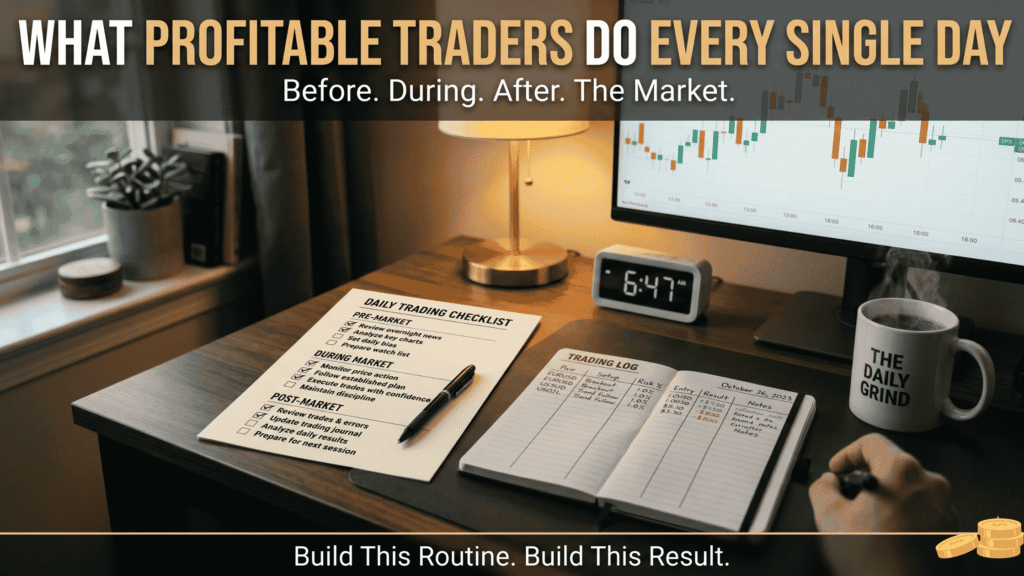
Before the market opens:
- Review the major support and resistance levels on your watchlist
- Identify the trend direction on your primary time frame
- Set your maximum loss for the day (a hard stop if you hit it, you’re done trading for the day)
- Write down your plan: specific setups you’re watching for and the conditions required to enter
During the trading session:
- Take only the setups that match your predefined criteria
- After each trade, step away from the screen briefly even 5 minutes
- If you lose 3 trades in a row, stop for the day. Review what happened. This rule alone prevents most catastrophic losing days.
After the market closes:
- Log every trade: entry, exit, size, reason for entry, whether you followed your rules
- Rate yourself on rule adherence, not on profit or loss a perfectly executed losing trade is better than a profitable trade taken for the wrong reasons
- Review the week’s trades together at the end of the week
This process feels tedious. It is tedious. It’s also the single practice that separates traders who improve from traders who keep making the same mistakes for years.
Risk Management: The Part That Keeps You Alive
A trading system without risk management is just gambling with a chart in front of it.
The core principle: every trade should have a defined maximum loss before you enter. Not after. Not “I’ll see how it develops.” Before.
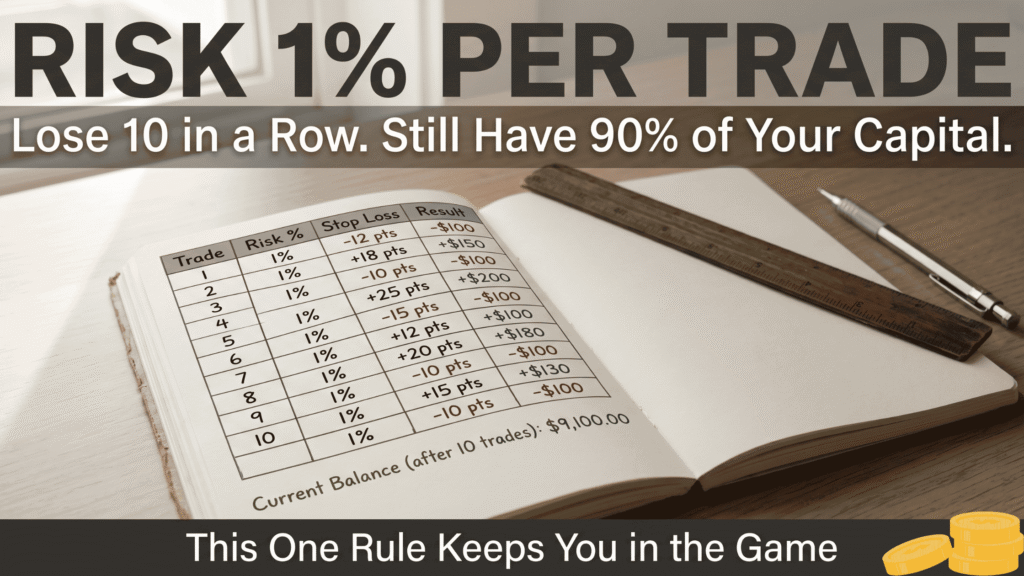
A common rule: risk no more than 1 to 2% of your total account on any single trade. With a $10,000 account, that’s $100 to $200 per trade. This feels small. It is small. That’s the point.
With proper position sizing, you can lose 10 trades in a row and still have over 80% of your capital intact. With aggressive sizing, 5 consecutive losses can destroy an account. Consecutive losing streaks of 5 to 10 happen to every trader at some point. The ones who survive are the ones whose position sizing accounted for it.
Stop losses are not optional. A stop loss is a predetermined exit point at which you accept being wrong about the trade and close it with a limited loss. Traders who don’t use stop losses are not managing risk they’re hoping. Hope is not a trading strategy.
The risk-to-reward ratio matters more than win rate. A system that wins 40% of trades but consistently captures 3 times the risk on winners is more profitable than a system that wins 70% of trades but cuts winners short. Most beginners chase high win rates and ignore what happens on the winning trades. The math doesn’t care about win rate alone.
The Revenge Trading Trap (And How to Escape It)

Revenge trading is when a loss triggers an immediate emotional need to win the money back leading to larger trades, skipped criteria, and usually larger losses.
It happens to almost everyone who trades long enough. The neuroscience behind it is real: the brain releases dopamine in response to the excitement of a trade regardless of outcome. That same dopamine loop that makes social media addictive makes trading addictive and makes the urge to “get back in” after a loss feel physically compelling, not just emotionally tempting.
The practical solution:
- After any loss that stings, wait a minimum of 30 minutes before entering another trade
- If you’ve hit your daily maximum loss, close your platform and don’t look at it again until tomorrow
- Keep a written log of every time you felt the urge to revenge trade patterns will emerge, and seeing them on paper makes them easier to interrupt
The true trader focuses on the process, not on recovering a specific loss. Any individual trade is almost irrelevant. What matters is whether the system is being executed correctly over hundreds of trades.
How to Build Long-Term Trading Success: The Road Map
Consistency comes before scale. Always.
The worst thing that can happen to a new trader is making a lot of money quickly. It creates the impression that the process has been mastered when it hasn’t and when the inevitable losing stretch comes, the trader doesn’t have the foundations to handle it.
Build in this order:
- Paper trade or demo trade until you can follow your rules consistently for 20 consecutive trades
- Trade with the smallest possible live position size small enough that a losing trade produces zero emotional reaction
- After 3 months of consistent rule-following with a small live account, assess results honestly
- Scale up position size only when consistency is proven, not when you feel ready
- Withdraw profits regularly keeping profits in the account creates pressure to protect them and distorts decision-making
The compounding effect of consistent small wins, properly managed, is genuinely powerful over time. The traders who skip to step 4 without completing steps 1 through 3 are the ones funding the accounts of the traders who didn’t.
FAQ
What is a trading system and why do I need one?
A trading system is a complete set of rules covering when to enter a trade, when to exit, how much to risk, how to review performance, and how to manage your psychology during losses. You need one because trading without a system is gambling you might win occasionally, but you can’t improve what you can’t measure, and you can’t measure what doesn’t have defined rules.
How long does it take to build a profitable trading system?
Realistically, 12 to 24 months of deliberate practice and consistent review. Some traders get there faster. Many take longer. The variable isn’t talent it’s how honestly you review your own mistakes and how strictly you follow your rules before changing them.
What is the most important part of a trading system?
Risk management. A mediocre strategy with excellent risk management will outperform an excellent strategy with poor risk management over any significant time period. Staying in the game when you’re losing is the prerequisite for winning when conditions improve.
How many indicators should I use in my trading system?
One or two maximum. Indicators confirm what price is already showing they don’t predict the future. The more indicators you add, the more conflicting signals you get, and the slower and more paralyzed your decision-making becomes. A clean chart with price action, one moving average, and one momentum indicator is enough for a complete system.
What is revenge trading and how do I stop it?
Revenge trading is entering trades emotionally to recover losses rather than because a valid setup exists. It almost always makes losses worse. The most effective solution is a hard rule: after hitting your daily maximum loss, close your platform for the day. No exceptions. The rule needs to be set before the market opens, not during the emotional heat of a losing session.
Can I build a trading system with a small account?
Yes and it’s actually the right way to start. A small account removes the pressure to make large returns quickly, which is the pressure that causes most beginners to overtrade and oversize. Focus entirely on consistency and rule-following. The account size will become relevant later, once the skill is proven.
Final Verdict
Building a trading system that actually works has nothing to do with finding the perfect strategy or the best indicator. Every element matters: the mindset foundations, the technical skills, the daily process, the risk management, and the ability to review your own performance honestly.
Most traders fail not because the market is too hard to beat. They fail because they skip the foundations, chase systems they don’t understand, and let emotions override their rules at exactly the moments when following those rules matters most.
The path is straightforward, if not easy: pick one system, follow it consistently, review it honestly, manage your risk strictly, and don’t quit before the consistency compounds.
Expert Tip
Keep a daily trade journal with two columns: what happened in the market, and what you felt during the trade. Do it for 30 days straight. You’ll start seeing patterns in your own behavior that no strategy book will ever show you and fixing those patterns will do more for your results than any new indicator or setup ever could.
1 thought on “How to Build a Trading System That Actually Works (Complete Step-by-Step Guide)”