

Trend following strategy is one of the oldest and most consistently profitable approaches in trading and one of the least understood by retail investors.
Most people have never heard of it. The ones who have usually dismiss it as “too simple.” And that dismissal is exactly why the small group of traders who use it have quietly compounded extraordinary returns for decades, in bull markets and bear markets alike.
This isn’t a post about moving averages or technical indicators. It’s about the philosophy, the psychology, and the specific mental shifts that make trend following work including the parts that nobody else covers.
What Trend Following Strategy Actually Is (And What It Isn’t)
The definition is deceptively simple: wait for a trend to establish itself, then follow it. Buy markets going up. Short markets going down. Exit when the trend ends.
That’s it. No earnings reports. No economic forecasts. No predictions about where a market “should” go. Just price.
Price is the only variable trend followers live and die by. Everything else fundamentals, news, analyst opinions is noise. By the time you read a news story about why a market moved, the price has already moved. The price always knows first.
The contrasting approach is fundamental analysis studying earnings, valuations, economic data, and business models to decide what something is “worth.” The problem with this approach isn’t that the analysis is wrong. The problem is that markets don’t move based on value. They move based on human emotion and the collective behavior of buyers and sellers. And human emotion follows trends.
There’s a story that illustrates this perfectly. A fundamentals-based trader was having dinner with a trend follower when the trend follower accidentally knocked a knife off the table. They both watched it fall, spin, and land point-first in the fundamentalist’s shoe. “Why didn’t you move your foot?” the trend follower asked. “I was waiting for it to come back up,” the fundamentalist replied.
That’s buy-and-hold investing in a nutshell. Waiting for the market to come back up while a knife is in your shoe.
The Capitalism Distribution: Why Most Stocks Secretly Fail
Here’s a concept that almost nobody in retail investing discusses and it completely changes how you think about stock picking.
Research analyzing individual stock returns from 1983 to 2006 found something startling: the majority of individual stocks actually underperform Treasury bills over their lifetimes. A large portion lose money entirely. The entire positive return of the stock market comes from a tiny minority of exceptional performers.
This is called the Capitalism Distribution, and it has profound implications.
If most stocks underperform and a few generate virtually all the returns, then stock picking trying to identify value and hold it is largely a game of finding needles in haystacks. And most people are terrible at it, not because they’re unintelligent, but because the distribution of outcomes is so skewed that even random selection produces poor results.
Trend following solves this problem elegantly. Rather than trying to identify in advance which stocks will be the exceptional performers, trend followers let the market tell them. When something starts going up strongly regardless of what it is or why they follow it. When it stops going up, they exit. The big winners reveal themselves through price action, and trend followers capture the majority of those moves without needing to predict them.
The flip side: trend followers will be wrong frequently. Many positions get stopped out for small losses. That’s intentional. Small losses are the price of admission for the occasional large win that more than compensates for everything else.
Why Trend Following Made Money in 2008 While Everyone Else Lost
October and November 2008 were the most catastrophic market months since the Great Depression. Most mutual funds, hedge funds, and individual investors lost staggering sums. Some of the most prestigious investment firms on Wall Street collapsed entirely.
Top trend following traders made between 5% and 40% in October 2008 alone.
This wasn’t luck. It wasn’t a contrarian bet that happened to pay off. It was the natural result of following price. When markets started signaling a turn in late 2007 when the 10-week moving average crossed below the 40-week average on the S&P 500 in early 2008, when the head-and-shoulders top formed, when long-term trend lines broke trend followers got out or went short. They followed the price wherever it went, including down.
Meanwhile, buy-and-hold investors, mutual fund managers, and fundamental analysts held their positions. Many were legally required to remain fully invested even as markets collapsed. Others genuinely believed in the underlying value of their holdings and couldn’t bring themselves to sell. The knife kept falling and they kept waiting for it to come back up.
The key lesson: trend following doesn’t predict market direction. It responds to it. By the time a trend follower goes short in a bear market, the trend is already established. They’re not calling the top they’re following the price that’s already moving.
This distinction matters enormously. The fundamental question for most investors is “where will the market go?” Trend followers don’t ask that question. They ask “where is the market going right now?” Those sound similar but they lead to completely different behaviors.
The numbers tell the full story. The S&P 500 fell 38.5% in 2008. The average US equity mutual fund lost 37%. Meanwhile top trend following programs posted gains ranging from 18% to over 100% for the full year not by predicting the crash, but simply by following price as it fell. Every major trend following firm had a record year while the rest of Wall Street recorded its worst losses in 80 years.

| Factor | Trend Following | Buy and Hold |
|---|---|---|
| Bear market response | Exits or goes short | Holds and loses |
| Typical win rate | 35-45% | N/A |
| Profit source | Few large wins | Long-term appreciation |
| Analysis required | Price only | Fundamental research |
| Works in all markets | Yes | Bull markets only |
| Drawdown control | Mechanical stops | Patience and hope |
| 2008 result | +18% to +100% | -37% average |
Prospect Theory: The Psychological Reason Most Traders Can’t Follow Trends
Even traders who understand trend following intellectually struggle to execute it consistently. The reason goes deep into human psychology.
Prospect Theory, developed by Nobel Prize winners Daniel Kahneman and Amos Tversky, explains how humans actually make decisions under uncertainty. The core finding: losses feel roughly twice as painful as equivalent gains feel pleasurable.
A $10,000 loss hurts more than a $10,000 gain feels good. This asymmetry isn’t rational, but it’s universal. It’s wired into how humans experience risk.
For traders, this creates a specific and devastating behavioral pattern: they take profits too early (to lock in the good feeling) and hold losses too long (to avoid the pain of confirming the loss). This is the exact opposite of what trend following requires.
Trend following demands that you cut losses quickly accepting the pain early and hold winners through uncomfortable periods of volatility, sometimes for months or years. Every instinct shaped by Prospect Theory pushes against this. The positions that should be held feel uncomfortable. The positions that should be cut feel like they might come back.
Most of the traders who lost money holding bad positions to zero weren’t stupid. Many of them were highly educated, experienced, and intelligent. Their problem was biology. They were doing what felt right. And what felt right was exactly backwards.
The mechanical trading system exists to solve this problem. By defining rules in advance when to enter, when to exit, how much to risk trend followers remove the in-the-moment emotional decision making. The system tells you what to do. Your job is to follow it, not to feel your way through each trade.
The Zero-Sum Reality: Understanding Who You’re Trading Against
Here’s something most retail investors never genuinely grapple with: trading is a zero-sum game. For every buyer, there’s a seller. For every winner, there’s a loser on the other side of the trade.
This isn’t technically precise for every market, but it’s close enough to matter. When you buy a stock that goes down, someone sold it to you at the top. When you sell at the bottom, someone buys it from you and profits on the recovery.
In this environment, edge matters enormously. You need a reason a real, structural reason to expect to be on the right side of trades more often or with larger wins than losses over time. Hoping, guessing, and following media narratives aren’t edges. They’re the activities of the losing side of the trade.
Trend following is an edge because it exploits a consistent feature of human behavior: people move in herds. When markets go up, more people buy, which pushes them higher, which attracts more buyers. Trends persist longer than fundamentals justify because human psychology amplifies them. Trend followers profit from this amplification.
The traders on the other side of trend following trades are often the ones waiting for the market to “come back to fair value.” They’re often right eventually. But eventually can be a very long time, and the trend follower has already taken their profit and moved on to the next trend.
The 5 Questions Every Trend Following System Must Answer
Any trading system trend following or otherwise needs to answer 5 specific questions before you put real money behind it. Most retail traders can’t answer all 5 for their own strategy. That’s worth sitting with.
1. What market are you trading, and why?
Trend following works across asset classes stocks, bonds, currencies, commodities. But different markets have different characteristics. Knowing which markets suit your system and why prevents the mistake of applying a strategy to an environment it wasn’t designed for.
2. What is your entry signal?
Trend followers typically enter when a market breaks out to a new high or crosses above a key moving average signal that a trend is establishing itself. The entry is the least important of the 5 questions, but it still needs a clear, objective answer.
3. How much will you risk per trade?
This is position sizing, and it’s the most important question. Most traders size positions based on conviction or gut feel. Systematic trend followers risk a fixed percentage of their account on each trade typically 1-2% regardless of how confident they feel.
4. How will you exit a winning trade?
This is where most systems fail. Entering trends is relatively easy. Staying in them through the volatility and drawdowns required to capture the big moves is psychologically brutal. Trailing stops that move up as the trend moves up, locking in profit while staying in the trend are the most common mechanism. The goal is to exit after the trend has clearly reversed, not in anticipation of a reversal.
5. How will you exit a losing trade?
The initial stop. Defined in advance. Non-negotiable. If price reaches your stop, you exit. No recalculation, no “let me just see what it does tomorrow,” no adding to a losing position.
The traders who skip question 5 or answer it but don’t execute it are the ones who hold positions to catastrophic losses. Every major trading disaster in history involves someone who didn’t follow their exit rules on losing trades.
Process vs Outcome: The Mental Shift That Changes Everything
Here’s one of the most important and rarely discussed concepts in trading:
A good decision can produce a bad outcome. A bad decision can produce a good outcome. Over a small number of trades, outcomes tell you almost nothing about the quality of your decision-making process.
Most traders evaluate their decisions based on outcomes. A trade worked out, so it was a good trade. A trade lost money, so it was a bad trade. This feels logical but it’s deeply flawed. A position that went up due to a random news event tells you nothing about whether your entry was correct. A position that was stopped out on normal volatility before running to a 10R gain tells you nothing about whether the decision to take the trade was wrong.
Professional trend followers evaluate decisions based on process. Did I follow my system’s rules? Did I enter when my signal triggered? Did I size correctly? Did I exit when my stop was hit? If yes to all of those the trade was a good trade, regardless of whether it made money.
This mental shift is harder to make than it sounds. The brain naturally connects outcomes to decisions as feedback. Overriding that instinct requires deliberately tracking process metrics separately from outcome metrics, and caring more about the former.
Over a large enough sample of trades, good process produces good outcomes. But in the short run 10, 20, even 50 trades good process can produce frustrating outcomes through normal statistical variance. The traders who abandon good process during bad outcome periods are the ones who never discover whether their system actually works.
Occam’s Razor: Why Simpler Systems Last Longer
Most retail traders build complex systems. Multiple indicators, multiple filters, multiple confirmation signals. The logic feels sound: more conditions mean fewer false signals, more precision, better entries.
In practice, complexity backfires in 2 ways.
First, complex systems are nearly impossible to execute consistently under emotional pressure. When a trade is unfolding in real time and you have 7 conditions to check, you’ll miss things, reinterpret conditions in your favor, and find reasons to override signals. Simplicity forces discipline.
Second, complex systems are almost always the result of overfitting optimizing too many parameters to historical data until the system looks perfect on paper but performs poorly in live trading. Every filter added to make the back test cleaner makes the system more fragile in the real world.
Occam’s Razor the principle that simpler explanations are generally better applies directly to trading systems. The best trend following systems use 2 or 3 rules at most. Enter when price breaks out. Exit when it reverses past a defined level. Risk a fixed percentage per trade. That’s the whole system.
One of the most successful trend followers of the past 30 years works from a quiet office in a small Florida coastal town with a handful of employees. Trades are entered only when a computer alarm goes off indicating a buy or sell signal. Nobody watches the screen all day. Nobody argues about fundamental analysis. The system is simple, mechanical, and consistently profitable.
The complexity trap is comfortable because it feels like work. More analysis feels like due diligence. The uncomfortable truth is that simpler systems, executed consistently, almost always outperform complex ones over time.
The 3 Indicators Trend Followers Actually Use
Most trading content lists 20 indicators. Trend followers use 3. Here’s what they are and why each one earns its place.
1. Moving Averages
The 50-day and 200-day simple moving averages are the most widely used trend filters in existence. When price is above the 200-day MA, the long-term trend is up. When below, it’s down. Simple, objective, and mechanical no interpretation required.
The “golden cross” when the 50-day crosses above the 200-day is one of the most watched signals in US markets. The “death cross” when it crosses below signals a potential downtrend. These signals aren’t perfect, but they’re consistent and they keep traders on the right side of major moves.
2. Average True Range (ATR)
ATR measures daily market volatility specifically how much a market typically moves in a single day. Trend followers use it in 2 ways: setting stops at a multiple of ATR below entry (e.g. 2x ATR), and sizing positions so that a 1 ATR move against them equals exactly their planned risk in dollars. This makes position sizing responsive to current market conditions rather than fixed arbitrarily.
3. Donchian Channels
Developed by Richard Donchian widely considered the grandfather of trend following. The channel plots the highest high and lowest low over a defined period, typically 20 days. A close above the upper channel signals a new trend beginning that’s the entry. A close below the lower channel signals the trend has ended that’s the exit.
The famous Turtle Traders trained by Richard Dennis in the 1980s used a version of this exact system to turn $1 million into $100 million in 4 years. The rules were simple enough to fit on one page. The difficulty was never the rules it was following them.
How to Start Trend Following as a Beginner (Step by Step)
Most trend following guides explain the philosophy and stop there. Here’s what to actually do.
Step 1 — Pick one market
For US investors, the cleanest starting markets are the S&P 500 via the SPY ETF or QQQ (Nasdaq 100). Both have decades of reliable price data, high liquidity, and produce clean trending moves that work well with simple moving average systems. One market. One system. No distractions.
Step 2 — Define your trend filter
The simplest version: if price is above the 200-day moving average, only take long trades. If price is below it, stay out or go short. This single filter keeps you on the right side of major market trends and out of the market during bear conditions.
Step 3 — Define your entry signal
A 20-day or 50-day high breakout is the most common entry for beginners. When price closes at a new 20-day high, you enter long. That’s it. You’re not predicting you’re confirming the trend already exists.
Step 4 — Set your initial stop
Place your stop below the most recent swing low or at 2x ATR below your entry price. This defines your 1R the maximum you’ll lose if the trade goes immediately against you.
Step 5 — Size your position
Risk 1% of your total account on the trade. Divide that dollar amount by your 1R to get your share count. If your account is $50,000, you risk $500 per trade. If your 1R is $5 per share, you buy 100 shares.
Step 6 — Trail your stop as the trend develops
Move your stop up as price moves up never down. A simple rule: trail to 2x ATR below the most recent close. This locks in profit while keeping you in the trend.
Step 7 — Exit when your trailing stop is hit
No prediction required. No target price. You stay in as long as the trend continues and exit when price reverses enough to hit your trailing stop. The trend tells you when it’s over.
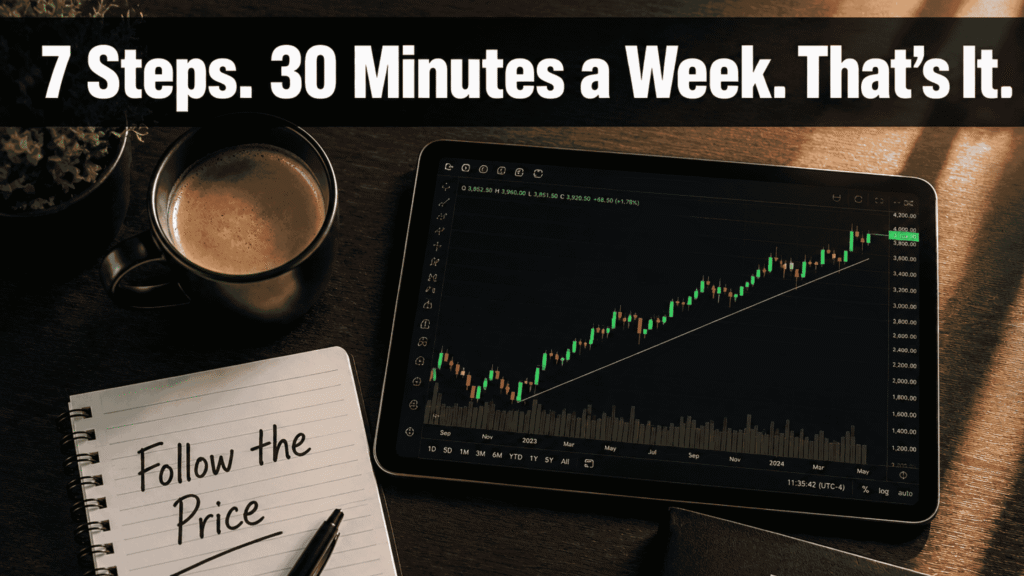
A basic system like this on SPY requires roughly 30 minutes per week to manage and no individual stock picking, earnings analysis, or macro forecasting. The system does the work. Your job is to not interfere with it.
“Losers Average Losers”: The Most Dangerous Habit in Trading
Four words that should be carved over the entrance of every trading desk: Losers Average Losers.
Averaging down buying more of a position that’s going against you to “lower your average cost” feels logical. You were right once about this stock. It’s cheaper now. That’s a better deal, right?
No. When a trend follower’s position moves against them, the market is telling them something: this trend isn’t materializing, or it’s reversed. The correct response is to cut the position and move on. Adding to it in the hope that it will eventually come back is the opposite of following a trend. It’s fighting one.
The traders who average down are the ones who turn small losses into catastrophic ones. They add at -10%. They add again at -20%. They’re “so confident” at -30% that they make their biggest purchase yet. By -50% they either blow up or hold for years waiting to break even while the money could have been compounding elsewhere.
Every major financial disaster Long-Term Capital Management, Barings Bank, the 2000-2002 tech bubble involved either institutions or individuals who couldn’t bring themselves to take the loss when the trend turned against them. LTCM had Nobel Prize-winning economists building their models. Barings had experienced traders. Neither had the discipline to follow the trend when it turned.
The discipline to cut losses is not natural. It contradicts Prospect Theory. It requires a mechanical system and the commitment to follow it. But it’s the single most important habit in trend following, because it’s the one that keeps you solvent long enough for the big trends to materialise.
Why Trend Following Works in Every Asset Class
Most retail investors think entirely in terms of stocks. Trend following works across every tradable market bonds, currencies, commodities, indices.
This matters for a specific reason: trends in different asset classes are often uncorrelated. When stock markets are in a bear trend, commodity markets might be in a bull trend. When currencies are trending, bonds might be rangebound. A trend follower with exposure across multiple asset classes has more opportunities to find trends at any given time.
True diversification real portfolio diversification comes from holding assets that don’t move together, not from holding different stocks in the same category. As one successful trend follower put it: spreading investments among different stocks or even mixing stocks and bonds doesn’t provide true diversification because the two tend to move together in market crises. The 2008 crash proved this conclusively virtually every traditional asset class fell simultaneously, while trend followers who were short across multiple markets made money.
This is also why trend followers don’t predict. They’re positioned across enough markets that they don’t need to be right about any particular one. They need trends to emerge somewhere and somewhere is almost always trending.
Frequently Asked Questions
What is trend following strategy in simple terms?
Trend following is a trading approach where you buy markets that are going up and sell (or short) markets that are going down, with no attempt to predict where they’ll go. You follow what price is already doing, enter after a trend establishes itself, and exit when the trend reverses. The goal is to capture the majority of major trends across any market stocks, commodities, currencies, or bonds while keeping losses small on the many trades that don’t develop into trends.
Does trend following strategy actually work?
Yes, there’s decades of verified performance data from real traders managing real money. Top trend followers have produced positive returns over 20–30-year periods spanning multiple bull markets, bear markets, recessions, and crises. The 2008 financial crisis is the most dramatic recent example: while most funds and investors lost catastrophically, trend followers made 5-40% in a single month by following price as it fell. The strategy works because it exploits a consistent feature of human behavior the tendency to move in herds which creates trends in every market.
Why do most trend following trades lose money?
They’re designed to. Trend following accepts a high frequency of small losses in exchange for occasional large wins. A trend following system might win 35-40% of trades and still be highly profitable because the winning trades are much larger than the losing ones. Cutting losses small when trends don’t materialise is what allows the system to stay solvent long enough to capture the rare, large trends that generate most of the profits.
What’s the difference between trend following and buy-and-hold investing?
Buy-and-hold involves selecting assets based on fundamental value and holding them through all market conditions, expecting long-term appreciation. Trend following involves no fundamental analysis only price and exits positions when trends reverse rather than holding through downturns. In a sustained bear market, buy-and-hold investors lose with the market. Trend followers exit (or go short) when the trend turns down, limiting losses and potentially profiting from declining markets.
How do trend followers handle losing streaks?E
Through strict position sizing and mechanical rules. Because each trade risks only 1-2% of account equity, a losing streak of 10-15 trades which any trend following system will experience reduces the account by 10-15%, not 50-80%. The mechanical rules prevent emotional responses during losing streaks: no revenge trading, no doubling down, no abandoning the system. The trader follows the rules and waits for the next trend.
Can trend following work for individual retail investors?
Yes, though it requires significant discipline and psychological preparation. The main challenges for retail trend followers are: the patience to hold winners through volatility without taking early profits; the discipline to cut losses mechanically without hoping for recovery; and the psychological resilience to stick to the system during losing streaks. None of these are intellectually difficult. All of them are emotionally difficult. Starting with smaller position sizes while building the discipline is the most practical path.
What markets work best for trend following?
Trend following works across stocks, commodities, currencies, and bond futures any liquid market with reliable price data. Diversifying across multiple uncorrelated asset classes is actually an advantage, because more markets mean more opportunities to find trends at any given time. Trend following on individual stocks works but requires managing a larger number of positions. Starting with broad market indices or ETFs simplifies the approach while maintaining the core strategy.
Why do most people prefer fundamental analysis over trend following?
Because trend following feels uncomfortable in ways that fundamental analysis doesn’t. Buying a stock because a company has strong earnings and a good business feels rational and grounded. Buying something purely because its price is going up with no fundamental reason feels speculative. This discomfort is largely psychological. The evidence strongly favors price-based approaches over the long run, but humans are wired to want narratives and reasons, and trend following deliberately rejects those in favor of pure price data.
Related Reading
- Stock Trading Psychology: Why Most Traders Lose Money — the psychological traps that prevent traders from executing trend following consistently
- Why Traders Fail: The 5-Step System for Consistent Trading Profits — position sizing and trading system design explained in depth
- The Complete Guide to Profitable Swing Trading — how trend following principles apply to shorter time frames
About the Author Jamaluddin K A is an investor and founder of The First Time Investor — a site dedicated to making stock market education clear and accessible for beginners and experienced traders alike. Learn more about this site →
Disclaimer: This blog is for educational purposes only and does not constitute financial advice. Always do your own research before making any investment decisions.
5 thoughts on “Trend Following Strategy: The Trading Approach That Profits in Any Market”