
How to trade stocks and options without fear is what separates the investors who build real wealth from the ones who watch their portfolios swing up and down with white knuckles.
Most people treat the stock market like a casino. They throw money in, hope something goes up, and panic when it doesn’t. The result is predictable: they buy high, sell low, and wonder why investing never seems to work for them.
This guide covers something different. A structured, risk-aware approach to trading that uses tools most retail investors have never touched, including put options, call options, covered calls, and credit spreads, to generate consistent returns while keeping risk completely defined before you ever enter a trade.
Why “Buy and Hold” Isn’t Always the Answer
Before diving into strategy, it’s worth being honest about the most popular investing advice out there: buy a stock and hold it forever.
The data makes a reasonable case for buy-and-hold over very long periods. The Dow Jones Industrial Average climbed from around 760 in 1966 to over 11,800 forty years later. The S&P 500 went from roughly 74 to over 1,350 over the same stretch. Long enough timelines make most patient investors money.
But the keyword is “long enough.” And life doesn’t always cooperate.
Consider someone who bought the Nasdaq tracking ETF (QQQQ) near its late 1999 lows around $61 a share. If they needed that money during the 2002 crash, they may have exited around $20. That’s a devastating loss. And as of 2006, they still hadn’t gotten back to breakeven from their 1999 entry price.
The strategy of simply holding works beautifully until it doesn’t. Companies go bankrupt. CEOs get arrested. CFOs cook the books. Entire sectors become obsolete. Enron and WorldCom weren’t fringe companies, they were household names that went to zero.
The problem isn’t investing itself. The problem is investing without an exit plan, without protection, and without a defined risk level you’ve decided you can live with.
Building Your Personal Trading Plan First
Before any strategy, before any specific trade, there’s something that matters more than all of it: a personal trading plan.
Most people skip this step entirely. They want to get to the “good stuff,” the trades that make money. But experienced traders know the plan is the good stuff. A head trader at a major brokerage once put it simply: almost all traders he met who had no plan failed. Those with any plan at all, even an imperfect one, generally achieved at least some measure of success.
A real trading plan answers specific questions:
Will you trade full time or part time? Part-time trading, even just a few hours a week, can be effective with the right strategies. Someone who checks the market only once a month can still run a functional investment system, as long as their strategy fits that timeline.
How much is your “risk money”? Risk money is money you could lose entirely without affecting your ability to pay bills, cover tuition, or handle emergencies. If you have $20,000 but $15,000 of it is earmarked for real expenses in the next 6-8 months, your risk money is $5,000, not $20,000. Never confuse the two.
What are your business hours? Trading is a business. Set specific hours for it, when your mind is fresh and you can give it undivided attention. Interruptions from family, friends, or distractions at home can cost real money when you’re making trading decisions.
What is your maximum number of open trades? More positions mean more things to track and more things that can go wrong simultaneously. New traders should start with just 1-3 positions. Even experienced traders often cap themselves at 10-15.
How will you enter and exit each trade? This is the most critical piece. Every decision about when to buy and when to sell should be made before you enter the position, not in the heat of a moving market. A disciplined entry driven by a technical signal, and a predefined exit if things go wrong, remove emotion from the equation almost entirely.
What is your money management rule? A reasonable rule of thumb: risk roughly 3-5% of your total account on any single trade. Never risk more than you can afford to lose on one position. Keeping 15-25% in cash gives you flexibility to act on opportunities and handle emergencies without being forced to liquidate positions at the wrong time.
The Role of Technical Analysis in Reducing Risk
Understanding when to enter a trade, and more importantly when to exit one, is where technical analysis earns its place.
Fundamental analysis tells you what a company is worth, at least in theory. Technical analysis tells you when to act. A stock can be a wonderful business and a terrible trade at the wrong entry point. Price and timing are not the same thing as quality and value.
The most useful insight technical analysis provides is a defined exit. Without a clear technical line that signals “I’m wrong, get out,” emotions take over. And emotions in trading almost always lead to the same outcome: cutting profits short and letting losses run.
Consider a simple example using a 50-day moving average. A stock breaks above its 50-day moving average in October. That becomes the entry. The rule is simple: stay in the position as long as the stock remains above that moving average. When it breaks back below, exit. The decision has been made in advance. No second-guessing, no “I think it might come back,” no fear-driven exits during a normal dip.

Several indicators work well as entry and exit signals when used consistently:
- Moving averages (20-day, 50-day, 200-day): price above the moving average signals uptrend, price below signals downtrend
- MACD (Moving Average Convergence Divergence): MACD line crossing above its signal line is bullish, crossing below is bearish
- Stochastics: useful for identifying overbought and oversold conditions
- DMI (Directional Movement Index): confirms trend strength and direction
- Japanese candlestick patterns: particularly powerful near support and resistance levels for identifying reversals
The goal isn’t to use all of these. Pick 2-3 that you understand thoroughly and use them consistently. A trader who knows one indicator well beats a trader who half-knows ten.
How Put Options Can Protect Your Money
Put options are one of the most powerful, and most misunderstood, tools in a retail investor’s toolkit. Most people assume options are only for sophisticated traders making high-risk bets. The opposite is true: options are among the most effective ways to reduce risk in a portfolio.
A put option gives the buyer the right, but not the obligation, to sell a stock at a specific price (the strike price) at any time before the option’s expiration date. The buyer pays a premium to obtain this right. The seller receives the premium and takes on the obligation to buy the stock at the strike price if the option is exercised.
The Protective Put: Insurance for Your Stock

Think of every insurance policy you own. Health insurance, car insurance, homeowner’s insurance. What about your stock portfolio? Can that be insured? Yes, absolutely.
The protective put works exactly like an insurance policy. You own a stock, and you buy a put option to protect yourself if it drops.
Here’s a concrete example. Suppose you buy 1,000 shares of a stock at $25 a share ($25,000 total). You also buy 10 contracts (each covering 100 shares) of a September $25 put for $2.50 per share, or $2,500 total. Now suppose the stock drops to $10 a share.
Without the put, you’d have lost $15,000. With the put, you can exercise your right to sell your shares at $25 each, no matter how low the market price falls. Your only loss is the $2,500 premium you paid for the protection. That’s a maximum loss of about 10% of your position instead of a 60% wipeout.
This becomes even more powerful when you look at the choices available:
| Protection Type | Expiration | Strike | Monthly Cost per Share | Your Deductible |
|---|---|---|---|---|
| At-the-money | 1 month | $30 | $0.75 | $0 |
| At-the-money | 5 months | $30 | $0.28 | $0 |
| At-the-money | 13+ months | $30 | $0.16 | $0 |
| Out-of-the-money | 5 months | $27.50 | $0.10 | $1.90/share |
The further out the expiration, the lower the monthly cost of protection. You’re essentially choosing your deductible, just like with car insurance. Longer coverage for less per month, or short-term coverage for a slightly higher monthly cost but more flexibility.
Directional Puts: Making Money When Stocks Fall
Beyond protecting existing positions, put options can be used as a standalone strategy to profit from falling stock prices.
When you buy a directional put, you’re not insuring a position you own. You’re simply betting that a stock is going to fall. If you’re right, the put gains value as the stock price drops. If you’re wrong, your maximum loss is the premium you paid.
Here’s how the economics work. Assume you buy a $22.50 put on a stock trading at $20, with 5 months to expiration, for $3.75 per share. The put has $2.50 in intrinsic value (since you could force someone to buy the stock at $22.50 when it’s worth $20) plus $1.25 in time value.
A month later, the stock has dropped to $15. Your put now has $7.50 in intrinsic value plus roughly $1 in remaining time value, for a total value of $8.50. You paid $3.75. You just made $4.75 per share, or a 126% return on your investment. On 10 contracts (controlling 1,000 shares), that’s $4,750 on a $3,750 investment in one month.
Compare this to selling a stock short. Short selling has theoretically unlimited risk because a stock price can rise indefinitely. Your loss if the stock goes from $20 to $100 is $80 per share. With a directional put, your maximum loss is the premium paid. The risk is completely defined before you enter.
When buying directional puts, prefer options with:
- At least 5-6 months until expiration (gives the position time to work)
- In-the-money strikes (provides intrinsic value and a higher delta)
- A stock that’s in a clear downtrend confirmed by technical signals
Selling Puts to Generate Income
Selling puts is one of the most consistent income-generating strategies available, and it’s considerably less risky than most brokers would have you believe.
When you sell a put, you collect a premium and take on the obligation to buy the stock at the strike price if the option is exercised. In exchange for that obligation, the market pays you.
Here’s the key insight: selling a put is actually less risky than simply buying the stock.
If you want to buy XYZ stock at $35, you could buy it for $35 and put $35 at risk. Or, you could sell a $35 put for $1.50 and receive that premium immediately. If the stock drops below $35, it gets assigned to you at $35. But your net cost is $33.50 ($35 minus the $1.50 you already received). Which approach has more risk? Buying at $35 or buying at $33.50?
The market has literally paid you to buy a stock you already wanted to own.
Best conditions for selling puts:
- Uptrending market, sector, and individual stock
- Out-of-the-money strike price well below a strong support level
- Short timeframe (3-4 weeks out at most)
- Significant open interest in the option you’re selling (at least 300 contracts)
Bullish Put Credit Spreads: Lower Risk, Still Strong Returns
If naked put selling requires a higher account balance or brokerage level than you currently have access to, the bullish put credit spread gives you most of the benefits with much less capital at risk and a much lower level requirement (typically Level 3 rather than Level 4).
Here’s how a spread works. Suppose a stock is trading at $51, just above a support level. You sell 10 contracts of the $50 put for $2.50 (bringing in $2,500), and simultaneously buy 10 contracts of the $45 put for $1.50 (paying $1,500). Your net credit is $1,000.
Your maximum risk is no longer the full stock price. The worst case: you’re forced to buy the stock at $50 ($50,000), but you can immediately force someone to buy it from you at $45 ($45,000). Spread loss = $5,000. Minus the $1,000 you already received. Net maximum risk = $4,000.
Return on risk: $1,000 / $4,000 = 25% potential return for one month.
It’s not unusual to find bullish put credit spreads offering 15-30% returns on risk per month when the conditions are right. That compares favorably to a CD paying 4-5% annually.
| Component | What You Do | Amount |
|---|---|---|
| Short put (sell) | Sell $50 puts | +$2,500 credit |
| Long put (buy) | Buy $45 puts | -$1,500 cost |
| Net credit received | $1,000 | |
| Maximum spread risk | $50 – $45 = $5 × 1,000 shares | $5,000 |
| Actual risk (spread minus credit) | $5,000 – $1,000 | $4,000 |
| Return on risk | $1,000 / $4,000 | 25% |
How Call Options Can Build Serious Wealth
Call options give the buyer the right to purchase a stock at the strike price at any time before expiration. They work in the opposite direction from puts: you profit when the stock goes up.
The power of calls is leverage. Here’s a straightforward comparison.
A stock is trading at $26. You buy 100 shares for $2,600. The stock goes to $30. You’ve made $400, or a 15% return.
Alternatively, you buy a $25 call with 6 months to expiration for $2 per share ($200 per contract). The stock goes to $30. Your call now has $5 in intrinsic value plus remaining time value, say $0.60. It’s worth $5.60. You paid $2. Your return: 180%.
The percentage gain with the call is 12 times larger. And your maximum loss was only $200, not $2,600.
The tradeoff: options expire. If the stock stays flat or drops, a call option loses value over time and can expire worthless. That’s why when buying calls, the approach should be:
- Buy longer-term expirations (reduce time decay pressure)
- Buy in-the-money options (provide intrinsic value and higher delta)
- Use LEAPS (Long-Term Equity Anticipation Securities) for maximum flexibility
LEAPS: Long-Term Calls for Patient Traders
LEAPS are call options with expirations up to 2-3 years out. They’re among the most versatile tools available for directional traders.
The key advantage of LEAPS over shorter-term calls is the time value economics. If a stock’s $40 strike 5-month call costs $2.40 in time value (about $0.44/month), the same $40 strike LEAPS with 24 months to expiration might cost $5.30 total, or roughly $0.22/month. You’re paying less per unit of time for far more runway.
LEAPS also tend to have higher deltas than shorter-term calls with the same strike. A higher delta means the option price moves more per dollar of stock movement, so when you’re right on direction, you profit faster.
Typical LEAPS approach: buy in-the-money LEAPS with a delta near 0.70, targeting stocks with confirmed uptrends and solid technical setups. Hold for weeks or months rather than years. Exit when you’ve captured the move, not when the option expires.
Writing Covered Calls: Monthly Income From Stocks You Already Own
Covered calls are the most widely available option strategy for retail investors, requiring only Level 1 trader status at most brokerages. And yet, most stock owners never use them.
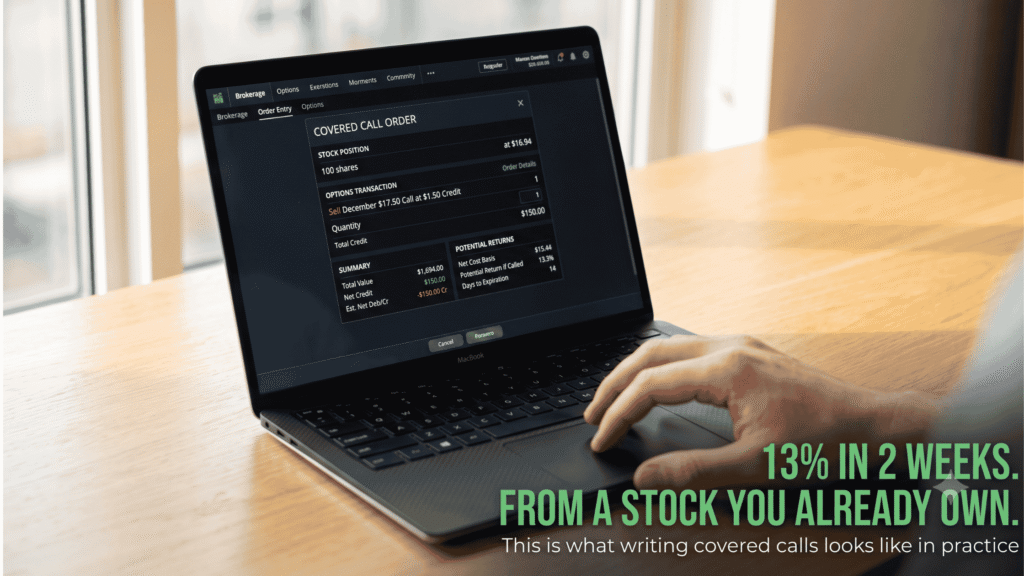
Here’s the concept. You own a stock. You sell a call option against it. The buyer of the call pays you a premium. In exchange, you agree to sell your stock to them at the strike price if it’s “called” before expiration.
Suppose you’ve owned a stock for a year, bought at $15, now trading at $16.94. There are two weeks until December option expiration. The December $17.50 calls are trading at $1.50 bid / $1.65 ask.
You sell one contract (100 shares) for $1.50 per share, or $150 total.
Two scenarios:
Scenario A: Stock goes above $17.50. You’re called out. You sell at $17.50 when you paid $15. That’s a $2.50 gain on the stock plus the $1.50 you received for the call. Total gain: $4.00 on a $15 investment = 26.7% in two weeks. Not bad.
Scenario B: Stock stays below $17.50. The call expires worthless. You keep your stock AND the $1.50 premium. Return of 8.8% in two weeks. You can now sell calls again for next month.
The risk when writing covered calls is simple and well-defined: you own the stock, and if it drops, you lose on the stock. But the premium you’ve collected reduces your cost basis, meaning the stock has to drop further before you start losing money compared to having never sold the call.
One thing that surprises many people: the risk profile of writing covered calls is mathematically identical to selling naked puts. In both cases, the maximum risk is the price of the stock minus the premium received. Brokerages treat them very differently from a permission standpoint, but the risk is the same.
Combining Strategies for No-Risk and Low-Risk Trades
Here’s where the strategies above become something most retail investors have never seen before: truly zero-risk trades.
The zero-risk trade works when you combine a protective put with a covered call in the right way. If you can collect enough premium selling a call to more than cover the cost of the put you’re buying for protection, you’ve built a position where any loss is fully offset by collected premium, and you still have upside potential.
This isn’t theoretical. When done correctly, you can find yourself in a position where:
- The put protects your downside completely
- The call premium you collected more than covers the put cost
- Any upward move in the stock is additional profit
It requires specific conditions and careful selection, but these trades do exist and are regularly used by experienced traders who want to participate in markets with no capital at risk.
Exchange-Traded Funds: Diversified Trading With Options
Exchange-traded funds (ETFs) are one of the best vehicles for the strategies covered above.
An ETF trades like a stock but represents a basket of underlying holdings. The SPDR S&P 500 ETF (SPY), for example, tracks the S&P 500. The Nasdaq 100 tracking stock (QQQQ) tracks 100 major Nasdaq companies. ETFs on specific sectors, commodities, and even inverse market movements exist across hundreds of variations.
Why ETFs are particularly useful for options trading:
They rarely go to zero. An individual stock can go bankrupt overnight. An ETF tracking the S&P 500 would require the entire US economy to collapse. This makes puts used for insurance on ETF positions extremely cost-effective.
Liquid options markets. The most popular ETFs have very active options markets with tight bid-ask spreads, making it easier to get in and out of positions at fair prices.
Sector-specific plays without individual company risk. If you’re bullish on technology but don’t want to bet on a single company, a technology sector ETF lets you express that view while spreading risk across dozens of companies.
When selecting ETFs for trading, look for high average daily volume, tight option spreads, strong institutional ownership, and a clear trend in the direction you want to trade.
The Real Enemy of Trading Success: Emotion
Every strategy in this guide works on paper. What defeats them in practice is emotion.
Fear makes you exit a winning position too early. Greed makes you hold a losing position too long. Both destroy returns far more than bad strategy selection ever could.

The famous trading adage “cut your losses and let your profits run” is known by almost everyone. Almost no one follows it naturally, because doing so requires doing the emotional opposite of what feels right.
Cutting a loss feels like admitting defeat. Holding a winner feels like leaving money on the table. The natural human response is always backwards for trading: hold the losers (hope it comes back) and sell the winners (lock in the gain before it disappears).
The solution isn’t willpower. It’s mechanical rules.
Decide your exit before you enter. Set a stop-loss order when you open the position. Use limit orders when buying, not market orders, because market orders can fill at dramatically different prices than expected, especially during volatile moments.
Make your trading decisions when the market is closed, when you can think clearly, then implement them mechanically when your triggers are hit. The decisions should never be made while a position is moving against you in real time.
Strategy Comparison: Which Approach Fits Your Risk Tolerance?
| Strategy | Risk Level | Return Potential | Account Level Required |
|---|---|---|---|
| Buy and hold stocks | Medium-High (no protection) | Unlimited upside, full downside | Level 0 |
| Protective puts | Low (defined maximum loss) | Unlimited upside, limited downside | Level 2 |
| Directional puts | Medium (premium at risk) | High (leverage) | Level 2 |
| Selling naked puts | Medium (stock could be assigned) | Premium income | Level 4 |
| Bullish put credit spread | Low-Medium (defined risk) | 15-30% monthly potential | Level 3 |
| Buying calls/LEAPS | Medium (premium at risk) | High (leverage) | Level 2 |
| Writing covered calls | Low-Medium (own stock) | Regular monthly income | Level 1 |
| Zero-risk combined strategy | Very Low | Moderate but capital preserved | Level 2-3 |
Frequently Asked Questions
What is the safest way to trade options for beginners?
Writing covered calls against stocks you already own is the most beginner-accessible options strategy. It generates monthly income, requires only Level 1 trader status at most brokerages, and carries no additional risk beyond owning the stock itself. The premium collected reduces your effective cost in the position.
How do protective puts work as portfolio insurance?
A protective put gives you the right to sell your stock at a predetermined price regardless of how far the stock falls. You pay a premium, just like an insurance premium, and in return your downside is completely capped for the life of the option. Think of it as setting a floor under your position.
Is selling naked puts really as risky as brokers say?
Brokers classify naked put selling as Level 4, the same level that requires experience and minimum account balances. But the risk is actually the same as owning the stock outright, and the net cost if the stock is assigned to you is lower because you’ve already received a premium. The main risk is that you’ll be required to buy shares of the underlying stock if it falls below your strike price.
What is a bullish put credit spread?
A bullish put credit spread involves selling an out-of-the-money put and simultaneously buying a put at a lower strike price. This creates a credit (cash into your account) and limits your maximum loss to the spread width minus the credit received. It generates defined-risk monthly income with the potential for 15-30% returns on the capital at risk.
How do LEAPS calls differ from regular call options?
LEAPS (Long-Term Equity Anticipation Securities) are call options with expirations up to 3 years out. They cost less per unit of time than shorter-term calls, have higher deltas (meaning they gain value faster as the stock moves up), and give the stock more time to move in the desired direction. They’re particularly useful for directional trades where you’re confident in the direction but want to avoid the pressure of a tight expiration window.
What is paper trading and why does it matter?
Paper trading means recording hypothetical trades without using real money, tracking entries, exits, and results exactly as you would with a real account. It lets you test a strategy and develop your rules before putting real capital at risk. The transition from paper trading to live trading can be
difficult even when the paper results have been strong, so starting with small positions and gradually scaling up is the recommended approach.
About the Author — Jamaluddin K.A.
Jamaluddin is the founder of The First Time Investor, a US and UK-focused personal finance and investing education site built for people who want to understand markets without a finance degree. He covers stock market basics, options strategies, retirement accounts, and the kind of investing principles that most financial media buries under jargon. Everything published on this site is written from the perspective of someone who believes financial literacy is a life skill, not a privilege.
Disclosure: This article is for educational purposes only. Nothing here constitutes financial advice. All investing and trading involves risk, including the risk of loss. Consult a licensed financial advisor before making investment decisions.
Great content! Keep up the good work!