

How professional traders profit from retail trader mistakes isn’t a mystery but most people in the market never figure it out. They assume they’re trading against the stock. They’re actually trading against other people who understand the game better.
All true. But incomplete.
The more accurate reason is this: experienced traders are watching everything a beginner does, and they’re positioning to profit directly from those predictable moves. The market isn’t just a battle between buyers and sellers. It’s a tiered competition between traders at very different levels of understanding and the ones who understand this dynamic have a permanent structural edge over those who don’t.
This article breaks down exactly how that works, what the levels look like, and how a retail trader can start thinking more like the professionals who are on the other side of their trades.
The Three Levels of Market Participants (And Which One You’re On)
Every single trade has someone on the other side of it. That’s not a metaphor it’s a mechanical fact. When you buy, someone sold to you. When you sell, someone bought from you.
The question that almost no beginner ever asks is: who is that person, and what do they know that I don’t?
Here’s how market participants roughly divide:
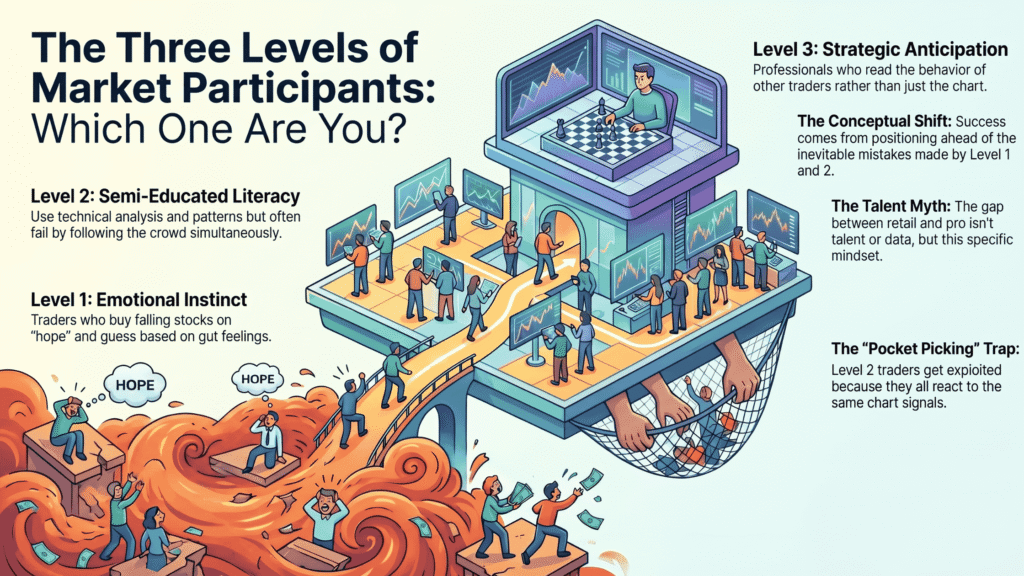
Level one traders act on emotion and instinct. They buy falling stocks hoping for a bounce. They average down on losers because they “believe in the company.” They get hurt on every major decline because they’re essentially guessing. After the 2008 crash, this group thinned out significantly, but it still exists.
Level two traders are semi-educated. They’ve read books, watched courses, learned technical analysis. They recognize cup-and-handle breakouts, head-and-shoulders patterns, support and resistance levels. They feel sophisticated. They short failing stocks instead of buying them blindly. And they’re still regularly getting their pockets picked, because they’re all doing the exact same thing at the exact same time.
Level three traders understand something the others don’t: the real trade isn’t just about reading the chart. It’s about reading what the other traders are doing with the chart and positioning ahead of their inevitable mistakes.
Most retail traders live at level one or two. Professional traders have moved to level three. The gap between them isn’t talent or access to better data. It’s this single conceptual shift.
Why Basic Technical Analysis Stopped Working
Technical analysis was built on a simple premise: study chart patterns, recognize the footprint of institutional money, and trade alongside it. For decades, it worked because only a minority of traders used it, and the majority of market participants were reacting emotionally without any framework at all.
Then it went mainstream.
After the 2008 financial crisis, millions of retail traders flooded into the world of technical analysis. Books sold. YouTube channels exploded. Trading communities formed around cup-and-handle setups, MACD crossovers, RSI divergences, and Fibonacci retracements. The level of participation in basic charting became enormous.
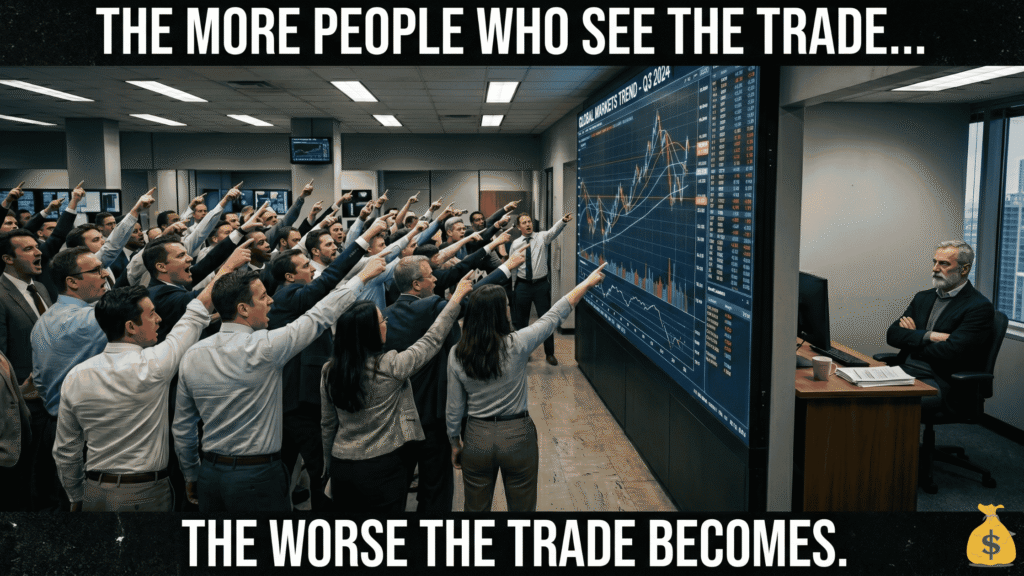
And here’s what that created: when millions of people see the same pattern and make the same trade, the pattern stops working as designed.
Take the summer of 2009 as a clean example. The S&P 500 had carved out a head-and-shoulders topping pattern that received more media attention than almost any technical setup in history. Financial television covered it. Trading blogs wrote about it. The consensus was nearly unanimous the market was topping out, short it.
The pattern failed. Massively. The market ripped higher, and everyone who shorted the head-and-shoulders pattern got squeezed. The move wasn’t random. The failure of that pattern, and the short squeeze that followed, was a direct consequence of how many people had piled into the same trade. The overcrowding destroyed the edge.
Level three traders bought that failure. They profited from the mass of level two traders who had been certain they were right.
The “Failed Move” Concept Where the Real Money Hides
There’s an old trading saying that goes: from failed moves come fast moves.
It’s worth unpacking carefully because this is the core mechanism behind how professional traders profit from retail trader mistakes.
When a widely watched chart pattern fails to produce the expected outcome, something predictable happens. Every trader who positioned for that outcome now has to exit or get stopped out. That mass exit creates a rapid, violent move in the opposite direction.
Here’s a concrete example. A stock trades up to $50, which is a key resistance level that’s been holding for months. Everyone can see the lateral resistance. Basic technical analysis says: if it breaks above $50 cleanly, buy the breakout.
The stock pops above $50. Volume comes in. Level two traders buy the breakout.
Then it reverses closes back below $50 the same day.
Stop orders trigger. Those who bought the breakout are exiting. The exits create selling pressure. The price drops quickly.
A professional who understood the setup who knew that an overcrowded trade at a heavily watched level was likely to fail was already positioned short above $50, ready to profit from that flush. The retail trader’s stop-loss is the professional’s profit trigger.
This isn’t manipulation. It’s math applied to crowd behavior.
How Institutions Make It Worse (On Purpose)
It’s not just retail traders who have figured out how technical analysis works. The institutional side mutual funds, prop desks, hedge funds has known for years exactly where retail stops cluster, and they use that knowledge operationally.
Think about how a large fund wants to buy a big position in a stock. If they just buy aggressively, they push the price against themselves. Instead, they sell into a key support level the exact price point where thousands of retail traders have placed their buy stops. The price dips below, retail stops trigger (creating a flush lower), and the fund buys those shares at the lower price. Then the stock reverses back up.
From the outside, this looks like “the market stopped me out and then went my way immediately.” That experience of being stopped out right before a reversal isn’t always bad luck. Sometimes it’s predictable crowd dynamics being exploited by someone with more size, more speed, and a better understanding of where the retail herd is positioned.
The only real counter to this is moving to a level where you understand what’s happening and building a strategy that accounts for it, not just a strategy that assumes the textbook patterns will always play out.

The Trader Mindset Shift That Changes Everything
Before any of the technical mechanics matter, there’s a psychological prerequisite. And most retail traders never clear it.
The market is neither good nor bad. It’s just directional. Up days aren’t good. Down days aren’t bad. Both are simply opportunities if you’re positioned correctly.
Most people come into trading with an inherited bias: stocks should go up, rising markets are good, falling markets are a problem to survive. That emotional framing immediately limits the trader to one-third of available setups. A market that only makes money going up captures roughly 33% of what’s actually available on any given day.
The traders who profit consistently both up and down, in trending and sideways conditions have stripped out that bias completely. They don’t have a rooting interest. They study what price is actually doing, decide if there’s an exploitable edge in either direction, or act accordingly.
This sounds simple. It genuinely isn’t. Investment media, social media, and most financial education is built around a bullish bias. Removing that conditioning takes deliberate effort. But it’s the prerequisite for everything else in this article to work.
Finding a Real Edge Before Trading the Trader
Here’s where things get important: you cannot skip the foundation.
Trading pattern failures buying when a bearish setup falls apart, shorting when a bullish breakout fails is an advanced strategy. Trying to execute it without a solid foundational understanding of the patterns themselves is just guessing with extra steps.
The sequence has to be:
- Develop a clear, defined trading strategy with a statistical edge. Not “buy low, sell high.” An actual system what pattern, what entry trigger, what stop level, what profit target.
- Execute that strategy over enough trades to verify the edge is real and not a short streak.
- Begin observing market context at a higher level are the patterns working consistently, or are they failing more than they should? If failure rate on standard setups spikes, that’s a signal to adjust.
Most retail traders skip step one entirely and jump to optimizing their exits or chasing the next hot strategy. That’s why they stay stuck. A strategy that wins 55% of the time with disciplined risk management is enough to be profitable over a large sample. The problem is that most traders abandon a working strategy after a losing streak without ever having run enough trades to know if the edge is real.
The successful trader isn’t always right. They just have an edge, execute it consistently, and cut losses before they compound.
Pattern Recognition: The Foundation Layer
Technical analysis, at its core, is pattern recognition. Stocks move in ways shaped by human emotion and human emotion is consistent enough that patterns repeat.
The two fundamental pattern categories are:
Lateral trends price levels where a stock reverses multiple times at roughly the same price point. These become significant because they carry emotional weight. The $30 level where a stock reversed means something to everyone who bought at $30 and watched it drop. When it comes back, they sell. That selling creates resistance. Understanding why a level matters makes you a better judge of when it will hold and when it will break.
Angular trends ascending or descending lines connecting a series of higher lows or lower highs. These develop as traders make decisions at progressively higher or lower prices. An ascending trend means buyers are consistently stepping in before the previous low demand is present. A break below it signals that support has eroded.
The crucial insight is that these patterns are fractal. The same dynamics that create a lateral trend on a daily chart also exist on a 10-minute chart and a weekly chart. A trader with limited screen time can work off weekly charts successfully. A day trader can work the same logic on short-term setups. The time available doesn’t have to dictate whether trading is accessible only which time frame to focus on.
Stop Placement: The Difference Between a Controlled Trade and a Hope Trade
The single habit that separates losing traders from consistent ones isn’t picking better setups. It’s setting appropriate stops and actually respecting them.
Most beginners treat stops as an afterthought. They find a setup, decide how much they want to make, and then figure out where to put the stop. That’s backwards.
A stop is the first decision. Before entering any trade, the question to answer is: at what price point is this thesis wrong? The stop goes there. Position size is then derived from how far the entry point is from the stop, keeping total financial risk within a predetermined limit per trade.
The common approach of using a fixed percentage “I always set a 5% stop” sounds disciplined but creates a practical problem. A 5% stop on a volatile stock might be triggered within normal price movement that doesn’t actually invalidate the setup. The position gets closed for a loss, and then the stock does exactly what was expected.
A better stop is placed at the level where the pattern that created the trade no longer makes sense. If trading a lateral trend break, the stop sits just below the breakout level that’s now supposed to act as support. If the price can’t hold that level, the trade thesis is invalid. That’s where to exit not at some arbitrary percentage.
There’s a harder lesson behind stop discipline, too. When a trader skips a stop and a trade goes against them, sometimes the stock reverses and comes back. That feels like a win. But what it actually does is train the wrong behavior it creates the belief that holding through pain eventually pays off.
At some point, it won’t. And that trade will be the account-damaging one.
Picking a Time Frame That Fits Your Life
One of the most practical decisions a trader can make is choosing a time frame that fits their actual schedule and sticking with it.
The fractal nature of pattern recognition means there’s no objectively superior time frame. A weekly chart trader who spends a few hours per month reviewing setups can be just as profitable as someone watching 5-minute charts all day. The setups look the same. The logic is identical. The moves just take longer to play out.
Where traders get into trouble is time frame jumping. They find a setup on a daily chart, then get nervous watching the 5-minute move against them and exit early. Or they enter a short-term trade and hold it because the weekly chart looks good. This mixing destroys the internal logic of any strategy.
Pick one time frame. Build your pattern recognition within that frame. Evaluate your trades against that frame’s rules. Consistency here is worth more than finding the “optimal” time frame.
Developing the Plan: What Successful Traders Actually Do
A trading plan isn’t a list of stocks. It’s a specific, executable decision tree.
For each potential trade, a real plan answers:
- What pattern am I playing? (Lateral breakout, angular trend continuation, pattern failure fade)
- What triggers my entry? (Break above level, close above level, price rejection at level)
- Where is my stop? (At the point that invalidates the setup, not a round number percentage)
- What’s my target or exit strategy? (Next resistance level, percentage gain, time-based exit)
- How many shares based on my risk? (Determined by stop distance and max dollar risk, not by how “confident” you feel)
Most traders can’t write this down coherently for the last trade they took. That’s not a small problem it’s the entire problem. Without a plan, every decision gets made emotionally in the moment. That’s exactly the kind of predictable behavior that level three traders are waiting to exploit.
Writing it down before entering forces clarity. It also makes post-trade review possible you can look back and ask whether you executed the plan, not just whether you made or lost money on that particular trade. A losing trade executed perfectly is more valuable than a winning trade taken for the wrong reasons.
FAQ: How Professional Traders Profit From Retail Trader Mistakes
Why do most retail traders consistently lose money in the stock market?
Most retail traders lose because they use the same widely known strategies as everyone else, creating overcrowded trades where the edge is eliminated. Combined with emotional decision-making holding losers too long, cutting winners too fast, and skipping stops the result is predictable losses that professional traders are positioned to benefit from.
What does “trading the trader” actually mean in practice?
It means recognizing that the biggest profit opportunities often come not from a pattern working as expected, but from a pattern failing. When a setup that thousands of traders are watching fails, those traders all need to exit simultaneously — creating a fast, violent move in the opposite direction. A professional positioned for that failure captures that move directly.
How do institutions use technical analysis levels against retail traders?
Institutions know where retail stop orders cluster typically just below key support levels or just above key resistance. By executing large trades around those levels, they can trigger a cascade of stop orders, push price through the level, accumulate or distribute at better prices, and then reverse. What looks like a random stop-out to a retail trader is often a deliberate execution strategy on the institutional side.
Can a beginner trader actually develop a real edge?
Yes, but it requires choosing a specific strategy and executing it consistently over a large enough sample of trades to verify the edge exists. Most beginners abandon strategies after short losing streaks before they’ve run enough trades to know if the edge is real. A strategy that wins 55% of trades with proper risk management is enough for consistent profitability over time.
What time frame is best for someone who can’t trade full-time?
Any time frame works, because pattern recognition is fractal the same setups appear on 10-minute charts, daily charts, and weekly charts. A trader with a few hours per week can work off weekly charts effectively. The key is to pick one time frame and stick with it consistently, not jump between frames depending on mood or current volatility.
What’s the most damaging mistake retail traders make with stop losses?
Skipping them or moving them after entry. When traders bypass their stop on a losing trade and the stock eventually recovers, they learn exactly the wrong lesson. They become conditioned to hold through pain. That conditioning eventually leads to a catastrophic trade that wipes out months of small gains.
The Real Takeaway
The market is a competition between participants at different levels of understanding. That’s not cynical it’s accurate and recognizing it is the first step toward competing more effectively.
Basic technical analysis gives retail traders a framework. But when millions of people use the same framework, the framework becomes the thing being exploited by those who understand it better. The patterns still matter but now you have to know who else is watching them, what they’re going to do, and what happens when their trade fails.
This isn’t about becoming a professional overnight. It’s about upgrading your mental model of what the market actually is: a game played between traders at different levels, where the level you’re on determines whether you’re hunting or being hunted.
Expert Tip
Before taking any trade, force yourself to answer one question: Who is on the other side of this, and why would they be wrong?
If you can’t answer that if you’re entering purely because a pattern looks textbook-clean you’re likely trading alongside a crowd, not ahead of it. The best trades come when you can see what the crowd is positioned for and take a view on what happens when they have to exit.
1 thought on “How Professional Traders Profit From Retail Trader Mistakes (And What You Can Do About It)”