
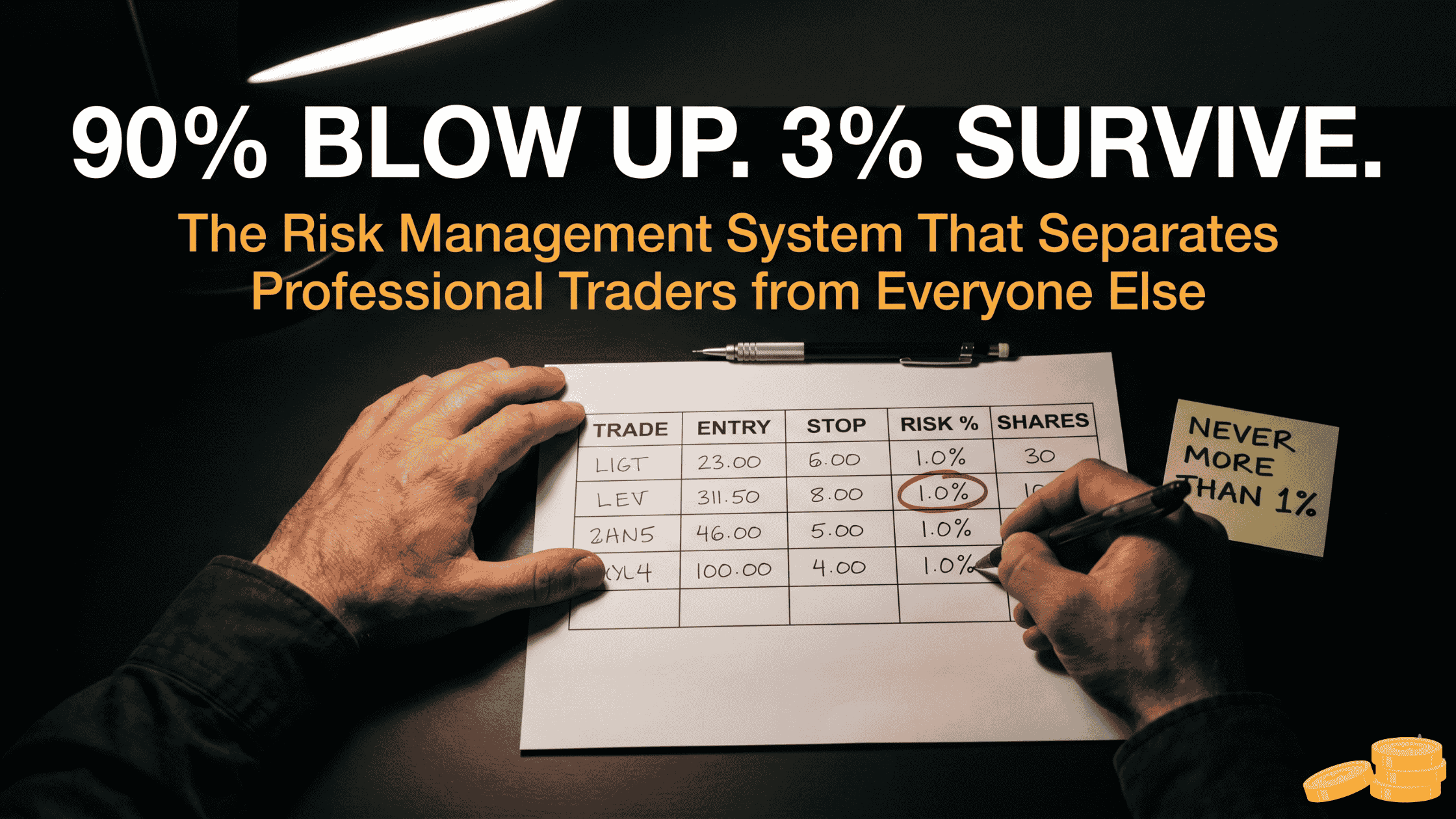
Most traders spend 90% of their time obsessing over entries. What to buy. When to get in. Which indicator gives the signal.
The traders who actually compound money over years are focused on something else entirely: how much to risk, how to survive losing streaks, and how to build a system they can follow without flinching.
This guide covers the complete risk management framework behind professional trend following — the exact rules for position sizing, stop losses, sector limits, and the mental framework that keeps traders in the game when everything is going wrong.
No indicators. No crystal balls. Just a disciplined system that works across markets and time frames.
What Is Trend Following Risk Management?
Trend following risk management is the set of rules that determine how much money you put at risk on any single trade, any single sector, and across your entire portfolio at any given time.
Without it, you’re gambling. With it, you’re running a business.
The core idea is simple: you can’t control whether any individual trade works. You can control exactly how much damage it does if it doesn’t.
Professional trend followers — the ones who’ve compounded money for 20 and 30 years — share one common characteristic. They are more obsessed with protecting capital than making it. The profits come from staying alive long enough to catch the rare big trend that makes the year.
This is the framework they use.
Why Most Retail Traders Fail Before the Trend Appears
Here’s a number that should stop you cold: roughly 90% of retail traders lose money and quit.
They don’t quit because trend following doesn’t work. They quit because they run out of capital — or nerve — before the market produces a trend large enough to justify all the small losses that came before it.
Professional trend followers accept that most trades fail. Jerry Parker, one of the most successful trend followers in history, has stated that out of 200 trades in a year, about 6 will pay for all the losses and generate profits. That’s a 3% win rate on trades that matter.
Think about what that means psychologically. You lose on 194 trades. You stay in. You follow the system. The 6 winners carry everything.
That’s trend following. And you can’t access that outcome if you blow up your account on trades 12 through 18 of the losing streak.
Risk management is what keeps you alive for trade 19.
The 1% Rule: The Foundation of Everything
The single most important number in trend following risk management is 1%.
Never risk more than 1% of your trading account on any single trade.
Not 2%. Not 3%. One percent.
Here’s why this number matters so much. Think of each 1% risk as one “bite of the apple.” At 1% per trade, you get 100 bites. You could lose 100 trades in a row and still have money to trade the next one. At 2% per trade, you get 50 bites. At 5%, you get 20. At 10%, ten losing trades — entirely achievable in trend following — wipe out 65% of your account.
And the math of recovery is brutal. Lose 50% of your account and you need a 100% gain just to break even. That’s not hyperbole. That’s arithmetic.
The table is stark:
| Loss | Gain required to recover |
|---|---|
| 10% | 11% |
| 20% | 25% |
| 30% | 43% |
| 40% | 67% |
| 50% | 100% |
| 70% | 233% |

Keeping losses manageable isn’t conservative. It’s the only way the math of compounding ever works in your favor.
The 1% rule also has a second benefit: it removes emotion from trade sizing. You don’t need to decide whether this trade “feels” more certain. Every trade gets 1%. Every trade is treated as 50/50 — because in the real world, it is.
The Position Sizing Formula: How to Calculate Your Exact Trade Size
Knowing to risk 1% isn’t enough. You need a formula that translates that percentage into an exact number of shares or contracts.
Here’s the formula:
Position Size = (Account Size × Risk %) ÷ (Entry Price − Stop Loss)Example 1:
- Account size: $100,000
- Risk per trade: 1% = $1,000
- Entry: $20.00
- Stop: $17.00 (risk per share: $3.00)
- Position size: $1,000 ÷ $3 = 333 shares
Example 2:
- Account size: $100,000
- Risk per trade: 1% = $1,000
- Entry: $15.00
- Stop: $13.00 (risk per share: $2.00)
- Position size: $1,000 ÷ $2 = 500 shares
Notice something: the total dollar risk is the same on both trades ($1,000). But the second trade uses 500 shares versus 333. If both trades move $2 in your direction, the second trade earns $1,000 while the first earns $666 — with zero additional risk.
This is the power of position sizing. When the risk is small (tight stop, low volatility), you automatically take more shares. When a trend really runs, you’ve already built in a larger position on the lower-risk setups.
The dollar cap rule: as your account grows, 1% becomes a larger dollar amount. A 1% risk on a $500,000 account is $5,000 per trade. At some point, that dollar amount per contract becomes imprudent even if the percentage feels fine. Successful trend followers also set an absolute dollar cap per trade — typically $2,000 to $2,500 per contract in futures, or a maximum dollar-per-share amount in stocks. Apply whichever limit is more restrictive.
Stop Losses: The Only Rule That Isn’t Optional
A stop loss is not a suggestion. It’s the mechanism that keeps the 1% rule from being theoretical.
Place your stop the moment your order is filled. Not after you see how it’s going. Not after lunch. The second the position is open, the stop is in the market.
Why mental stops fail:
“Mental stops” — the idea that you’ll exit when the price hits your level without an actual order placed — fail in practice for one consistent reason: humans rationalize. The market hits your mental stop level and you tell yourself it’s going to bounce. You wait. It doesn’t bounce. A $300 loss becomes $800 becomes $2,000.
This is the fastest way into the 90% club of failed traders. The market doesn’t care what you planned. Only the actual order in the system protects you.
Two types of stops to know:
The initial protective stop is set the moment you enter the trade. It represents the price at which the trade thesis is broken. For a trend breakout buy, this is typically the recent period low — the point below which the “new high” signal would be invalid.
The trailing stop follows the trade as it moves in your favor. As the position profits, you move the stop higher (on a long) to protect those gains. You never move it lower to give the trade more room. The trailing stop only moves in the direction of profit.
The gap reality: stops aren’t perfect. Markets gap overnight. Earnings come out. Geopolitical events hit at 2 AM. Your stop at $47 might execute at $44.80 in a gap situation. That’s not a failure of the system — it’s the nature of markets. The answer is never to skip the stop. It’s to size positions conservatively enough that even a gap-through stop doesn’t cause catastrophic damage.
Sector Risk: The Hidden Danger Nobody Talks About
Here’s where most retail trend followers make the mistake that causes their worst drawdowns.
They use 1% risk per trade. They feel disciplined. But they hold 6 positions in the same sector — all correlated — and when that sector reverses, they lose 6 trades simultaneously instead of 1.
Gold drops 4%. Your gold trade is stopped out. Your silver trade is stopped out. Your platinum trade is stopped out. Three 1% losses in an afternoon. The 1% rule didn’t protect you because the correlation did the damage, not any single trade.
The sector cap rule: never allocate more than 5% total risk to any single sector.
A sector is any group of correlated markets. In stocks: tech, energy, healthcare, financials. In commodities: grains (corn, wheat, soybeans), metals (gold, silver, copper), energies (crude oil, natural gas). In currencies: dollar pairs, yen crosses.
If your account is $100,000, your total sector risk cap is $5,000. At 1% risk per trade ($1,000), that means maximum 5 positions in any one sector at any time.
In practice, this is much more conservative than most traders realize. Markets that look independent often trade in lockstep when a major move hits. The grain complex will all move together. Interest rate products will all move together. When you see a sea of red across an entire sector, your sector cap is what keeps that from becoming a catastrophic drawdown.

Total Portfolio Risk: The Open Trade Equity Rule
There’s a third layer of risk management that even experienced traders overlook: capping your total open trade equity relative to your core account.
Here’s how it works.
Your core equity is your actual account balance — closed positions plus cash. It does not include unrealized profits from open positions. This is your real money.
Your open trade equity is the unrealized profit sitting in positions that are currently working. It’s not real money yet. It’s yours only when you close the trade.
The rule: when your open trade profits reach 20% of your core equity, stop opening new positions.
Why this matters: your largest drawdowns typically occur right after your best runs. When multiple positions are all profitable simultaneously, your emotional confidence is highest — and your actual portfolio risk is also highest. More open positions means more exposure to a sudden reversal.
If your core equity is $100,000 and your open trades are showing $20,000 in unrealized profit, that’s the signal to stop adding. Let what’s working run. Don’t pile on new risk at the moment your portfolio feels best.
This single rule has saved more long-term trend followers from catastrophic drawdowns than almost any other measure.
How to Choose Which Markets to Trade
One of the most underappreciated aspects of trend following risk management is market selection. Not every market deserves your attention at any given time.
The goal is simple: trade markets that are moving, either up or down. Avoid sideways, choppy markets entirely.
The rate of change approach:
Rank your watchlist of markets by momentum. The simplest version: calculate the price change over the last 5, 20, and 60 days for each market. Average those three figures. Rank highest to lowest.
Go long in the strongest markets. Go short in the weakest. Only enter if you can take a trade with 1% or less risk. If the stop-to-entry distance requires more than 1% risk, skip it — even if the market is trending strongly.
The market will still be there. Another setup will form. There is no such thing as a trade you had to take.
Additional filters:
For stocks, avoid shares under $10. The volatility and spread in these stocks can create situations where your stop is hit not by real selling but by illiquid price action. Below $20, be cautious about shorting. Bull markets tend to grind upward slowly. Bear markets fall sharply. The asymmetry matters for timing your positions.
The 200-day moving average test:
When looking at the broader stock market, confirm whether the index is above or below its 200-day exponential moving average. Above it: conditions favor long positions in individual stocks. Below it: defensive positioning, reduced exposure, or active short-selling makes more sense.
This isn’t a mechanical rule for every trade. It’s context. The market environment doesn’t override your individual setup rules — but it informs how aggressively you pursue new positions.
The Trend Breakout Entry: How Professional Trend Followers Get In
The trend breakout is one of the oldest and most proven entry methods in trading. Richard Donchian traded it profitably for decades. The Turtle Traders used a version of it to produce some of the best-documented trading results in history.
The concept is deliberately simple: buy the X-period high. Sell the X-period low.
Here’s the basic version of the setup:
- For a long trade: buy when price closes above or trades through the highest price of the last 20 trading days (the 20-day breakout). The initial stop is the lowest price of the last 10 trading days.
- For a short trade: sell when price closes below or trades through the lowest price of the last 20 trading days. The initial stop is the highest price of the last 10 trading days.
These parameters are not magic. Shorter parameters produce more trades and more false breakouts. Longer parameters filter more noise but get you into trends later. You’ll backtest your own preferences and find what fits.
The MACD filter:
Before entering any breakout, confirm the direction matches the MACD (Moving Average Convergence Divergence) on your chart. For a buy signal, the MACD should be above zero — confirming that overall momentum is bullish. For a short signal, MACD should be below zero.
This filter reduces whipsaws in choppy, trendless periods where breakouts constantly fail. It’s not a perfect filter — nothing is — but it removes a meaningful percentage of the worst-performing breakout setups.

Before taking any breakout:
Calculate your risk: the distance from the breakout entry to the initial stop. Convert that to a dollar amount per share or contract. If the risk exceeds 1% of your core equity, pass on the trade.
Most traders take every signal their system generates. Professional trend followers only take signals where the risk is acceptable. The distinction is enormous over time.
The Trend Retracement Entry: Getting In at Lower Risk
The breakout entry gets you into trends that are already running. The retracement entry offers a different opportunity: getting in during a pullback within an existing trend.
Here’s the logic. A market has been trending higher for weeks. It pauses and pulls back 5-10%. That pullback, within an uptrend, can be a lower-risk entry point than the original breakout — you’re entering at a better price with a tighter stop.
The 3-step retracement setup:
Step 1: Confirm the trend on the higher time frame. If you’re looking at daily charts for entry, confirm that the weekly chart shows a clear uptrend. Higher highs, higher lows, trending in your direction. If the weekly is choppy or sideways, the daily pullback isn’t a retracement entry — it’s a coin flip.
Step 2: Identify the retracement on the entry time frame. On the daily chart, look for the price to pull back from its recent highs. A natural pullback of 30-50% of the prior move is often a reasonable zone. The stock was at $50, pulled back from $65 to $57. That pullback is your entry area.
Step 3: Wait for confirmation before entering. You’re not buying the pullback blindly. You’re waiting for the pullback to stall and for some evidence of renewed buying. A bullish candlestick pattern, a daily close back above a short-term level, or a momentum indicator turning back up. Once confirmed, enter with your 1% stop below the low of the pullback.
The retracement advantage: because you’re buying at a better price relative to your stop, the position size calculation often gives you more shares for the same dollar risk. The same $1,000 risk on a tighter entry-to-stop distance means a larger position. If the trend resumes, a bigger position captures more profit.
The retracement risk: pullbacks in strong trends sometimes turn into full reversals. Your stop protects you. Take it when it’s hit.
The Trading Journal: Your Most Underused Risk Tool
Every professional trend follower keeps a journal. Not because it’s good for personal development. Because it’s a systematic tool for identifying where your plan is breaking down.
After every trade, answer these questions:
- Did I follow the exact entry rules?
- Did I take the stop when it was hit, or did I rationalize holding?
- Did I size the position correctly per the formula?
- Did I add to a losing position at any point?
- Did I exit a profitable trade early because of fear?
- Was my sector exposure within limits when I entered?
The answers are uncomfortable. That’s the point.
Most losses in trend following aren’t from bad strategies. They’re from traders who deviated from good strategies in moments of fear, greed, or ego. The journal makes those deviations visible. You can’t improve what you don’t track.
One rule for the journal: never beat yourself up over a losing trade that followed all the rules. In trend following, losing trades that follow the system are correct. Winning trades that broke the rules are dangerous — they reward bad behavior. The journal helps you separate good process from good outcomes.
Compounding: The Long Game That Justifies All of This
All of this discipline exists for one reason: to allow compounding to work.
At 15% annual returns, a $100,000 account becomes $400,000 in 10 years. At 15 years, it’s over $800,000. The math is geometric — small consistent gains, protected by strict risk management, produce results that look extraordinary over time.
But compounding is fragile. A 50% drawdown — entirely preventable with proper position sizing — requires a 100% gain just to get back to even. You’ve set yourself back 8 years.
This is why professional trend followers describe themselves as running a marathon, not a sprint. The daily decisions — follow the 1% rule, cap the sector, honor the stop — are boring. They’re meant to be boring.
The excitement comes later, in the form of a portfolio that’s doubled while your undisciplined counterpart has blown up three accounts chasing the same result.
How to Survive a Drawdown Without Breaking Your System
Drawdowns are not failures. They’re structural realities of trend following. Every professional trend follower in history — those with 20 and 30-year track records — has experienced drawdowns exceeding 20, 30, even 40%.
What separates the ones who survived is simple: they didn’t change the plan.
The most dangerous moment in a drawdown is when you start thinking the strategy is broken. That’s the moment ego enters the conversation. You stop following the rules. You add to losing positions. You skip the stop. You try to “trade your way out.”
Every one of these responses makes the drawdown worse. Every single time.
The drawdown protocol:
When losses begin accumulating, the first response should be to do less, not more. Review whether all losses followed your rules. If they did, the system is fine — you’re just in the inevitable rough patch. Continue taking signals. Continue honoring stops. Continue the 1% rule.
If losses came from broken rules, fix the rules before taking the next trade. Not mid-trade. After you’ve exited.
The most experienced traders describe drawdowns as the market charging admission to the big trades that come after. Trends that produce 20-to-1 reward-to-risk payoffs don’t show up in calm, comfortable markets. They show up after the ugly periods that force most traders out.

Your greatest drawdown is always ahead of you — not behind. Accepting this isn’t pessimism. It’s the realistic preparation that keeps you trading when others quit.
Frequently Asked Questions
How much money do you need to start trend following?
For stocks on a daily time frame, a minimum of $10,000 is workable. At 1% risk per trade, that’s $100 per trade — tight but functional. For futures, $50,000 to $100,000 is the realistic minimum given contract sizes and the margin requirements involved. Start with what you can genuinely afford to lose without impacting your daily life, then build from there.
How do you know when to exit a winning trend following trade?
You don’t exit until your trailing stop is hit. That’s the discipline. Professional trend followers don’t exit profitable trades because they “feel” the trend is ending, or because they’ve hit an arbitrary profit target. The trailing stop follows the trend and gets you out when the trend actually reverses. Exiting too early is one of the most common reasons trend followers underperform their own systems.
What’s the difference between a trend breakout and a retracement entry?
A breakout entry buys the new high — you’re entering at the moment the market breaks through a prior resistance level. A retracement entry buys after the initial breakout, during a pullback within the established trend. Breakouts catch more of the initial move; retracements typically offer a tighter stop and lower risk per trade but require patience waiting for the pullback.
Can trend following work on stocks, or only futures?
It works on both. The same principles — position sizing by volatility, 1% risk per trade, holding through trends and stopping out of countertrends — apply whether you’re trading stocks, futures, currencies, or commodities. The specific parameters (breakout period, stop distance) may vary, but the risk management framework is universal.
What’s the biggest mistake beginner trend followers make?
Oversizing positions. New traders see a strong signal and increase their position size because they’re “more confident” in this particular trade. This is exactly the wrong instinct. In trend following, every trade is 50/50 regardless of how strong it looks. The trades that feel most certain are often the ones that fail most dramatically. Position size is determined by the formula, not by conviction.
How long does it take to see results from trend following?
Trend following requires a multi-year time horizon. You’re building a positive equity curve over hundreds of trades across different market environments. Some months will be flat. Some quarters will be negative. The strategy compounds money over years, not weeks. Anyone promising faster results is selling something.
Final Verdict: The Framework That Works Long-Term
Trend following risk management isn’t a collection of optional guidelines. It’s a complete system where every component supports the others.
The 1% rule keeps individual losses small. The position sizing formula automatically adjusts your size to match volatility. The sector cap prevents correlated positions from amplifying a single market move. The open trade equity limit stops you from doubling down on exposure when your portfolio feels its best. The stop loss turns all of this from theory into execution.
And the trading journal keeps you honest about whether you’re actually following the system or just telling yourself you are.
None of this is complex. All of it is hard. The difficulty isn’t in understanding the rules — it’s in following them when fear and greed are pushing you in the opposite direction. That mental discipline, built trade by trade over months and years, is the actual competitive advantage.
Expert Tip
The most dangerous period in a trader’s career isn’t the early losses. It’s the first winning streak.
When 6 or 8 trades work in a row, the instinct is to increase position size, add more sectors, take borderline setups that the rules would normally reject. The market has just “confirmed” you’re good at this. The 1% rule feels unnecessarily conservative.
That’s exactly when traders get hurt. The largest drawdowns in trend following history happen after the largest runups. The market has a way of charging the highest price at the moment of maximum confidence.
Keep the 1% rule when you’re winning. Keep the sector cap when everything is trending. Keep the stop even when you “know” the market will bounce. The rules that protect you in down periods are the same rules that compound your money in good ones. They’re not separate categories. They’re the same system.
Related Articles to Build Your Trading Foundation
- How to build a complete trend following trading plan from scratch
- The Turtle Trading rules: what they were and why they worked
- Average True Range (ATR) explained: using volatility to set stops
- How to backtest a trend following system without curve fitting
- Sector correlation in trading: how correlated positions multiply your risk