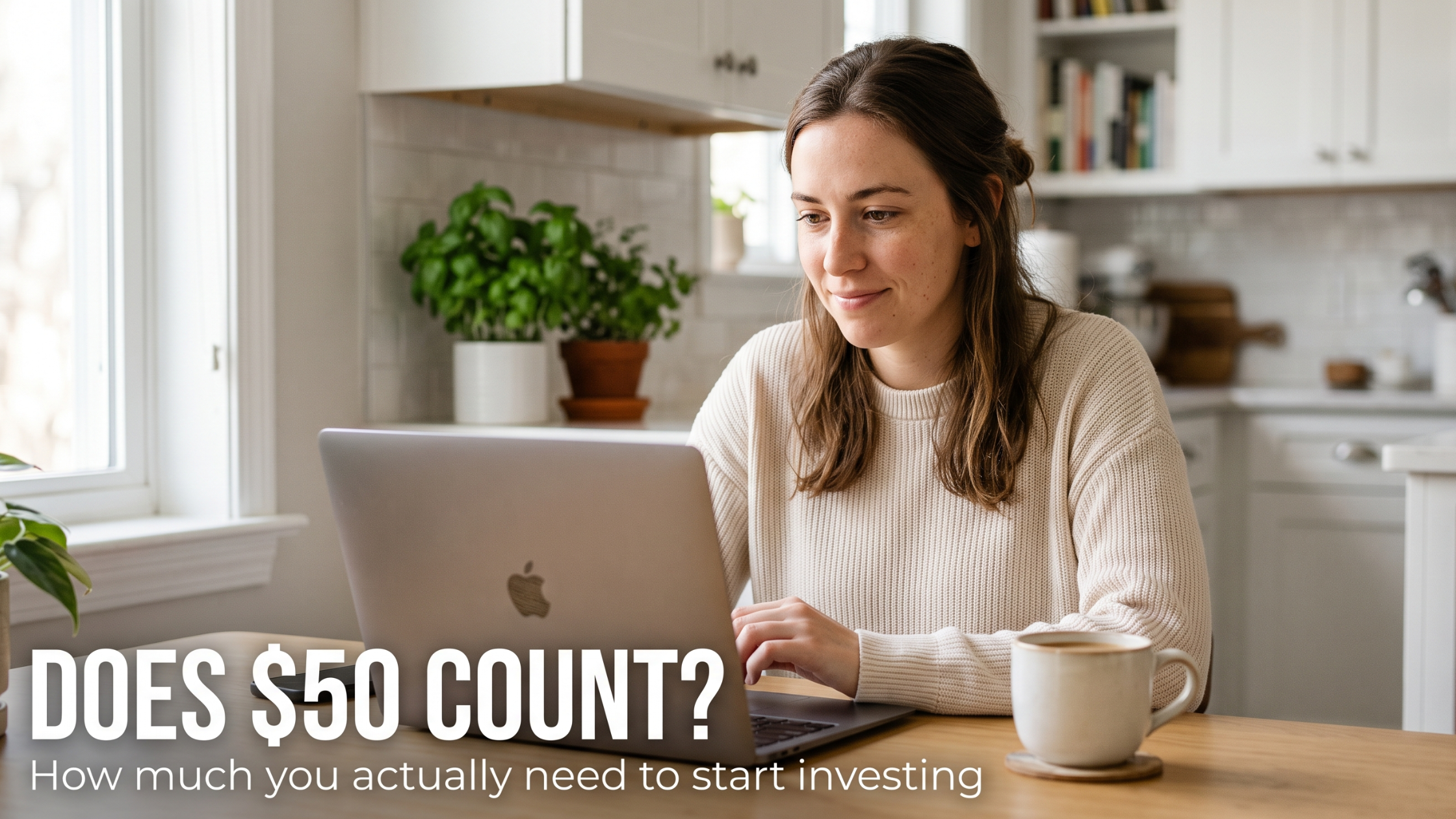
How much money do I need to start investing is the question that keeps more people out of the market than almost anything else. Not fear. Not confusion. Just the belief that they don’t have enough yet.
The short answer is less than you think. The useful answer depends on what you actually have and what to do with it.
This guide gives you a real decision for every starting amount, from $50 to $5,000. No vague advice. No “just start with whatever you have.” Specific numbers, specific moves.
The 3-Question Check Before You Invest Anything
Before putting a single dollar in the market, answer these 3 questions. Skip them and you may end up selling your investments at the worst possible time.
1. Do you have high-interest debt?
Credit cards in the US typically charge 20-28% APR. The stock market has returned around 10% annually on average over the long term. If you’re carrying a credit card balance, paying it off first is mathematically a better “investment” than buying stocks. Pay the debt first.
2. Do you have an emergency fund?
If you invest $1,000 and then your car breaks down, you’ll be forced to sell those investments possibly at a loss. A basic emergency fund of $1,000 to $3,000 keeps your investments intact when life goes sideways. Build this before you invest anything meaningful.
3. Is this money you won’t need for at least 3 years?
The stock market drops regularly. Sometimes 20%, sometimes 40%. If you need this money in 18 months for a house down payment or tuition, it doesn’t belong in stocks. Investing works for money you can leave alone long enough for it to recover and grow.
If you answered yes to all 3 you have no high-interest debt, some emergency savings, and a timeline of 3+ years you’re ready to start. Now let’s look at what to do based on how much you have.
If You Have $50 to $200: Start the Habit, Not the Portfolio
At this amount, the math won’t change your life yet. But the habit will.
The biggest mistake beginners make is waiting until they have “enough” to invest. That wait typically lasts years. People who start with $50 and invest consistently build a completely different relationship with money than people who wait for $5,000 and never quite get there.
What to do with $50-$200:
Open a brokerage account with no minimum balance. Fidelity, Charles Schwab, and Robinhood all allow you to open an account with $0 and buy investments immediately. No minimum required.
Buy 1 share (or a fractional share) of a broad US market index fund. The Fidelity ZERO Total Market Index Fund (FZROX) has no minimum and a 0% expense ratio. Vanguard’s VTI ETF can be bought in fractional shares on most platforms from as little as $1.
Set up an automatic recurring contribution. Even $25 every 2 weeks. Automation is the whole game at this stage. It removes the decision from your hands and turns investing into a bill that pays you instead of someone else.
What not to do with $50-$200:
Don’t buy individual stocks. At this amount, one bad trade wipes you out entirely. An index fund owns 500+ companies. A single stock owns one.
Don’t use a robo-advisor with fees at this level. A 0.25% annual fee on $100 is $0.25. Technically fine, but the added complexity isn’t worth it yet.
If You Have $500 to $1,000: Your First Real Portfolio
$500 is the amount where you’re investing actually starts to matter not as a life-changing sum, but as a foundation you can build on.
What to do with $500-$1,000:
Open a Roth IRA if you’re a US-based investor with earned income. This is the single best account for most people starting out. Contributions are made with after-tax money, but all growth and withdrawals in retirement are completely tax-free. The 2026 contribution limit is $7,000.
Put your money into 2 funds:
- 80% in a US total market index fund (VTI or FSKAX)
- 20% in an international index fund (VXUS or FZILX)
That’s it. That’s a real, diversified portfolio that professional fund managers charge thousands to build for clients.
The compound interest reality check:
$500 invested at age 25, growing at 8% annually with no additional contributions, becomes around $10,800 by age 65. That same $500 invested at 35 becomes around $5,000. Starting 10 years earlier more than doubled the outcome without putting in a single extra dollar.
The point isn’t that $500 alone will retire you. It’s that the clock matters more than the amount at this stage.
Set a monthly contribution goal:
At $500-$1,000 in your account, the most powerful thing you can add is consistency. Even $50/month grows to over $30,000 in 20 years at 8% average returns. That’s with just $50 a month and a starting balance of $500.
If You Have $1,000 to $3,000: Build the Foundation Properly
At this level, you have enough to do things right from the start the right accounts, the right structure, and a system that runs itself.
Step 1: Split it correctly.
If you don’t have a $1,000 emergency fund yet, hold $1,000 back in a high-yield savings account (HYSA). Online banks like Marcus by Goldman Sachs, Ally, or Marcus currently offer 4-5% APY on savings. That’s your cushion. The rest goes into investments.
Step 2: Maximize tax-advantaged accounts first.
Order of priority for US investors:
- 401(k) up to your employer match (this is free money always take it)
- Roth IRA up to the $7,000 annual limit
- Taxable brokerage account for anything beyond that
If you’re in the UK, the equivalent is:
- Workplace pension up to your employer match
- Stocks and Shares ISA up to the £20,000 annual limit
- General investment account for anything beyond
Step 3: Keep the portfolio simple.
At $1,000-$3,000, you don’t need more than 2-3 funds. Complexity doesn’t improve returns. It usually hurts them.
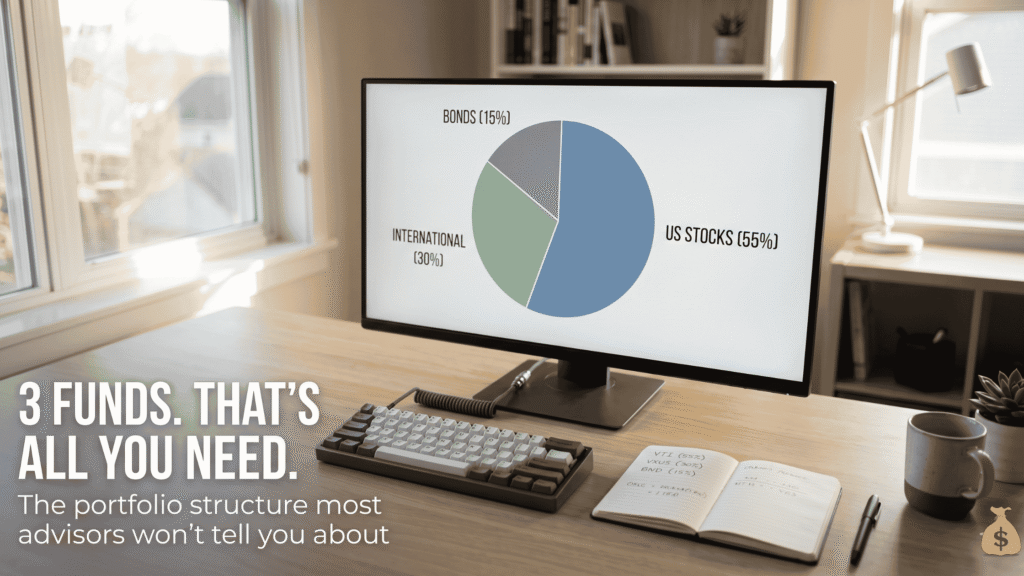
A simple 3-fund portfolio:
- US total market index (60%)
- International index (30%)
- Bond index (10%) optional if you’re under 40 with a long timeline
Rebalance once a year. That means once a year, check if your percentages have drifted and adjust. Takes 15 minutes. That’s your entire portfolio management obligation.
If You Have $3,000 to $5,000: Now You Have Options
At $3,000+, you have enough starting capital to diversify across account types, think about sector exposure, and if you want to start practicing individual stock picking alongside your core index fund portfolio.
The core stays the same:
70-80% of this money should still go into low-cost index funds inside a Roth IRA or 401(k). This is your foundation. Don’t touch it for decades.
The 10-20% experiment fund:
If you want to learn to pick individual stocks, allocate 10-20% of your portfolio for that purpose. This teaches you how markets work at the cost of a manageable amount of capital if you’re wrong. You’ll learn faster from real money than any book or course.
Rules for the experiment fund:
- Never put more than 5% of your total portfolio in a single stock
- Set a stop-loss before you buy know exactly at what price you’ll sell if you’re wrong
- Track every trade in a spreadsheet. Review quarterly.
Most people who do this for 12 months discover that their index fund outperforms their stock-picking. That’s a valuable, relatively cheap lesson.
$5,000+ opens one more door: tax-loss harvesting.
If a stock you bought drops 15%, you can sell it, take the loss on your taxes, and immediately buy a similar (not identical) fund or stock. That tax loss offsets your capital gains elsewhere. It’s a legitimate strategy, but only relevant once you have taxable gains to offset. Worth understanding by the time your portfolio reaches $5,000+.
What the “Right Amount” Actually Looks Like Over Time
Here’s a real compound growth table using 8% average annual returns roughly the historical inflation-adjusted return of the US stock market:
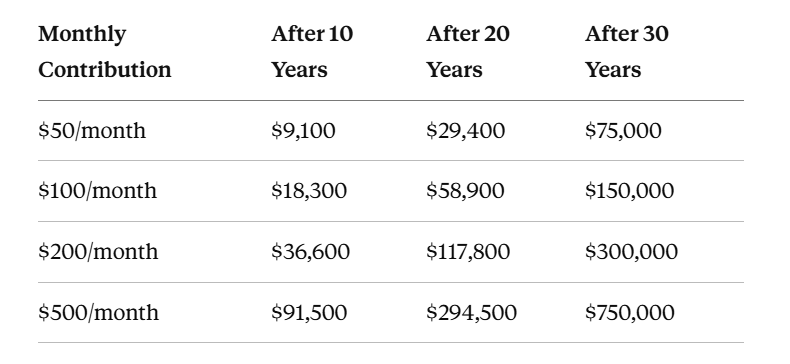
Two things jump out of this table.
First, $50/month for 30 years produces $75,000 from $18,000 in total contributions. The market did the rest. That’s compound interest working exactly as advertised.
Second, the jump from 20 years to 30 years is enormous. $100/month goes from $58,900 to $150,000 in that last decade. Time is the most powerful variable in this entire equation more than the amount you start with, more than the fund you pick.
The One Mistake That Cancels Everything
You can get every other decision right the account type, the fund selection, the contribution amount and still lose money if you do this one thing:
Sell when the market drops.
The S&P 500 drops 10% or more about once every 16 months on average. It drops 20% or more roughly once every 3-4 years. Every single time it has ever done this, it has eventually recovered and gone higher.
The investors who get rich are the ones who keep buying during the drops, not the ones who sell and wait for it to “stabilize.” Buying during a 20% correction means you’re buying at a 20% discount. Every share you buy at that price compounds from a lower starting point.
The investors who lose money are the ones who panic-sell at the bottom, sit in cash, wait for confidence to return, and buy back in when prices are already high again. They turned a temporary paper loss into a permanent real one.
If you sell when the market drops, the amount you started with doesn’t matter.
Frequently Asked Questions
Can I really start investing with $1?
Technically yes, through fractional shares on platforms like Robinhood or Fidelity. Practically, $1 won’t build a portfolio it’ll build a habit. The habit is worth building but set a goal to reach at least $50-$100/month in contributions as soon as your budget allows.
How much should a 25-year-old invest per month?
A commonly used guideline is 15% of your gross income toward retirement, including any employer match. So, if you earn $4,000/month, that’s $600 going toward retirement accounts. If that’s too much right now, start with whatever you can even $50/month and increase it by 1% each year, or every time you get a raise.
Is $1,000 enough to start investing in stocks?
Yes. $1,000 is a solid starting point, especially inside a Roth IRA where it grows tax-free. Put it in a broad market index fund, set up a monthly automatic contribution, and leave it alone. Don’t try to pick individual stocks with $1,000 a single bad trade can wipe out 30-50% of your account.
What if I can only invest $20 a month right now?
Start anyway. $20/month invested for 30 years at 8% average returns becomes around $30,000. More importantly, the habit you build at $20/month transfers directly to $200/month when your income grows. The people who start late usually didn’t have less money in their 20s they just hadn’t built the habit.
How much money do I need before I stop investing in index funds and start picking stocks?
There’s no rule that says you have to stop. Most professional investors including Warren Buffett recommend that most people stick with index funds permanently. If you want to pick individual stocks, treat it as a separate bucket of 10-20% of your portfolio, not a replacement for your core index fund holdings. Most people who switch entirely to stock picking underperform the index within 3 years.
How long until I see real returns on my investment?
Day one. If you buy a fund today and the market rises 1% tomorrow, you’ve made money. But “real” as in meaningful? Think in 5-10 year blocks, not months. The investors who obsessively track monthly performance make worse decisions and earn lower returns than those who check quarterly and let the compounding work.
2 thoughts on “How Much Money Do I Need to Start Investing? (Honest Answers for Every Budget)”