
You pull up a stock chart for the first time, and it looks like static. Red and green bars, jagged lines, numbers running up the side. Everyone around you seems to glance at it and instantly know what’s happening. You stare at the same picture and see noise. You should know how to read a stock chart.
Here’s what nobody tells you upfront: most beginners read charts in the wrong order. They jump straight to candlestick patterns and indicators before they’ve even figured out what timeframe they’re looking at or which direction the stock has been moving. That’s like trying to read the ending of a book before you know who the characters are.
This guide flips that. We’re going in the order a chart actually needs to be read: zoom out first, establish the baseline, then look for the details. By the end, you’ll be able to open any stock chart and know exactly where to look first.
What a stock chart actually shows you
A stock chart is a visual record of price over time. Nothing more mystical than that. Time runs left to right along the bottom. Price runs bottom to top on the side. Every point on that chart represents a trade that actually happened, at a price two people agreed on.
That’s worth sitting with for a second. A chart isn’t a prediction. It’s history. Every squiggle is a record of what buyers and sellers already decided. Reading a chart well means reading that history accurately, not guessing at the future from it.
Most charting platforms (Yahoo Finance, TradingView, your brokerage app) show you the same three building blocks: price, volume, and a timeframe selector. We’ll go through each one in the order you should actually look at them.
Step 1: Set your timeframe before you look at anything else
This is the step almost every beginner skips, and it’s the one that causes the most confusion. The exact same stock can look like it’s crashing on a 5-minute chart and look perfectly healthy on a weekly chart. Neither view is wrong. They’re just answering different questions.
A daily chart shows one candle per trading day and works well if you’re a swing trader or a long-term investor checking in periodically. A weekly chart compresses five days into one candle and is better for spotting the bigger trend without getting distracted by daily noise. An hourly or 5-minute chart is for day traders who need to see what’s happening right now.
If you’re investing for the long term, start on a weekly or monthly chart. If you’re a beginner trying to learn the mechanics, daily candles are the standard starting point most material is written for.
Step 2: Pick a chart type (and understand what it’s hiding)
There are three common chart types, and each one trades detail for clarity in a different way.
Line charts connect closing prices with a single line. They’re the cleanest view and the best for spotting a long-term trend at a glance. The tradeoff: you lose all information about what happened within each day. A wild 8% swing that closed flat shows up as a boring flat line.
Bar charts (also called OHLC charts) show open, high, low, and close for each period using small tick marks. More detail than a line chart, but visually busier and slower to read at a glance.
Candlestick charts show the same OHLC data as bar charts, but with a colored body that makes bullish and bearish periods instantly visible. This is the standard for most traders today, and it’s what we’ll use for the rest of this guide.
Here’s exactly what each part of a candle represents:
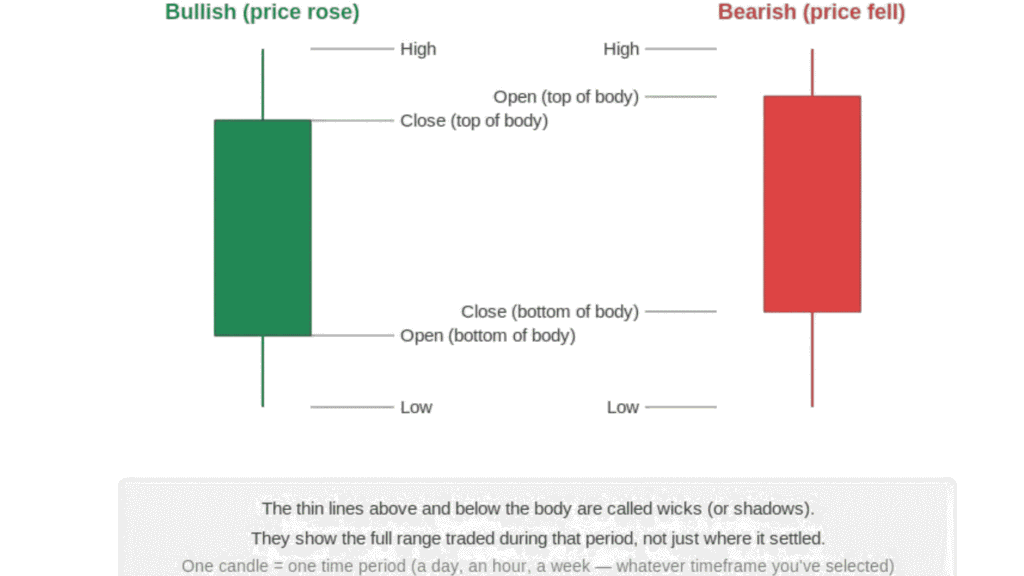
candlestick anatomy diagram
The body is the range between open and close. The thin lines extending above and below, called wicks or shadows, show the full high and low for that period. A long wick with a small body tells you price moved a lot during the period but mostly reversed back. That detail alone is something a line chart would have hidden completely.
Step 3: Read the trend before you read anything else on the chart
Trend is the single most important thing on any chart, and it’s also the thing beginners look at last (if at all) because patterns and indicators feel more exciting. Get this step wrong and everything you do afterward is built on a bad foundation.
An uptrend is a series of higher highs and higher lows. Each peak is higher than the last peak, and each pullback finds a floor higher than the previous floor. A downtrend is the mirror image: lower highs and lower lows. If price is bouncing in a range without making clear progress in either direction, that’s a sideways or ranging market, and a different set of rules applies.
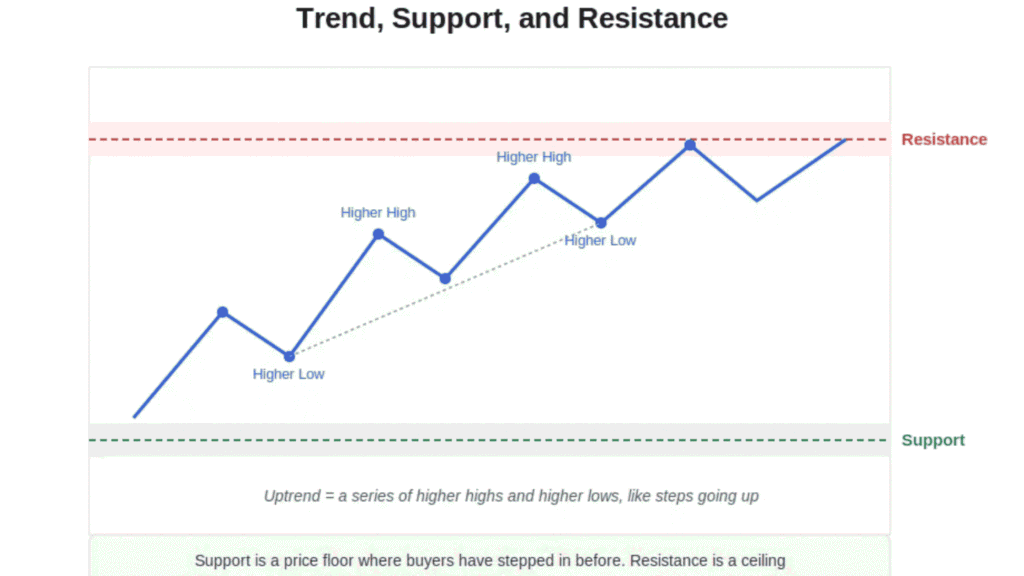
support resistance diagram Notice the dotted line connecting the higher lows in the diagram above. That’s a basic trendline, and it’s one of the simplest tools you have. As long as price keeps respecting that rising line on pullbacks, the uptrend is considered intact. A decisive break below it is often the first warning sign that the trend is losing strength.
Why does this matter so much? Because the same candlestick pattern means something different depending on the trend it shows up in. A bullish reversal candle after a 2-week downtrend is meaningful. The same candle in the middle of a sideways chop is mostly noise.
Step 4: Find support and resistance
Once you know the trend, the next layer is identifying the price levels where that trend has previously paused or reversed.
Support is a price floor. It’s a level where the stock has fallen to before and then bounced, meaning buyers stepped in and took control from sellers at that price. Resistance works the opposite way: a price ceiling where the stock has risen to and then turned back down, meaning sellers took over from buyers.
These levels aren’t exact lines so much as zones. Price often pokes slightly above or below a support or resistance level before reacting, so think of them as a band rather than a single price point. Looking back at the diagram, that’s why we drew them as shaded zones instead of hairline rules.
What makes support and resistance useful is what happens when they break. A stock that finally pushes through resistance on strong volume is showing you something different than a stock that creeps 1% above resistance on a quiet afternoon and slips back. Context, again, decides what the level actually means.
Step 5: Read volume alongside price, never in isolation
Volume tells you how many shares actually changed hands during a given period. On its own it’s just a number. Paired with price, it tells you how much conviction is behind a move.
A stock breaking out to a new high on volume well above its recent average suggests real buying interest is driving the move. The same breakout on weak, below-average volume suggests the move might lack the participation to hold, and it’s a common reason breakouts fail and reverse shortly after.
Here’s a real example. SMCI (Super Micro Computer) spent the first half of June 2026 sliding from the low $40s down toward the high $30s on unremarkable, fairly steady volume, normal behavior for a stock drifting lower without a specific trigger. Then the stock gapped down sharply on a day with volume roughly 4 times its prior average, coinciding with news of a $7 billion equity financing plan tied to the company’s AI server backlog. That volume spike is what separated an ordinary down day from a structurally important one.
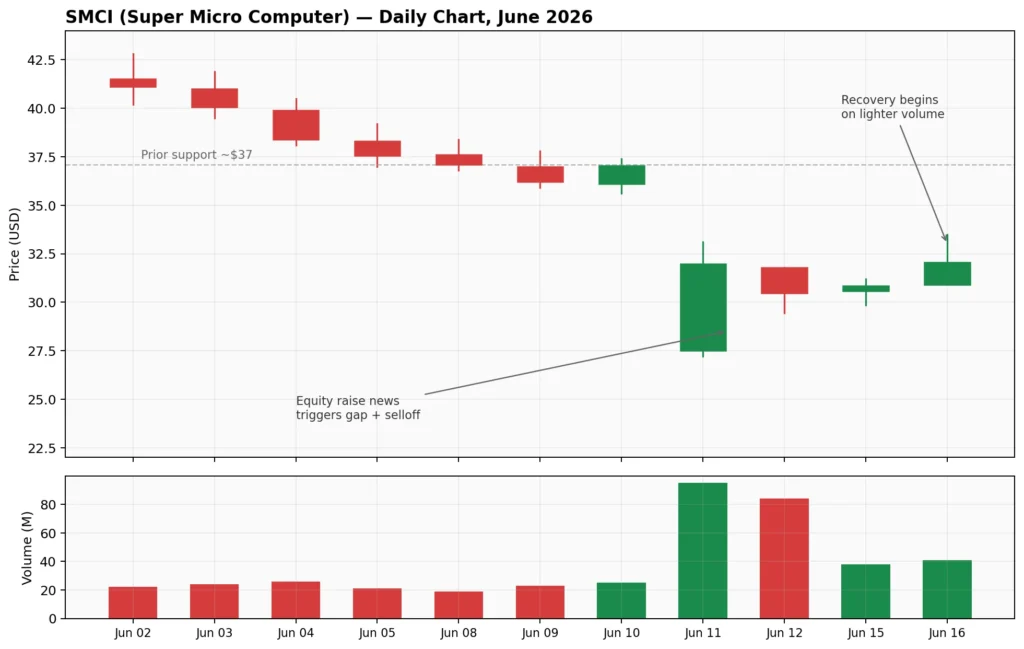
Look at the volume bars beneath the price candles. The two heaviest-volume days line up exactly with the breakdown and the news that caused it, and you can see volume cool off noticeably as the stock began stabilizing in the days after. That’s the kind of detail you’d completely miss if you only looked at the price line and ignored the bars underneath it.
Step 6: Add at most one or two indicators (and know why you’re adding them)
Once you’re comfortable reading trend, support, resistance, and volume, indicators can add useful confirmation. The mistake is loading up six or seven of them at once, which usually creates contradictory signals and analysis paralysis rather than clarity.
A simple moving average (the 50-day or 200-day are common defaults) smooths out price into a single line and helps confirm the trend you already identified visually. If price is consistently trading above its 50-day moving average, that supports the case for an uptrend. If it’s below, that supports a downtrend.
Relative Strength Index (RSI) measures whether a stock has moved unusually far in a short time, which some traders use to gauge whether a move is stretched and due for a pause. It’s a secondary confirmation tool, not a standalone signal.
Start with zero indicators while you’re learning to read raw price and volume. Add one at a time, and only once you understand exactly what it’s measuring and why.
Putting it all together: the order that actually works
To recap the sequence, because the order is the entire point of this guide:
- Pick your timeframe based on your goal (daily for most beginners)
- Choose candlesticks as your chart type
- Identify the trend: higher highs and higher lows, or the reverse
- Mark the nearest support and resistance zones
- Check volume on any move that looks significant
- Layer in one or two indicators only after the above feels intuitive
Most guides teach these as a flat list, like ingredients in a recipe with no particular order. They’re not equally weighted, and they’re not interchangeable. Trend and volume context change what a candlestick pattern or indicator signal actually means. Skip the order and you’re pattern-matching on autopilot, which is exactly how beginners end up overconfident in signals that don’t actually mean what they think.
actually mean what they think.
Common mistakes beginners make even after learning the basics
Knowing the pieces and applying them well are different skills, and a few mistakes show up constantly even among people who technically understand every concept above.
Looking at only one timeframe is the most common one. A stock can look bullish on a daily chart and bearish on a weekly chart at the same time, and both views are simultaneously true. Always check at least one timeframe above and below the one you’re trading on.
Ignoring the left side of the chart is another. If a stock failed at a price level three times over the past year, that level still matters even if you only pulled up the last month of data. Scroll back further before assuming a level is fresh.
Treating a pattern as a certainty rather than a probability causes a lot of damage. Patterns describe what has tended to happen historically under similar conditions, not what will definitely happen this time. Even well-formed setups fail regularly, which is exactly why risk management (deciding your exit before you enter) matters more than the pattern itself.
FAQ
What’s the best chart type for beginners? Candlesticks. They show the same data as bar charts but make bullish and bearish periods visually obvious at a glance, which speeds up the learning process significantly.
What timeframe should I start with? Daily charts are the standard starting point for most beginner material and work well for swing trading or general investing. Move to weekly charts if you’re investing for the long term and don’t need day-to-day detail.
Do I need indicators to read a chart? No. Price, volume, trend, and support/resistance are the core of chart reading. Indicators are optional confirmation tools layered on top, not a replacement for understanding the raw price action.
Why does the same chart look different on different timeframes? Because each timeframe compresses a different amount of trading activity into a single candle. A short-term pullback on a daily chart can be invisible on a weekly chart, and a multi-week downtrend can be hard to spot if you’re only looking at 5-minute candles.
Can chart reading predict where a stock is going next? Not with certainty. Charts show probabilities based on how price has behaved historically under similar conditions, not guarantees. Pair chart reading with proper risk management rather than treating it as a forecasting tool.
What’s the difference between support and a trendline? Support is typically a horizontal price zone the stock has bounced from multiple times. A trendline is diagonal and connects a series of rising or falling lows (or highs), tracking a trend in progress rather than a fixed price level.
Where to go from here
Reading a chart is a mechanical skill before it’s anything else. Practice on charts you have no money riding on. Pull up five stocks you’ve never looked at, identify the trend, mark support and resistance, and check whether volume confirms the recent move. Do that daily for a couple of weeks and the chart stops looking like static. It starts looking like a record you can actually follow.