
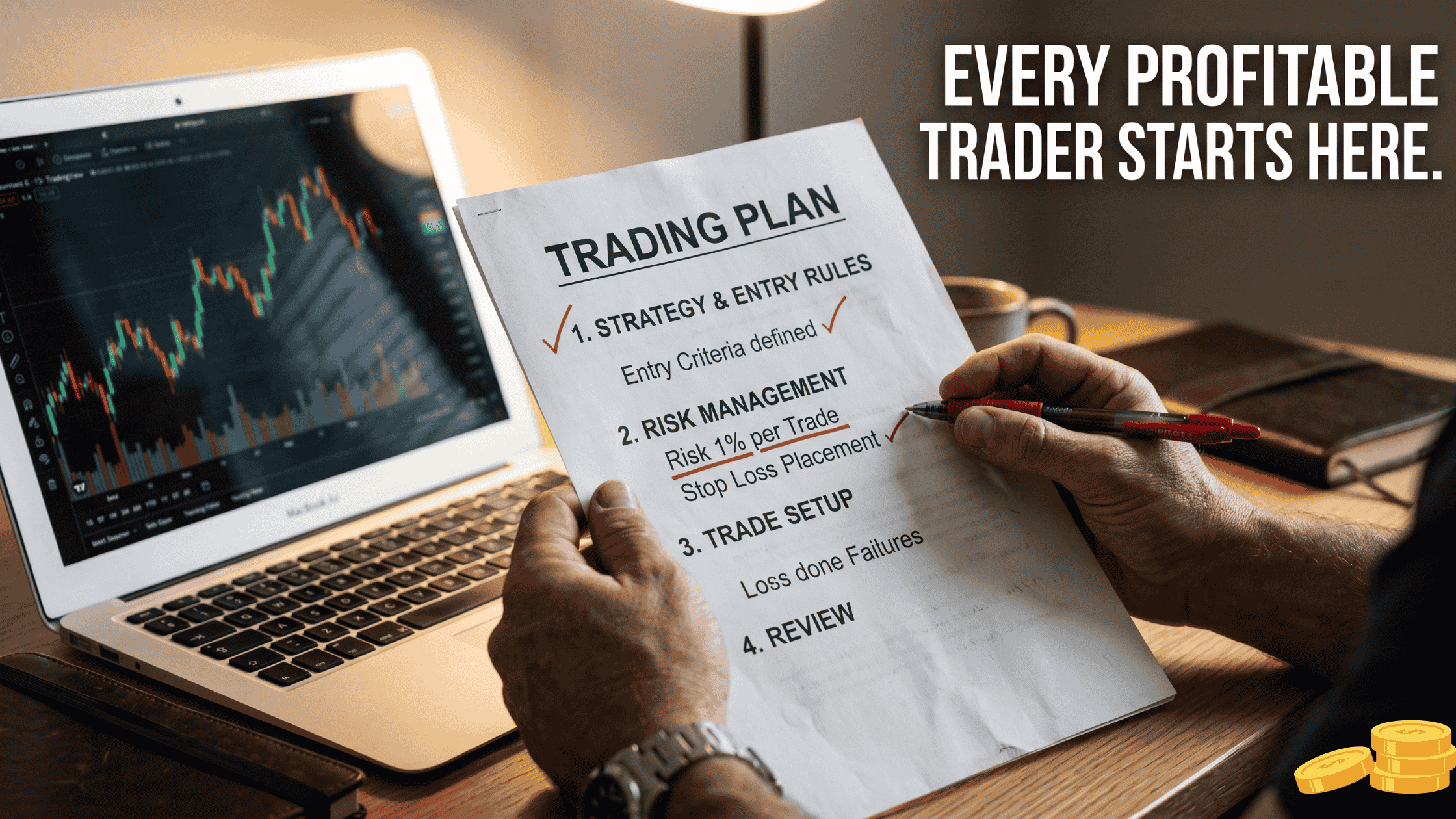
Most new traders skip the one thing that separates consistent traders from blown accounts.
They jump straight to charts, indicators, and strategies. They open a brokerage account before they’ve asked themselves a single serious question about what they’re trying to accomplish. And then they’re surprised when six months later they’ve lost money they couldn’t afford to lose, trading in a style that never matched their personality or schedule.
The missing piece is a trading plan. And learning how to build a trading plan for beginners is exactly what this guide covers not the theory of it, but the actual construction, step by step.
How to Build a Trading Plan for Beginners: What It Actually Is
A trading plan is not a list of indicators. It’s not a strategy you found on YouTube.
It’s a complete, written document that defines everything about your trading: what markets you’ll trade, how much risk you’ll take, what conditions trigger a buy or sell, and how you’ll measure whether you’re on track or off it. Investopedia’s overview of trading plans describes this same idea a plan removes guesswork by defining your rules before you need them, not in the middle of a trade.
Think of it as a business plan but for your trading account.
The biggest value of a trading plan isn’t that it makes you profitable overnight. It’s that it tells you, with clarity, whether a bad stretch of results comes from a flawed system or from you not following the system. Without a plan, you can’t know the difference. With one, the answer is always one of two things: either the plan needs fixing, or you need to follow it better.
That’s it. Every performance problem in trading traces back to one of those two causes.
Why 90% of Beginners Don’t Have One (And Pay for It)
Ask ten beginner traders if they have a written trading plan. Maybe two will say yes.
The reason the other eight don’t is a combination of impatience and misplaced confidence. Trading feels intuitive you look at a chart, you sense direction, you click buy. Formalizing that into a documented plan feels unnecessary.
But here’s what actually happens without one.
You trade too large when you’re feeling confident. You exit early when you’re feeling scared. You switch strategies after three losing trades. You move from stocks to forex to crypto depending on what’s trending on social media. Each time, you’re not executing a plan you’re reacting to your emotions.
Emotions are the single biggest reason beginner traders underperform. A trading plan doesn’t eliminate emotion. It creates a framework that makes emotion largely irrelevant. You’ve already decided what to do. The plan says so.
Related reading: Trading Psychology: Why Discipline Matters More Than Strategy
Step 1: Define Your Why and Set Clear Trading Objectives
Before you touch a chart or open a demo account, answer this question honestly: why do you want to trade?
That’s not a philosophical question. It’s a practical one with direct consequences for how you should set up your plan.
Someone trading for retirement income needs a completely different approach than someone trading for supplemental monthly cash flow. Someone drawn to trading because it’s intellectually stimulating will operate differently than someone who needs consistent, predictable returns.
Your motivation shapes everything: the markets you trade, the time frame you operate in, the risk you take on, and the expectations you set.
Write these down in your trading journal:
- What is your primary goal for trading? (Monthly income, capital growth, retirement savings, skill development?)
- What return do you realistically expect? Be specific “make money” is not a goal. “$500 per month” or “12% annually” is a goal.
- How would you feel if your account dropped 20%? Could you hold steady, or would you abandon your system?
- Are you trading for excitement, or for consistent results? (These two objectives often conflict.)
The answers here aren’t just self-reflection they directly determine what kind of trading system makes sense for you. A trader wanting steady 10% annual growth with minimal drawdowns needs a completely different approach than one chasing 100%+ returns and willing to accept the volatility that comes with it.
Step 2: Do a Brutal Financial Assessment
Trading should only ever be done with risk capital money that, if lost entirely, would not affect your quality of life, your ability to pay bills, or your financial security. Investopedia’s overview of trading plans describes this same idea a plan removes guesswork by defining your rules before you need them, not in the middle of a trade.
The SEC’s investor education guidance on day trading risks makes this point directly: never trade with money you need for living expenses, retirement, or other essential goals. This is a non-negotiable rule, not a preference.
A trader playing with money they need to live on operates under a kind of pressure that almost always leads to poor decisions. Every loss feels urgent. Every drawdown trigger panic. The psychological burden of trading money you can’t afford to lose will undermine even the best trading plan.
Ask yourself two separate questions:
- How much money could I lose completely without it affecting my financial wellbeing?
- How much of that am I willing to lose?
These are different questions. Someone might have $20,000 in available risk capital but only be emotionally comfortable losing $8,000 of it. The second number the lower one is the one that governs your plan.
Also consider account size in practical terms. A very small account (under $1,000) gets disproportionately eaten by transaction costs. A $5 commission on a $200 trade is 2.5% before the market has moved at all. Minimum account sizes also matter in futures and some other markets. Know your numbers before committing capital.
Related reading: How Much Money Do You Need to Start Trading?

Step 3: Assess How Much Time You Can Actually Commit
Here’s a common beginner mistake: choosing a trading style that doesn’t match their schedule.
Day trading sounds appealing. Fast decisions, quick results, active engagement. But day trading realistically requires 4 to 8 hours of uninterrupted, focused time during market hours. Not 4 hours where you’re also taking calls and checking email actually uninterrupted.
If you have a full-time job, that’s probably not your trading style.
Match your trading time frame to your actual life:
| Trading Style | Time Required | Holding Period |
|---|---|---|
| Scalping | 4–8 hours/day, fully focused | Minutes |
| Day Trading | 4–8 hours/day, market hours | Hours (no overnight) |
| Swing Trading | 1–2 hours/day, flexible timing | 2–5 days |
| Position Trading | 30 min/week | Weeks to months |
| Long-Term Investing |
The shorter the time frame, the more uninterrupted attention it demands and the harder it is to execute properly with competing obligations.
Swing trading and position trading are generally the most realistic choices for beginners with full-time jobs. You can do market analysis in the evenings, place orders for the next day, and manage positions without needing to watch a screen all day.
Also factor in quality of time. Six hours of distracted time during which you’re fielding phone calls is not the same as two hours of genuine focused analysis. A plan built around time you don’t actually have will fail from day one.
Step 4: Set Your Return Expectations Honestly
Every trader wants maximum returns with minimum risk. The market doesn’t offer that combination.
Return expectations and risk tolerance are directly linked. A trading system designed to produce 8–12% annual returns with small, manageable drawdowns looks completely different from a system targeting 50%+ annual returns. The second system will have larger drawdowns, more volatility, and require more frequent trading.
Understanding drawdown is critical here.
A drawdown is the percentage decline from an account’s peak to its subsequent lowest point before recovering. If your account grows from $10,000 to $15,000 and then falls to $11,000 before recovering, that’s a $4,000 or 27% drawdown from peak.
Here’s why drawdowns matter more than most beginners realize:
| Portfolio Loss | Gain Required to Break Even |
|---|---|
| 10% | 11% |
| 20% | 25% |
| 30% | 43% |
| 40% | 67% |
| 50% | 100% |
| 75% | 300% |
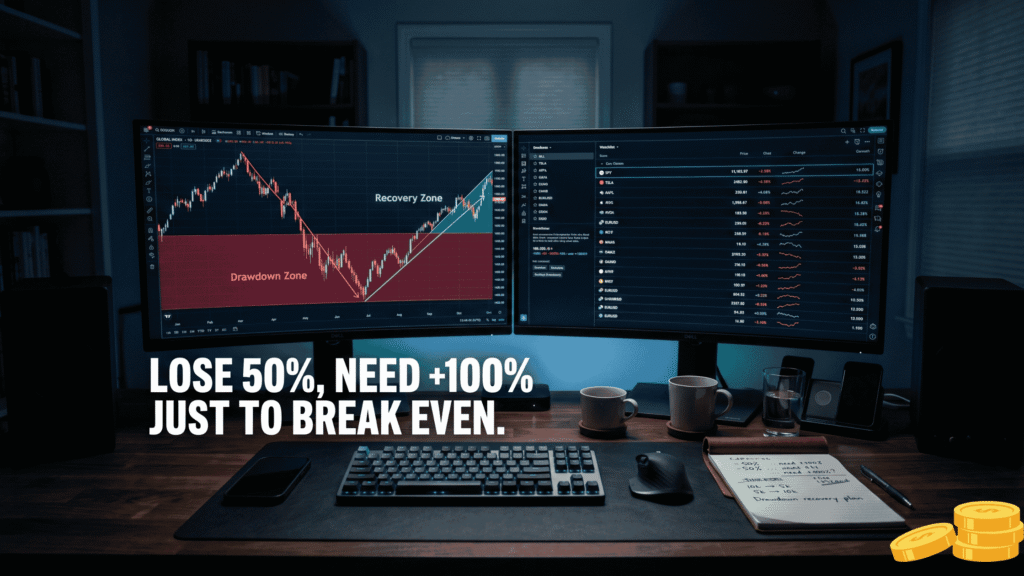
A 50% drawdown doesn’t require a 50% recovery to break even. It requires 100%. This is why controlling losses isn’t just conservative advice it’s mathematically essential.
Set an expectation for maximum drawdown you can tolerate psychologically, not just mathematically. A trader who abandons their system after a 25% drawdown should not build a system designed to have 40% drawdowns, even if the expected long-term returns are attractive.
Step 5: Choose Your Market and Instrument
Once you know your time, capital, and return expectations, you can make a rational choice about what to actually trade.
The main markets available to individual traders:
- Equities (stocks) US exchanges open 9:30 AM to 4:00 PM ET. Best for corporate earnings-driven trades and longer time frames.
- Indices Trade broad market moves via ETFs (like SPY, QQQ) or index futures. Good for medium-term trend trading.
- Forex True 24-hour market. Best overall volume during the New York/London overlap (roughly 8 AM to 12 PM ET). Extremely liquid, with tight spreads on major pairs.
- Futures Exchange-based contracts for indices, commodities, and currencies. Require higher minimum capital but offer strong leverage. CME Group’s Futures Fundamentals resource is a solid starting point for understanding contract specifications and margin requirements before trading futures.
- Options Advanced instruments that allow for defined-risk strategies. Not recommended for beginners until core trading fundamentals are solid.
- Commodities Gold, oil, agricultural products. Often trade via futures or CFDs.
For beginners, the general guidance is:
Start with one market. Master it. Add others later.
Forex is often recommended for beginners learning the mechanics of trading because it’s a 24-hour market (allowing practice at any time), spreads on major pairs are tight, and demo accounts with realistic conditions are widely available. Stocks and index ETFs are also strong starting points if your interest is in equities and your schedule fits US market hours.
Do not start with options or complex derivatives. The structural complexity adds a layer of learning on top of the already significant challenge of developing a trading system.
Step 6: Build Your Risk Management Rules
This is the section most beginners skip, and it’s the section that determines survival.
Risk management is not just about stop-loss orders. It’s a complete framework for how much of your capital is exposed at any given time, what a single trade can cost you, and at what point you stop trading to reassess.
The core questions your risk management rules must answer:
- What percentage of your total account will you risk on a single trade? Most professional traders risk 1% to 2% per trade. This means a 10-trade losing streak (which happens to every trader) costs 10–20% of your account, not everything.
- What percentage of your account can you lose in a single week or month before you stop trading? Define this in advance. It keeps a bad week from becoming a blown account.
- What maximum drawdown will trigger a full system review? If your account drops 20% peak to trough, that’s a signal to stop trading and analyze what’s wrong not to increase position size to try to make it back.
- Where will your stop-loss be, and how is it determined? Stops should be based on market structure — a logical point where the trade idea is proven wrong not just a round number that feels comfortable.
Position sizing example:
If your account is $10,000 and you risk 2% per trade, your maximum loss per trade is $200. If your stop-loss on a particular trade is 50 pips in EUR/USD, and each pip is worth $1 at standard lot size, you’d trade 4,000 units (4 mini lots) to keep the loss within $200.
This is not optional math. It’s how you stay in the game long enough to get good.
Related reading: Stop-Loss Orders: How to Use Them Without Getting Stopped Out Too Early
Step 7: Define Your Trading System (Entry and Exit Rules)
A trading system is the set of rules that tells you when to buy, when to sell, and when to stay out of the market. It’s the engine inside your trading plan.
It does not have to be complicated. A complete mechanical trading system can be expressed as four statements:
- Go long if/when…
- Exit long if/when…
- Go short if/when…
- Exit short if/when…
Fill in those blanks with specific, testable conditions and you have a working system.
There are three primary approaches to building those rules:
Fundamental Analysis
Focuses on the underlying economic factors driving price interest rates, GDP data, earnings reports, central bank policy. More relevant for longer time frames (weeks to months). A forex swing trader might go long USD/JPY when US interest rate expectations are rising relative to Japan’s, for example.
Technical Analysis
Uses price history, chart patterns, and indicators (moving averages, RSI, support and resistance levels) to identify entry and exit points. Works across all time frames and markets. Most beginner systems start here because the signals are clear and testable.
Quantitative Analysis
Uses mathematical models and statistical testing to identify trading edges. Overlaps with both fundamental and technical approaches. More complex, but increasingly accessible through tools like Excel and Python for retail traders.
For beginners: start with a simple technical system.
A moving average crossover go long when price closes above the 10-period moving average, go short when it closes below is a complete, testable system. It won’t make you rich, but it gives you a clear, rule-based framework to practice executing a plan consistently, which is the actual skill you’re developing at this stage.
Mechanical systems (where rules are defined and followed without discretion) are generally better for beginners than discretionary ones. Discretionary trading requires significant market experience to execute well. Until you have that experience, your “discretion” is mostly your emotions.
Step 8: Keep Two Journals (Most Traders Keep Zero)
There are two journals every trader should maintain, and almost no beginner does.
Journal 1: System Research Log
This is where you record everything related to developing and testing your trading system. Strategy ideas, backtesting results, modifications you made and why, experiments you ran, things you ruled out. This journal becomes invaluable over time — it prevents you from repeating tests you’ve already done, keeps you from forgetting why a specific rule is in place, and creates a record of your thinking as your system evolves.
Journal 2: Trade Log
This is a record of every trade: entry price, exit price, reason for entry, what the market did, whether you followed your plan, and the result. Not just whether you made or lost money whether you followed your rules.
The trade log serves two purposes. First, it shows whether your trading system actually has an edge over time. Second, and more importantly for beginners, it shows whether you’re executing your system properly or deviating from it.
Poor trading systems are less frequently the cause of poor results than the inability to execute them consistently. Most beginner traders who think they have a bad system actually have a decent system they’re not following properly.
A trade log makes that visible.
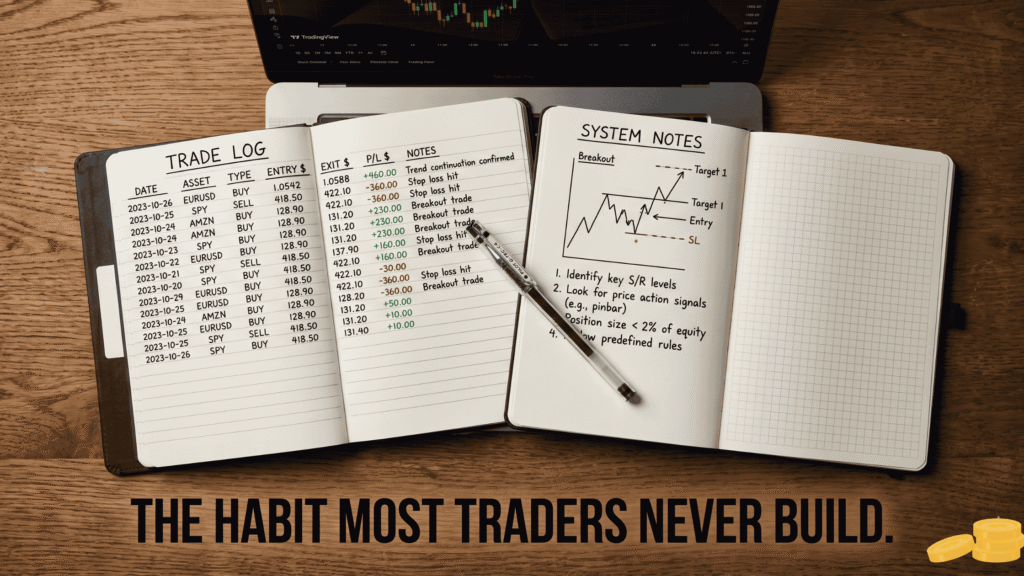
Simple trade log structure:
| Date | Market | Direction | Entry | Exit | Stop | P/L | Plan Followed? | Notes |
|---|---|---|---|---|---|---|---|---|
| 6/11 | EUR/USD | Long | 1.0850 | 1.0920 | 1.0820 | +$70 | Yes | Textbook setup |
| 6/13 | EUR/USD | Short | 1.0930 | 1.0970 | 1.0950 | –$40 | No | Moved stop |
Step 9: Test Your System Before Risking Real Money
Before putting real capital behind any trading system, test it.
Backtesting means applying your rules to historical price data to see how the system would have performed. Most charting platforms, including TradingView, allow you to scroll back through price history and manually test your signals. Some support automated backtesting with code.
Backtesting is not perfect. Markets change, and past performance doesn’t guarantee future results. But a system that has never produced positive results in historical testing has no logical reason to produce them in live trading.
Paper trading (demo accounts) comes after back testing. Most brokers offer free demo accounts with real-time data and virtual money. Trade your system on a demo account for at least 30 to 60 trades before going live. This tests your execution not just whether your rules work in principle, but whether you can actually follow them consistently in real-time conditions.
Be honest with yourself during demo trading. If you find yourself deviating from your rules, the reason is important. Is it because the rules are unclear? Because you don’t trust them? Because you get impatient? These are signals your plan needs refinement before live trading begins.
Related reading: How to Backtest a Trading Strategy Without Special Software
What Your Completed Trading Plan Should Include
When you’ve worked through all the steps above, your written trading plan should cover:
- Trading objectives specific, measurable return targets and time horizon
- Financial parameters total risk capital, maximum loss tolerance (total and per trade)
- Time commitment hours available, time of day, trading style selected
- Markets and instruments exactly what you’ll trade and why
- Risk management rules max risk per trade (%), maximum drawdown before stopping, stop-loss methodology
- Trading system rules specific entry and exit conditions (written as if/then statements)
- Software and tools platform, charting tool, data source, backup plan
- Trading routine when you analyze markets, when you place orders, when you review performance
- Journal structure how you’ll track both system development and individual trades
This is a living document. Review it whenever your life situation changes (more or less time available, change in capital, change in goals) and whenever your system shows signs of structural problems.
FAQ
What is a trading plan and why do beginners need one?
A trading plan is a written document that defines every aspect of your trading what markets you’ll trade, how much you’ll risk, what conditions trigger entry and exit decisions, and how you’ll measure performance. Beginners need one because without it, trading decisions default to emotion, which is the primary cause of poor performance. A plan makes decision-making clear and gives you a framework to diagnose problems: either you’re not following the plan, or the plan needs fixing.
How long does it take to build a trading plan for beginners?
A basic trading plan can be drafted in a few hours using the framework in this guide. Refining it especially developing and testing your trading system takes longer. Expect to spend 2 to 4 weeks on paper trading and system testing before your plan is ready for live capital. Rushing this stage is one of the most common and costly mistakes beginner traders make.
What is the 1% risk rule in trading?
The 1% risk rule means never risking more than 1% of your total trading account on a single trade. On a $10,000 account, that’s a maximum loss of $100 per trade. The rule ensures that a losing streak which happens to every trader doesn’t wipe out an account before the system has a chance to prove itself. Most professional traders use 1% to 2% per trade.
What markets should a beginner start trading?
Most beginners do best starting with either forex (specifically major pairs like EUR/USD or USD/JPY) or US stock ETFs (like SPY or QQQ). Forex’s 24-hour availability makes it convenient for practice at any time, and major pairs have tight spreads. Stock ETFs avoid the complexity of picking individual companies while still tracking overall market direction. Avoid options and complex derivatives until the fundamentals are solid.
What’s the difference between a trading plan and a trading system?
A trading plan is the broader document that governs all aspects of your trading goals, risk rules, markets, time commitment, and performance metrics. A trading system is one component within the plan: specifically, the rules that determine when you buy and sell. You can have a great trading system inside a poorly constructed plan and still fail. The plan is the architecture; the system is one of the components inside it.
How do I know if my trading plan is working?
Track three things: whether your system is generating the expected results over a meaningful sample of trades (at least 30 to 50), whether you’re following the plan consistently (your trade log shows this), and whether your actual drawdowns are within the range you defined in your plan. If results are poor and you’ve been following the plan, the system needs revision. If results are poor and you haven’t been following the plan, the execution needs revision. The plan itself gives you the clarity to tell them apart.
Conclusion
Learning how to build a trading plan for beginners is the highest-leverage thing a new trader can do more valuable than finding the right indicator, the right broker, or the right market.
The plan is the structure that makes everything else work.
Start with the six personal assessments: your why, your financial situation, your available time, your return expectations, your market knowledge, and your skills. Build your risk management rules before you build your trading system. Choose a simple, mechanical system you can actually test and follow consistently. Keep both journals from day one.
Then test it. Demo trade it until the execution feels automatic. Only after that should real capital come into play.
Profitable trading isn’t about finding a magic strategy. It’s about building a framework you can execute with discipline over hundreds of trades. This guide gives you the structure to build that framework.
Expert Tip
The single most overlooked element of a beginner trading plan is the “stop trading” rule the maximum drawdown at which you stop trading and force a system review.
Most beginners don’t define this. So when a bad stretch happens (and it will), they either keep trading and compound the losses, or they abandon the system too early and never give it a fair chance.
Pick a number before you start. Something like: “If my account drops 15% from its starting point or any subsequent peak, I stop trading, review every trade in my log, and do not resume until I’ve identified whether the problem is the system or my execution.”
That one rule has saved more trading accounts than any indicator ever has.
1 thought on “How to Build a Trading Plan for Beginners (Step-by-Step Guide)”