
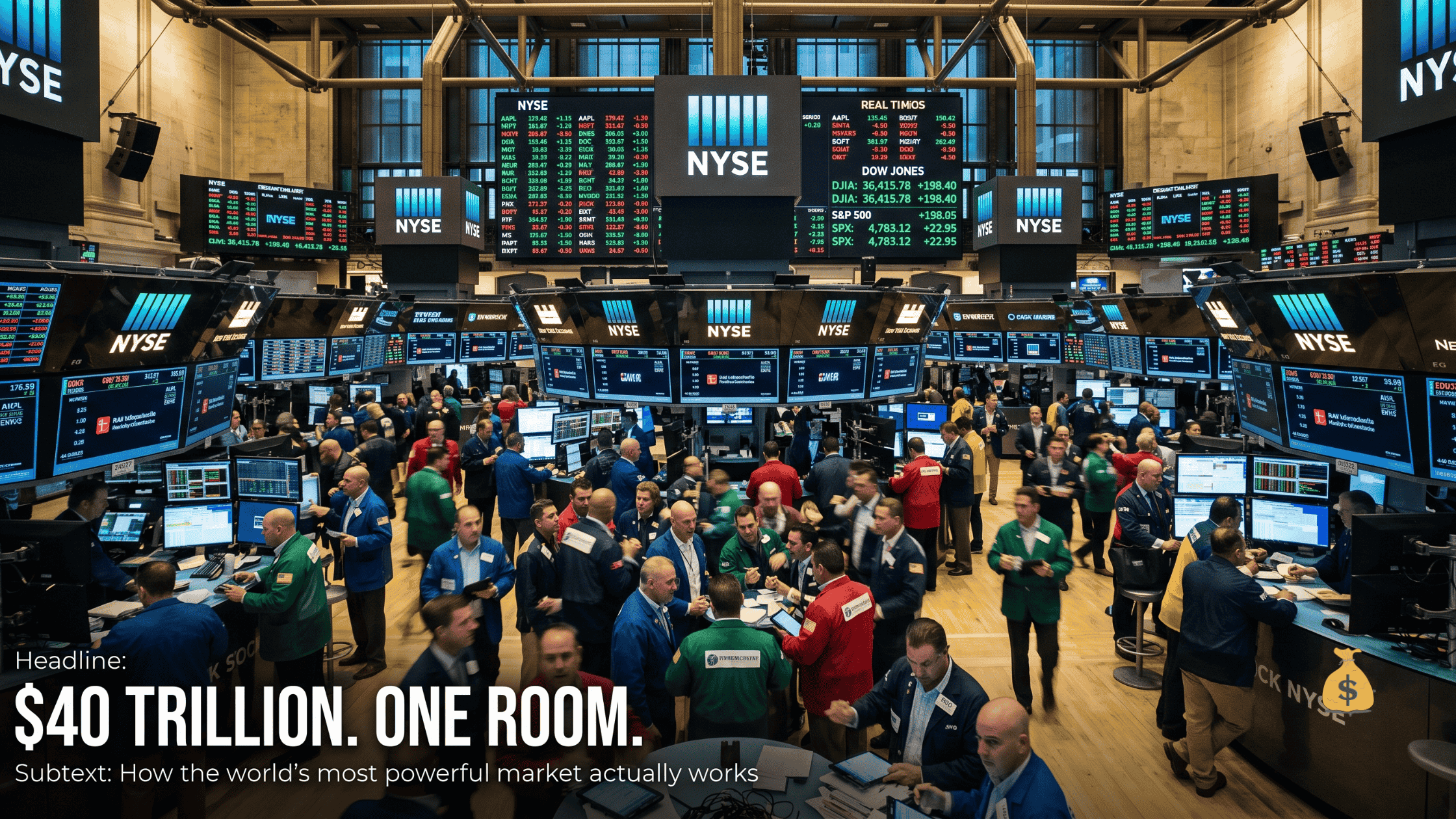
What is the stock market and how does it work is the question that should come before every other investing question. Before index funds, before Roth IRAs, before brokerage accounts.
Most beginner content skips past it. This one doesn’t.
What Is the Stock Market and How Does It Work?
The stock market is a network of exchanges where people buy and sell ownership in companies.
When you buy a share of Apple, you own a tiny fraction of Apple. Not the building. Not Tim Cook’s parking spot. A fraction of the business itself, including a claim on future profits.
The New York Stock Exchange (NYSE) and the Nasdaq are the 2 biggest exchanges in the US. The NYSE lists over 2,400 companies. The Nasdaq lists around 3,300, mostly technology-focused. Between them, they handle trillions of dollars in trades every single day.
The market runs Monday to Friday, 9:30am to 4pm Eastern Time. Pre-market and after-hours trading exists but is thinner and more volatile. Most beginners should stick to regular hours.
How a stock actually works
A company starts private. The founders own it. Maybe some early investors do too.
At some point, the company wants to raise more money to expand. Instead of borrowing from a bank, it sells ownership to the public through an Initial Public Offering (IPO). It issues shares, prices them, and lists them on an exchange.
After that, those shares trade between investors on the secondary market. The company itself doesn’t get a cut of those subsequent trades. When you buy Apple stock today, you’re buying from another investor, not from Apple directly.
The price of a share is just what someone is willing to pay for it right now. Nothing more complicated than that.
Why stock prices move
Supply and demand. More buyers than sellers, price goes up. More sellers than buyers, price falls.
But what drives those buyers and sellers?
Earnings. Every publicly traded company reports its financial results every 3 months. Revenue, profit, outlook. If a company earns more than analysts expected, the stock usually jumps. If it misses, it usually drops. Sometimes violently.
Interest rates. When the Federal Reserve raises interest rates, borrowing gets more expensive, business growth slows, and investors often rotate out of stocks into bonds. Rate cuts tend to do the opposite.
Sentiment. The market is partly rational and partly psychological. During a panic, people sell things they know are fine because everyone else is selling. During a bubble, people buy things they know are overpriced because everyone else is buying. Both behaviors have been documented over and over for 200+ years.
Economic data. Unemployment numbers, inflation reports, GDP growth, consumer confidence. All of it gets priced in almost instantly.
The honest truth is that nobody can reliably predict short-term price movements. The people on TV who try are mostly guessing with confidence.

Bull markets and bear markets
You’ll hear these terms constantly.
A bull market is a period of rising prices, generally defined as a 20% gain from a recent low. The bull market that ran from 2009 to early 2020 was the longest in recorded history, over a decade of mostly rising prices.
A bear market is a decline of 20% or more from a recent high. The COVID crash of February-March 2020 was one of the fastest bear markets ever, dropping 34% in about 5 weeks.
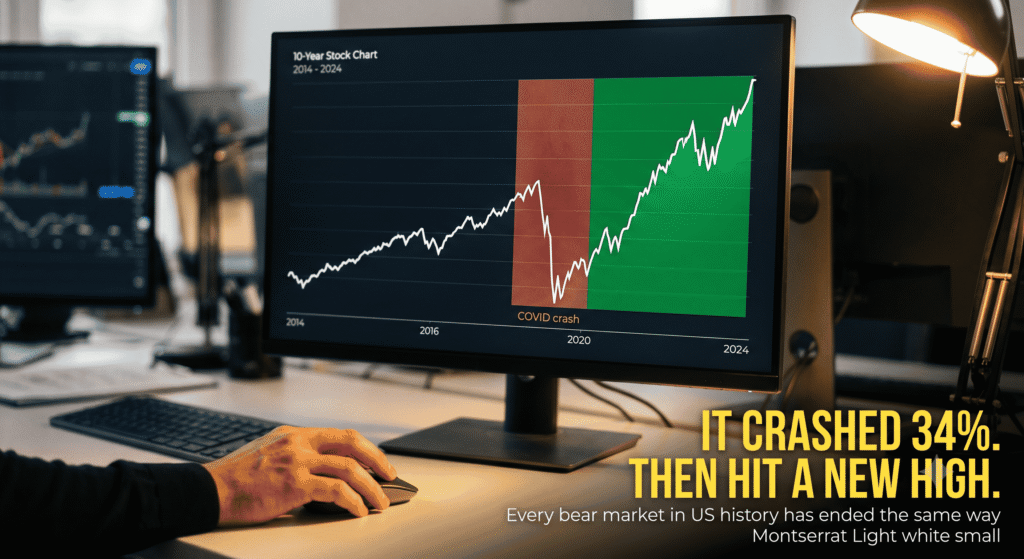
What’s worth knowing: the market has gone up in roughly 73% of years since 1928. Bear markets happen. They end. The long-term direction has always been up.
This doesn’t mean you’ll never lose money. It means that patient investors who hold diversified portfolios through downturns have historically come out ahead.
Stocks vs bonds: what’s the actual difference
When a company needs money, it has 2 options: sell ownership (stocks) or borrow (bonds).
A stock gives you a slice of the company. Your return depends on how well the business does. No guaranteed income. Higher risk, higher potential return over long periods.
A bond is a loan. The company (or government) promises to pay you back with interest on a fixed schedule. More predictable income, lower risk, lower long-term return.
A 30-year-old investor focused on growth usually holds mostly stocks. Someone approaching retirement often shifts toward more bonds to reduce volatility. That shift is the logic behind target-date funds, which adjust automatically as you age.
What is a stock index?
An index is just a list of stocks grouped by some rule, used to measure overall market performance.
The S&P 500 tracks the 500 largest publicly traded US companies. When people say “the market was up 1% today,” they almost always mean the S&P 500.
The Dow Jones Industrial Average tracks just 30 large US companies. It’s older and more famous, but less representative.
The Nasdaq Composite tracks all Nasdaq-listed stocks, heavily weighted toward technology.
Indexes matter for beginners because they’re the benchmark. If your investments return 7% a year over 10 years but the S&P 500 returned 10%, you underperformed. Most actively managed funds do exactly that, which is why index funds have become the default recommendation for most investors.
How to actually buy a stock
You can’t call the NYSE and buy shares directly. You need a broker as the intermediary.
Most people use an online brokerage: Fidelity, Charles Schwab, or Vanguard for long-term investors. You open an account, deposit money, search for the company by ticker symbol (AAPL for Apple, MSFT for Microsoft), and place an order.
2 order types beginners need to know:
Market order: buys at whatever the current price is. Fast, simple, almost always fills immediately during market hours.
Limit order: you set the maximum price you’re willing to pay. The order only fills if the stock reaches that price. More control, but it might not fill at all if the price never hits your target.
For index funds and long-term investing, a market order is usually fine. You’re not trying to time the exact price down to the cent.
We covered the full account opening process in our guide on how to open a brokerage account for the first time.
Individual stocks vs index funds: what beginners should actually buy
This is where most beginner content gives you watered-down advice. Here’s the direct version.
Picking individual stocks is hard. Not because it’s complicated, but because you’re competing against professional fund managers with research teams, proprietary data, and decades of experience, and most of them still underperform the index over 10+ years.
Warren Buffett has publicly recommended that most people, including his own heirs, should put their money in a low-cost S&P 500 index fund rather than trying to pick stocks.
An index fund owns every company in the index. S&P 500 index fund = fractional ownership of 500 companies in one purchase. If 1 company has a bad year, 499 others absorb it.
For most beginners, the smartest first move is a total US market index fund or an S&P 500 index fund inside a Roth IRA. That single purchase gives you diversification, low cost (0% to 0.03% expense ratio at major brokerages), and decades of historical data showing it outperforms most alternatives.
If you want to understand index funds in full, we broke it down in our index fund guide for beginners.
What is market cap?
Market cap is the total value of a company’s shares. Share price multiplied by total shares outstanding.
Apple’s market cap is around $4 trillion as of mid-2026. That makes it one of the largest companies ever measured by this metric.
Companies get grouped by market cap:
- Large-cap: over $10 billion. Apple, Microsoft, Amazon. Stable, widely followed.
- Mid-cap: $2 billion to $10 billion. Established but still growing faster.
- Small-cap: under $2 billion. Higher growth potential, higher volatility.
Most beginner investors don’t need to think about this much. A total market index fund owns all 3 categories automatically in proportion to their size.
What are dividends?
Some companies pay dividends: regular cash payments to shareholders, usually quarterly.
If you own 100 shares of a company that pays a $2 annual dividend, you get $200 per year just for holding the stock. The average S&P 500 dividend yield sits around 1.3% annually.
Dividend investing is a popular strategy for income-focused investors, particularly retirees who want cash flow without selling shares. For younger investors focused on growth, dividends matter less because reinvesting them compounds the return over time.
What actually happens during a crash
The S&P 500 dropped 34% between February 19 and March 23, 2020. 33 days.
Investors who sold in late February or early March locked in real losses. The index fully recovered by August 2020, less than 6 months later. By end of 2020 it was at new highs.

The 2008-2009 financial crisis was worse. The S&P 500 dropped about 57% from peak to trough. It took roughly 4 years to fully recover. Investors who held through it made back everything and more.
Crashes feel permanent when you’re in them. The data says they aren’t. Every market crash in US history has been followed by recovery and new highs. That record includes the Great Depression, multiple recessions, 9/11, 2008, and COVID.
The investors who lost money permanently in those crashes were mostly the ones who sold near the bottom and never bought back in.
The stock market isn’t a casino, but it’s not a sure thing either
The casino analogy gets used a lot, usually to scare people away from investing. It’s wrong.
A casino has fixed odds that always favor the house. Over enough spins, you always lose.
The stock market has had a positive expected return over every 20-year period in US history. The odds favor the patient investor, not the house.
But the stock market is also not a savings account. Values fluctuate. Companies fail. If you put $10,000 in the market today and need it in 18 months, you might get $7,000 back. Or $13,000. Nobody knows.
The risk profile changes with time. Over 1 year, stocks are genuinely unpredictable. Over 20 years, the historical probability of losing money in a diversified US stock portfolio approaches zero.
This is why how much money you start with matters less than how long you stay invested.
The 3 biggest mistakes beginners make
Trying to time the market. Missing the 10 best trading days over a 20-year period cuts your total return nearly in half. Most of those best days happen during or right after the worst stretches. People who sell during crashes often miss the recovery.
Buying individual stocks too early. Before you understand a company’s financials, competitive position, and valuation, buying its stock is speculation. Start with index funds. Add individual stocks when you actually know what you’re evaluating.
Checking the account every day. Daily price movements are noise. They tell you nothing about where a stock will be in 5 years. Frequent checking leads to emotional decisions, and emotional decisions in investing almost always cost money.
How the stock market connects to everything else
Your 401(k) at work is invested in the stock market. The pension your parents or grandparents receive is funded partly by stock market returns. The endowments that keep universities running invest in the market. Insurance companies hold stocks.
When the S&P 500 drops 20%, it doesn’t just affect the people watching ticker symbols. It affects retirement savings, college endowments, and the confidence that drives consumer spending and business investment.
And when it rises over time, the compounding effect builds wealth quietly in the background for anyone who stayed invested.
The dollar cost averaging strategy we covered earlier is specifically designed to keep you invested through all of it, up markets and down, automatically.
Frequently asked questions
What is the stock market in simple terms?
A marketplace where people buy and sell ownership in companies. When you buy a share, you own a fraction of that company. Prices move based on supply and demand, earnings reports, economic data, and investor sentiment.
How does the stock market work for beginners?
You open a brokerage account, deposit money, and buy shares or funds through the platform. Most beginners start with index funds, which own hundreds of companies at once, rather than picking individual stocks. The goal for most is to hold long-term and let compounding do the work.
Is the stock market safe for beginners?
Diversified long-term investing in index funds has historically been one of the most reliable ways to build wealth. It’s not risk-free. Values drop during downturns. But over 20-year periods, the US stock market has never delivered a negative return for diversified investors. The risk profile shortens with time horizon.
How much money do you need to start investing in the stock market?
As little as $1 through fractional shares at Fidelity or Schwab. Practically, most people start with $100 to $500 and add monthly contributions. The starting amount matters less than starting early and staying consistent. Full breakdown in our starting amount guide.
What is the difference between the NYSE and Nasdaq?
Both are US stock exchanges. The NYSE is the largest by market cap, known for listing large established companies like Berkshire Hathaway and JPMorgan. The Nasdaq is the second largest and skews toward technology companies like Apple, Amazon, and Nvidia. Most investors never need to care which exchange their stock trades on.
When does the stock market open and close?
Regular trading hours are 9:30am to 4pm Eastern Time, Monday to Friday. Closed on US public holidays. Pre-market trading runs from 4am to 9:30am and after-hours from 4pm to 8pm, but volume is lower and spreads are wider during those windows.
3 thoughts on “What Is the Stock Market and How Does It Work? A Beginner’s Guide”