
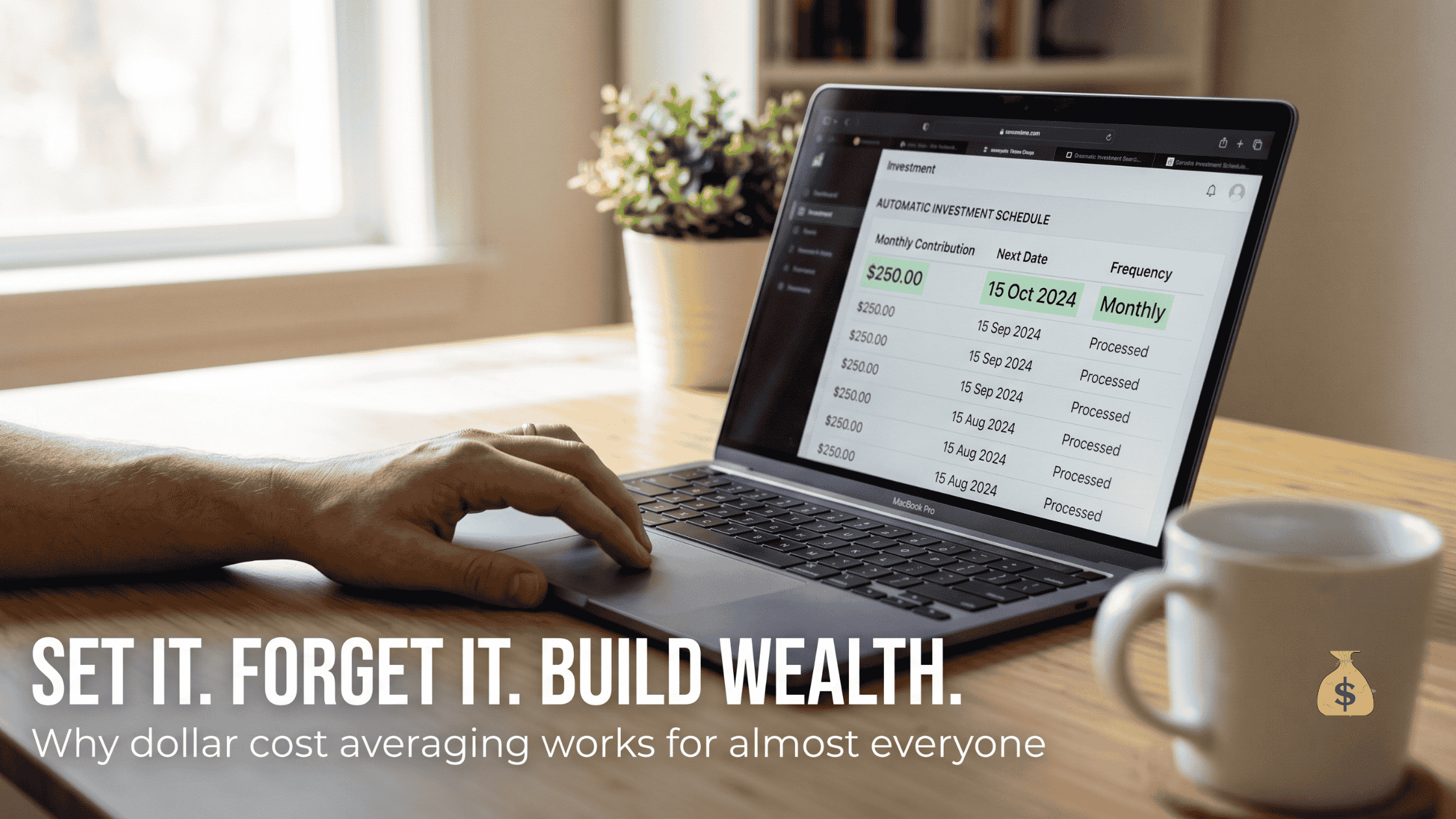
What is dollar cost averaging is one of those questions where the textbook definition takes 30 seconds and the honest answer takes a lot longer.
Here’s both.
What is dollar cost averaging?
Dollar cost averaging means investing a fixed amount of money at regular intervals, no matter what the market is doing.
$200 a month into an index fund. Every month. January, April, August, doesn’t matter. Market up 12%? You invest. Market down 20%? You still invest. Same amount, same schedule, no decisions.
Benjamin Graham coined the term in his 1949 book The Intelligent Investor. The logic is clean: if you invest the same dollar amount every time, you automatically buy more shares when prices are low and fewer when prices are high. Over enough time, that pulls your average cost per share down.
Simple. Almost boring. That’s the point.
How it works with real numbers
Say you invest $200 a month into a total market index fund.
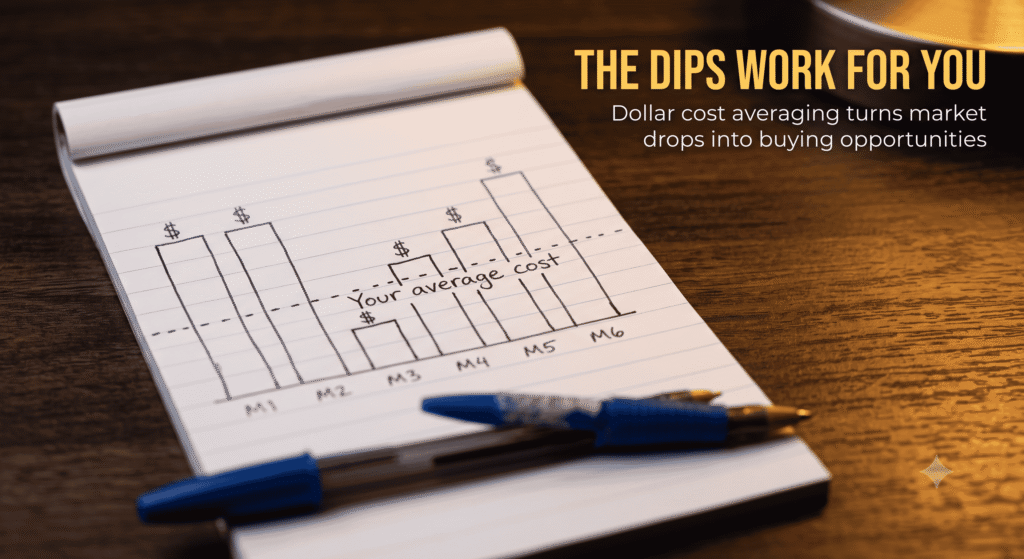
Month 1: the fund costs $50 per share. Your $200 buys 4 shares. Month 2: the fund drops to $40. Your $200 buys 5 shares. Month 3: back to $50. Your $200 buys 4 shares.
You’ve invested $600 total. You own 13 shares. Average cost per share: $46.15.
Now compare that to putting the full $600 in during Month 1 at $50 a share. You’d own 12 shares at an average cost of $50 each.
Same $600. Same fund. One more share, lower average cost. The dip in Month 2 worked for you instead of against you, because you were still buying.
That’s the whole mechanism. The drops become purchases at a discount, automatically, without you having to decide anything.
The honest question: does it actually work?
Yes. With a caveat most articles skip.
Vanguard ran the numbers across US, UK, and Australian markets going back decades. Lump sum investing beat dollar cost averaging about two-thirds of the time.
Not a small margin. Two thirds.
The reason is boring and correct: markets go up more than they go down over the long run. Money in the market earlier has more time to compound. If you have $10,000 sitting in cash and you invest it all in January, that entire sum starts earning returns in January. If you spread it over 10 months at $1,000 a shot, $9,000 of it is sitting in cash earning almost nothing while you wait.
Lump sum wins because time in the market beats timing the market, and DCA voluntarily sacrifices some of that time.
So why bother with DCA at all?
Two reasons.
Most people don’t have a lump sum. They have a paycheck. If you’re putting $300 a month into investments from your salary, there’s no lump sum sitting around to compare against. The choice isn’t DCA vs lump sum. The choice is DCA vs not investing. That’s not a close call.
Emotion destroys returns more reliably than timing does. Plenty of people have $10,000 available and still can’t bring themselves to invest it all at once. They watch the market drop the week after they invest, panic, and pull out. They’ve turned a theoretical short-term loss into a real one. DCA sidesteps that. You commit to a schedule, drops feel less catastrophic because you know next month you’ll be buying cheaper, and the whole thing becomes mechanical enough that fear doesn’t get a vote.
For most beginners, the psychological benefit is worth more than the theoretical performance gap.
The honest question: does it actually work?
Yes. With a caveat most articles skip.
Vanguard ran the numbers across US, UK, and Australian markets going back decades. Lump sum investing beat dollar cost averaging about two-thirds of the time.
Not a small margin. Two thirds.
The reason is boring and correct: markets go up more than they go down over the long run. Money in the market earlier has more time to compound. If you have $10,000 sitting in cash and you invest it all in January, that entire sum starts earning returns in January. If you spread it over 10 months at $1,000 a shot, $9,000 of it is sitting in cash earning almost nothing while you wait.
Lump sum wins because time in the market beats timing the market, and DCA voluntarily sacrifices some of that time.
So why bother with DCA at all?
Two reasons.
Most people don’t have a lump sum. They have a paycheck. If you’re putting $300 a month into investments from your salary, there’s no lump sum sitting around to compare against. The choice isn’t DCA vs lump sum. The choice is DCA vs not investing. That’s not a close call.
Emotion destroys returns more reliably than timing does. Plenty of people have $10,000 available and still can’t bring themselves to invest it all at once. They watch the market drop the week after they invest, panic, and pull out. They’ve turned a theoretical short-term loss into a real one. DCA sidesteps that. You commit to a schedule, drops feel less catastrophic because you know next month you’ll be buying cheaper, and the whole thing becomes mechanical enough that fear doesn’t get a vote.
For most beginners, the psychological benefit is worth more than the theoretical performance gap.
The right way to set it up
Pick an amount you won’t miss. Not an amount that feels ambitious. An amount that won’t cause you to stop when money gets tight. Consistent $100 monthly contributions for 5 years beats $500 for 3 months and then nothing.
Pick a fixed date. The 1st, the 15th, the day after payday. It genuinely doesn’t matter which. What matters is the same date every month, so investing becomes as automatic as paying rent.
Automate it completely. Log into your brokerage account. Set up an automatic transfer from your bank. Point it at your chosen fund. Done. Fidelity, Schwab, and Vanguard all support this, takes about 5 minutes to configure.
Leave it alone. This is where most people break the system. The market drops 15% and they pause contributions “until things stabilize.” That pause is expensive. The drops are exactly when you want to be buying. The schedule only works if you keep the schedule.
What to invest in when you’re dollar cost averaging
DCA works with almost any investment, but it works best with diversified, long-term holdings.
For most beginners, that means a total US market index fund as the core. VTI if you’re at Vanguard or Schwab. FZROX or FSKAX at Fidelity. These funds own thousands of US companies in a single purchase. One bad quarter at one company barely registers.
Add an international fund alongside it if you want global exposure. VXUS at Vanguard, FZILX at Fidelity. Between those 2, you own a piece of the global economy.
DCA into individual stocks concentrates the risk in a way that index funds don’t. If you’re putting $200 a month into a single company and that company has a rough few years, your whole system suffers. Check our full breakdown of what an index fund actually is before you decide where to point your contributions.
Dollar cost averaging vs lump sum: when to use each
This decision only really matters when you have a lump sum available. If you’re investing from income, you’re doing DCA by default.
But say you get a $15,000 bonus. Or an inheritance. Or you’ve been sitting on savings for a year trying to decide what to do.
Here’s how to think about it.
If you have a long time horizon (10 or more years) and you genuinely won’t panic-sell if the market drops 30% the month after you invest, lump sum gives you better expected returns. Put it all in. Stop checking the account.
If the thought of watching $15,000 become $10,500 in your first month makes you want to pull out, DCA it over 6 to 12 months. The expected return is slightly lower, but you’ll actually stay invested, which matters more.
The worst outcome isn’t a slightly suboptimal investment strategy. The worst outcome is investing a lump sum, watching it drop, panic-selling at the bottom, and sitting in cash while the market recovers. That has happened to a huge number of people. DCA is partial insurance against it.
| Situation | Approach |
|---|---|
| Investing monthly income | DCA, automatically |
| Lump sum, long horizon, calm about volatility | Lump sum |
| Lump sum, know you’ll worry about it | DCA over 6-12 months |
| New investor, paralyzed by timing | DCA, start now |
A real example of DCA over a full market cycle
The S&P 500 peaked in early 2020, dropped roughly 34% by March 2020 during the COVID crash, then fully recovered by August 2020 and hit new highs by end of year.
An investor who paused their DCA contributions during the crash bought nothing during the cheapest months of 2020. An investor who kept the schedule bought aggressively cheap in March and April, and those shares more than doubled in value within 12 months.
Nobody knew in March 2020 that the recovery would be that fast. That’s precisely the point. The schedule makes the decision for you. You don’t have to be brave. You don’t have to read the news and judge whether this dip is the one that recovers or the one that keeps going. You just keep investing, because that’s what the calendar says.
What DCA doesn’t do
It’s worth being clear about this.
Dollar cost averaging doesn’t protect your portfolio from losses. If you’re investing $200 a month into an index fund and the market drops 40% and stays there, your balance is down 40%. DCA didn’t help you avoid that. It just means your average cost per share is lower than it would’ve been if you’d invested a lump sum at the top.
It doesn’t predict the future. It doesn’t catch market bottoms. It doesn’t outperform a perfectly timed lump sum investment (nothing does, because perfect timing is impossible).
What it does is keep you in the game. And staying in the game long enough is how most ordinary investors build meaningful wealth.
Vanguard’s long-term data puts this clearly: an investor who missed just the 10 best days in the stock market over a 30-year period ended up with roughly half the returns of someone who stayed fully invested the whole time. Most of those best days came during or just after the worst stretches of volatility, when scared investors had already sold.
DCA keeps you invested through those stretches.
The compound growth argument for starting now
Here’s the number that usually changes people’s minds.
$200 a month, invested consistently in a total market index fund, at a 7% average annual return over 30 years: roughly $243,000. You contributed $72,000. The market added $171,000.
Delay by 5 years and start at the same amount. After 25 years: roughly $162,000. You contributed $60,000. The market added $102,000.
That 5-year delay cost $81,000. Starting early matters more than the amount. And DCA’s entire value proposition is getting you started immediately, at whatever amount you can afford, rather than waiting for a better time that never arrives.
The best time to start was 10 years ago. The second best time is today, with whatever you have, on whatever schedule you can sustain.
Pound cost averaging for UK investors
If you’re in the UK, the same strategy goes by a different name: pound cost averaging. Exact same mechanics. Fixed pounds, regular intervals, regardless of market conditions.
The tax-advantaged account to run it through is a Stocks and Shares ISA. You can contribute up to £20,000 per tax year. Growth is tax-free. Withdrawals are tax-free. It’s the UK equivalent of a Roth IRA, and DCA fits it perfectly because you can set up a monthly direct debit directly into your ISA at most major UK platforms including Vanguard UK, Hargreaves Lansdown, and AJ Bell.
Same strategy, same logic, different currency and account wrapper.
The common mistakes
Pausing during downturns. This is the one that undoes the whole strategy. The drops are when DCA earns its value. If you stop when things get uncomfortable, you’ve kept the discipline during the easy part and abandoned it during the part that matters.
Checking the account too often. DCA is designed to be set-and-forget. If you’re logging in every week to watch the balance fluctuate, you’re creating the emotional exposure the strategy is built to avoid. Check quarterly. Rebalance once a year. Otherwise, leave it.
Investing in too many funds. Some people set up DCA contributions across 10 different funds thinking diversification means variety. A total US market fund already owns 3,500 companies. Adding 9 more funds on top of it doesn’t diversify you further. It just creates complexity.
Setting an unsustainable amount. If you commit to $500 a month and have to stop after 4 months because money gets tight, you’ve broken the one rule that makes DCA work. Set an amount that survives a bad month.
Frequently asked questions
What is dollar cost averaging in simple terms?
Investing a fixed amount at regular intervals regardless of what the market is doing. $100 a month into an index fund, every month, automatically. When prices are high you buy fewer shares. When prices are low you buy more. Over time your average cost per share tends to be lower than if you’d tried to pick the right moment to invest.
Does dollar cost averaging actually work?
For people investing from regular income, yes. For lump sum investors, lump sum investing beats DCA about two-thirds of the time in rising markets. But DCA removes emotion from the process, keeps you invested through downturns, and is the only realistic option when you’re investing a monthly paycheck rather than a windfall.
How much should I invest each month?
Whatever you can sustain without stopping. $50 a month for 5 years is worth more than $300 for 4 months followed by nothing. Pick an amount that survives a tight month, automate it, and increase it when your income grows.
Is dollar cost averaging good for beginners?
Probably the best strategy for beginners specifically. It removes the question of when to invest. The answer becomes: now, and every month after that. It also builds the investing habit automatically, which most financial advisors say is worth more than any particular strategy.
Can you lose money with dollar cost averaging?
Yes. DCA doesn’t protect against market losses. It spreads your entry points over time, which can lower your average cost per share, but if the market falls your balance falls with it. The long-term data says markets recover; DCA keeps you invested long enough to benefit.
What’s the difference between dollar cost averaging and lump sum investing?
DCA spreads investment across multiple purchases over time. Lump sum puts everything in at once. Lump sum wins more often mathematically because money in the market earlier has more time to grow. DCA wins when you’d otherwise hesitate to invest at all, or when the money is coming from monthly income rather than a windfall.