Trading psychology cognitive biases are the reason two traders can use the exact same strategy, on the exact same stock, on the exact same day, and walk away with completely opposite results. Not because one strategy was better. Because one trader could execute it, and the other couldn’t.
This isn’t a motivational chapter about “controlling your emotions.” It’s a breakdown of the specific, named cognitive biases hardwired into your brain that sabotage trading decisions the same subconscious forces that make mastering the art of trading as much about psychology as it is about charts and the exact mechanical hacks that neutralize each one.
Why Knowing the Right Move Isn’t Enough-trading psychology cognitive biases
Imagine two traders, both with a year of experience, both with nearly identical skill levels, both using the same freshly-learned strategy on the same contract on the same day. Same broker, same software, same internet speed. Every technical variable is identical.
A week later, one trader has made great money. The other has lost consistently, every single day, following the exact same rules.
The difference wasn’t the strategy. It wasn’t intelligence, and it wasn’t access. The difference was execution the ability to actually do what you know you should do, in the moment it matters, when every instinct in your brain is screaming at you to do something else.
Here’s the uncomfortable fact behind that gap: roughly 90% of what happens in your brain happens on a subconscious level, entirely outside your direct awareness. You are not nearly as in control of your trading decisions as you believe. The good news is that once you know exactly which biases are working against you, you can build specific mechanical countermeasures that neutralize them without needing superhuman willpower.
Bias 1: Optimism Bias – Seeing What You Want to See
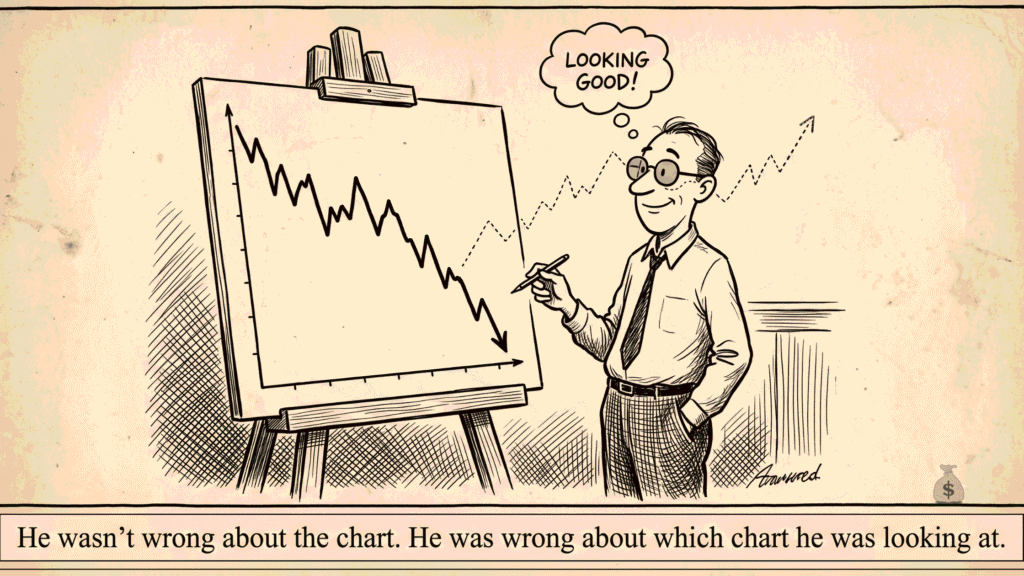
Optimism bias is the tendency to accept information that confirms what we want to believe, and quietly discard information that doesn’t.
Researchers demonstrated this with a simple experiment: subjects were asked to estimate their personal risk of various negative life events, then told the actual statistical risk, then asked again later. Subjects who had underestimated their risk the first time kept their original (wrong) answer even after being corrected. Subjects who had overestimated their risk adjusted down to the correct figure. People readily accept good news and reject bad news, even when directly presented with facts.
How this destroys trades: When you’re in a losing position, optimism bias actively filters out the technical signals telling you to exit. It highlights any small detail that could justify staying in — a slight uptick, a nearby support level, anything while suppressing the larger picture showing the trade has failed. The same bias works in reverse before you even enter: a mediocre setup looks more attractive than it should, because optimism bias is quietly hiding the warning signs.
The Hack: Flip the Chart Upside Down
This sounds absurd. It works because it hijacks the bias itself rather than fighting it.
If you’re long a stock and the trade isn’t working, optimism bias is actively hunting for reasons the price will still go up. Turn your chart upside down. Now your brain still hunting for confirmation that “up” is happening is looking at what is actually a falling market flipped the right way up. If the upside-down chart still looks bullish to you, your original read was compromised by bias. If it now looks bearish (which it usually will, because it’s literally the same falling price shown right-side up), you have your answer: exit.
Use this before every entry too. If a setup looks like a strong long, flip the chart and check if it also looks like a strong short. If it does, the original signal wasn’t as clean as your optimism bias told you it was.
On Windows: Ctrl+Alt+Arrow key rotates the display. On Mac: Option+Command+click Displays in System Preferences, then select 180 degrees. For forex pairs, simply load the inverse pair (GBPUSD instead of USDUSD) same data, opposite orientation, no rotation needed.
Bias 2: Confirmation Bias – The Twin That Makes It Worse
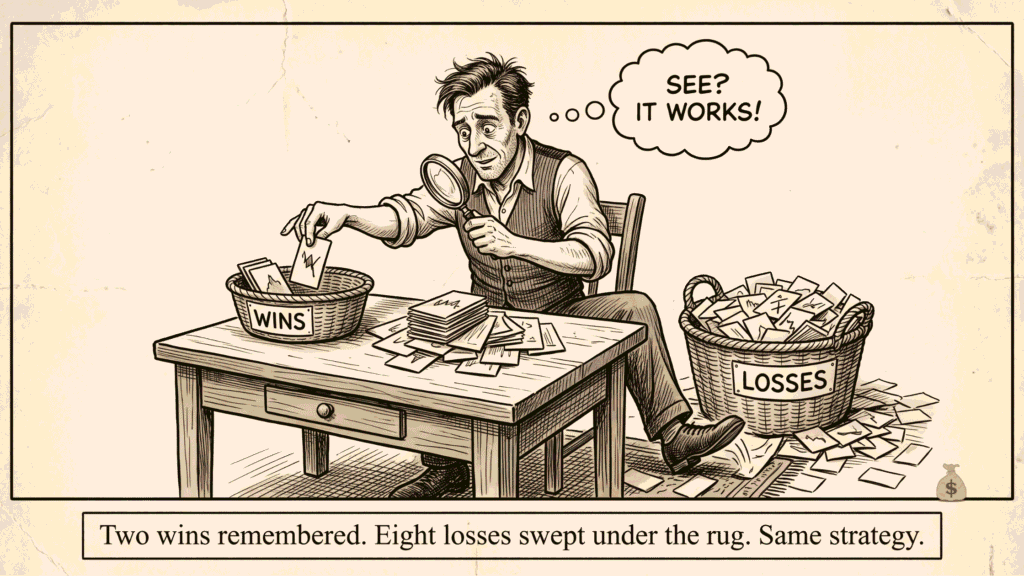
Where optimism bias filters out bad news, confirmation bias actively seeks out and amplifies anything that confirms what you already believe.
How this destroys trades: Take 10 trades on a new strategy. Say 8 lose and 2 wins. Confirmation bias will have you replaying those 2 wins in your head, using them as proof the strategy works, while the 8 losses fade into background noise. Taken further, this bias makes you see setups that aren’t really there the faintest resemblance to a recent winning pattern gets you jumping in, because your brain wants another confirmation that you were right.
The Hack: The Trading Journal
This is the single most effective countermeasure across almost every bias in this list, so it’s worth explaining properly.
The mechanism: writing longhand with a pen, rather than typing, requires significantly more cognitive engagement. Forming letters by hand activates more neurons than pressing keys. Information recorded this way is more likely to be genuinely absorbed by your brain and critically, while your brain is busy processing what you’re writing, it has less spare capacity to manufacture false confirmations or illusory patterns.
For every trade, log:
- What you traded and the setup/pattern used
- Direction (long or short)
- Entry time, price, and any slippage
- Position size
- Exit price, size, and reason for exit (stop hit, target hit, discretionary)
- An execution scores out of 5 not whether you won or lost, but how well you followed your own plan
That last point matters enormously. Score your execution, not your P&L. A trade that lost money but was executed perfectly according to plan scores a 5. A trade that made money by accident, breaking your own rules, scores low. This retrains what your brain treats as “success” rewarding process, not random outcomes.
Bias 3: Illusory Correlation – Lucky Underwear and Broken Logic
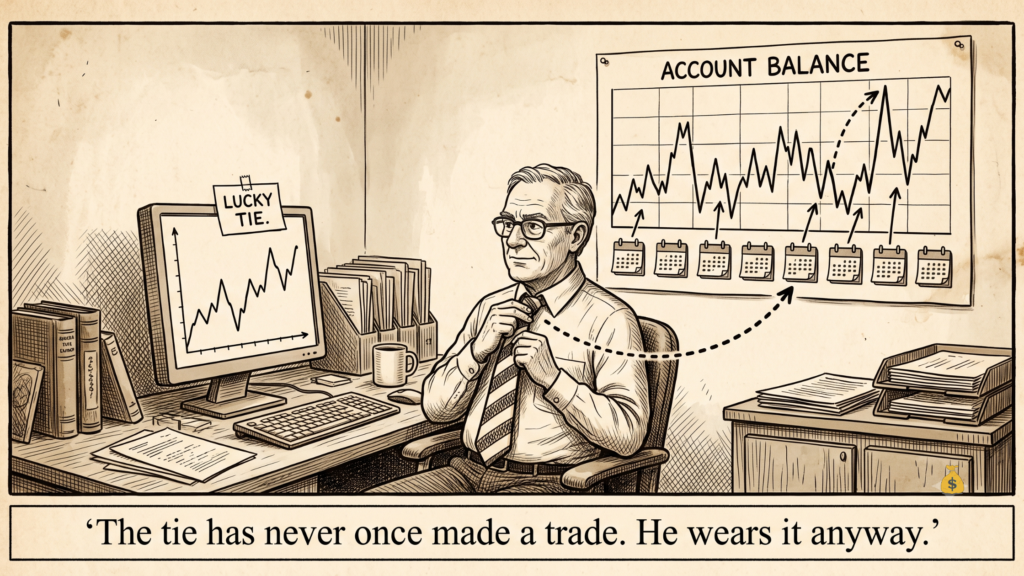
Illusory correlation is the tendency to connect two things that happened together, and assume one caused the other, even when there’s no actual link.
A well-known example: a Formula One driver won several early races while wearing a specific pair of underwear given to him by a relative. He continued wearing them for every race afterward, convinced they brought good luck even after they were damaged in a serious crash. This is a textbook case of what psychologists call illusory pattern perception the tendency to see meaningful connections in random or unrelated events.
How this destroys trades: After an unusually good trade, your brain goes hunting for what made it special. Was it the time of day? The specific stock? Something about the setup that felt slightly different? If it happens to land on something arbitrary the day of the week, a particular indicator setting, even something as random as what you had for breakfast that connection gets reinforced every time a similar coincidence lines up with a win and conveniently forgotten every time it doesn’t.
The flip side is equally damaging: blaming a loss on some external factor (“the big players were shaking out stops, the news moved against me”) rather than on your own execution. It’s far more comfortable to blame an outside force than to admit you deviated from your plan.
The Hack: Force-Feed the Correlation Engine
Your brain’s pattern-matching system (the “correlation engine”) is going to fire regardless. The fix isn’t to suppress it it’s to control what data it has available to work with.
This is where the trading journal does double duty. By writing down only the facts that actually matter to your performance setup quality, entry timing, exit discipline, adherence to your plan — you starve the correlation engine of the irrelevant data (weather, lucky objects, day of the week) it would otherwise use to build false patterns. If it’s not written down, it has less power to shape your beliefs about what “worked.”
Bias 4: Gambler’s Fallacy – The Coin Has No Memory
Gambler’s fallacy is the belief that after a run of one outcome, the opposite outcome becomes more likely. Flip a fair coin and get 10 heads in a row most people intuitively feel the 11th flip is “due” to be tails. It isn’t. The odds remain exactly 50/50, every single time, because the coin has no memory of previous flips.
How this destroys trades: After a string of losses, this bias whispers “the next trade has to work I can’t keep losing forever.” But the market has no memory of your personal losing streak. Each trade’s probability is independent of your recent history, just like the coin. Believing otherwise leads directly into over-leveraged “revenge trades” meant to force a win that statistically isn’t any more likely than the last five losses were.
Interestingly, this same fallacy operating collectively across thousands of traders is part of what actually drives market behavior. When a resistance level gets tested repeatedly, traders collectively start believing “it has to break eventually” and when it does, that same crowd piles in with confidence, pushing the breakout further than pure technicals alone would predict. Understanding this helps you recognize when a breakout is being driven by genuine momentum versus crowd-level gambler’s fallacy.
The Hack: Statistical Reframing
Before entering any trade, explicitly say (out loud or on paper) that this trade’s outcome has zero relationship to your last several trades’ outcomes. Each position is independent. This sounds almost too simple to work but combined with the trading journal where you can literally see, in writing, that your last loss and your next trade are unconnected events it interrupts the automatic “it’s due” thinking before it drives a decision.
Bias 5: The Knowledge Gap Illusion – When More Learning Makes Things Worse
Humans are wired to close knowledge gaps. It’s one of the first things we ever learn how to do, and it serves us well in almost every area of life except one specific situation.
The pattern most new traders fall into:
- Decide to become a trader
- Read books, take courses, absorb information voraciously
- Apply the new knowledge in live trades
- Lose money (or don’t get the results expected)
- Conclude: “I must be missing something” and go back for more books, more courses, more indicators, more complexity
How this destroys trades: By the time most traders reach step 4, they already know enough. The problem isn’t a knowledge gap it’s an experience gap. But because closing knowledge gaps is such a deeply automatic behavior, traders instinctively reach for more information rather than more practice. This leads to strategy-stacking: layering on additional indicators, additional rules, additional complexity, none of which addresses the actual problem, which is inconsistent execution of what they already know.
Think of it like building your first house. Your foundation might be slightly uneven and your brickwork not perfectly straight on the first attempt but the fix is practice with the same basic technique, not learning five entirely different construction methods simultaneously. Mixing techniques, you don’t fully understand into a system you were already executing inconsistently just makes the inconsistency worse.
The Hack: The Three-Question Test
Before buying another course or adding another indicator, ask honestly:
- Do I know what to trade?
- Do I know when to enter?
- Do I know when to exit?
If you can answer yes to all three, your problem is very likely execution, not knowledge. More education at this point is not neutral it’s actively harmful, because it adds complexity to a system you haven’t yet mastered at its current level of simplicity.
Bias 6: Over Trading – The Disease That Empties Accounts
Over trading isn’t about volume. You can over trade with a single position, and you can take 50 trades in a day without over trading. Over trading means entering any position that shouldn’t have been entered according to your own plan.
Table 1: Common Forms of Over Trading
| Behavior | Why It Happens |
|---|---|
| Entering substandard setups that don’t meet your plan’s criteria | Boredom, fear of missing action |
| Continuing after hitting your daily loss limit | Desire to “win back” losses immediately |
| Trading through a scheduled news blackout | Impatience, overconfidence |
| Trading outside your defined hours | Lack of structure |
| Trading setups not on your actual plan | Curiosity, novelty-seeking |
| Taking poor risk/reward trades | Fear of missing an opportunity |
How this destroys trades: Once over trading starts, it spirals. Confirmation bias and illusory correlation reinforce whatever happened to work by accident, making bad habits feel validated. This has been observed to be one of the single most common reasons traders fail more than any strategy flaw.
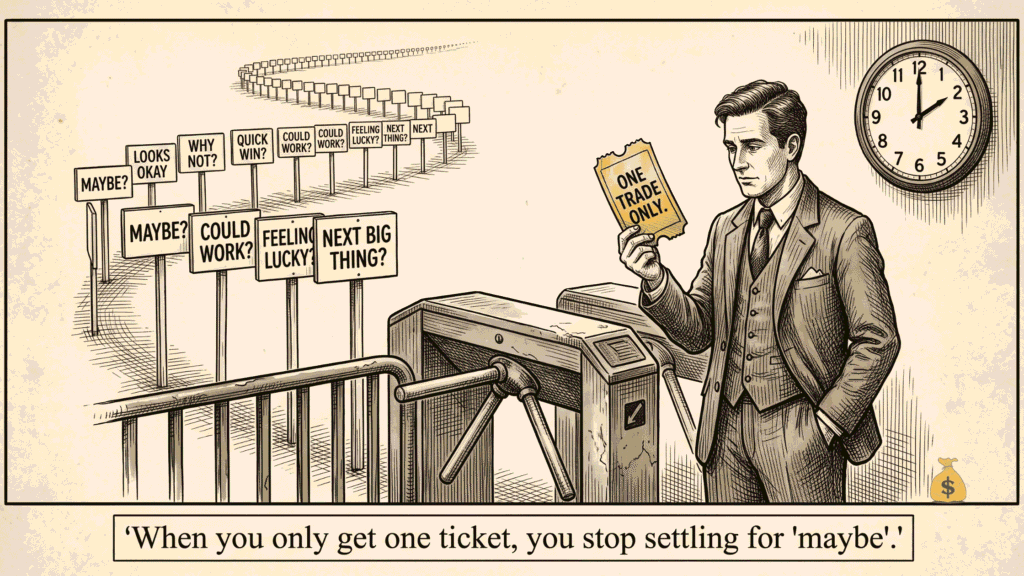
The Hack: The Golden Ticket Method
This deliberately uses a bias scarcity against itself.
Set a hard limit: one trade per defined period (one day for day traders, one week for swing traders). Once that single trade is taken, close your order entry software completely. Win or lose, no more entries until the next period begins.
This works because scarcity forces genuine deliberation. When you know you only get one shot, you’re forced to ask honestly: “Is this actually a great setup, or am I just looking for action?” Every aspect of the trade gets scrutinized with real clarity, because you can’t casually take a second shot if this one doesn’t feel right.
As your execution consistency improves (tracked in your trading journal), raise the limit by one trade per period at a time. If you hit a losing streak, lower it back down. The limit itself becomes a real-time gauge of how well you’re currently executing not a permanent restriction, but a dial you adjust based on evidence.
Bias 7: Attention Decay – The Twenty-Minute Wall
Research on sustained attention places most people’s genuine focus limit at around 20 minutes for a single task, regardless of how important that task is. Your brain treats prolonged concentration as expensive, and will actively look for excuses to disengage.
How this destroys trades: Long stretches in front of charts lead to a predictable cycle: sharp focus early, followed by wandering attention (news sites, forums, daydreaming), followed by missed setups during the distracted window, followed by impulsive over trading later in the session to “catch up” for what felt like lost time. This isn’t a discipline failure it’s a biological limit being ignored.
The Hack: Structural Time Limits, Not Willpower
Two specific structural fixes:
Match your trading window to your actual attention span. If you can only genuinely focus for 2 hours, don’t build a strategy that requires 8 hours of screen time. Fit your strategy to your biology, not the other way around. Many traders find their performance improves dramatically simply by compressing their active trading window to their mornings (or whatever period matches their personal energy peak) and closing positions by early afternoon.
Use structured work-break chunks for research and prep time. The Pomodoro Technique originally 25 minutes of focused work followed by a 5-minute break, with a longer break after 4 cycles isn’t practical to apply rigidly while actively managing a live position, but it’s highly effective for pre-market research and watch-list building. Break preparation into fixed 20-minute blocks with short breaks between them, so you enter your actual trading window already recharged rather than already fatigued.
The Master Pattern Behind All 7 Biases
Notice that almost every hack above shares a common thread: they don’t try to eliminate an emotion or bias through willpower. They redirect the bias’s own mechanism against the problem it usually causes.
Flipping charts hijacks optimism bias into revealing the truth. The Golden Ticket method uses scarcity bias normally a source of bad, impulsive trades to force better discipline. The trading journal exploits the brain’s heightened engagement with handwriting to starve confirmation bias and illusory correlation of the raw material they need.
This is the core principle worth taking away: fighting your subconscious directly rarely works, because you’re fighting 90% of your own brain with the 10% that’s aware anything is happening. Redirecting these biases, using their own strength against themselves, is a far more reliable path to consistent execution than sheer willpower ever will be.
Frequently Asked Questions
What is the most damaging cognitive bias for traders?
Optimism bias and confirmation bias are typically the most damaging because they work together to distort what you actually see on a chart. Optimism bias filters out warning signs in a losing trade, while confirmation bias amplifies any evidence that supports your existing position. Together they can keep a trader in a failing trade far longer than their own trading plan would allow, simply because the brain is selectively editing the information reaching conscious awareness.
Does keeping a trading journal actually improve performance?
Yes, and the mechanism is specific: writing by hand engages significantly more cognitive processing than typing, which means the information is more likely to be genuinely retained and acted upon. A journal that scores execution quality (not just profit or loss) also retrains what the brain treats as a “successful” outcome, shifting focus from random results to consistent process.
What is the Golden Ticket method in trading?
The Golden Ticket method is a discipline technique where a trader sets a hard limit of one trade per defined period (a day or a week). Once that single trade is taken, no further entries are allowed until the next period begins, regardless of the outcome. This uses scarcity to force careful deliberation before every entry, since the trader knows they don’t get a casual second attempt if the setup doesn’t feel exactly right.
Why does gambler’s fallacy affect trading if trading isn’t gambling?
Even though trading involves skill and statistically favorable setups rather than pure chance, the human brain applies the same flawed pattern-recognition to both. After a losing streak, traders often feel the next trade is “due” to win, even though each trade’s outcome is largely independent of the previous ones. This bias can lead to oversized, poorly planned “revenge trades” intended to force a win.
Is more trading education always beneficial?
Not necessarily. Many traders who aren’t getting the results they want assume they have a knowledge gap and seek out more courses, books, and indicators. In most cases, by the time a trader has taken live trades, they already possess sufficient knowledge what they lack is execution experience with what they already know. Adding more complexity at that stage often makes consistent execution harder, not easier.
How long can a trader realistically focus during a session?
Research on sustained attention generally places the practical limit for a single task around 20 minutes, even for engaged and motivated individuals. Traders who need to watch charts for multiple hours should structure their sessions around this limit matching their trading window to their actual attention span, and using short, structured breaks during preparation time, rather than trying to will themselves into hours of unbroken focus.
About the Author — Jamaluddin K.A.
Jamaluddin is the founder of The First Time Investor, a US and UK-focused personal finance and investing education site. He covers trading psychology, market mechanics, and the behavioral research behind why traders struggle with execution even when their strategy is sound.
Disclosure: This article is for educational purposes only and does not constitute financial advice. Trading involves significant risk including the potential loss of principal. Consult a licensed financial advisor before making investment decisions.