

How to open a brokerage account for the first time is easier than most people expect. Takes about 15 minutes. Costs nothing. And you can start with whatever you have.
The confusion usually comes before the account, not during it. Which broker? Which account type? What happens after? This guide answers all of that, in order.
What a brokerage account actually is
A brokerage account is an investment account. You deposit money, and use it to buy investments: stocks, index funds, ETFs, bonds. When you want the money back, you sell and withdraw.
Unlike a savings account, a brokerage account has no deposit insurance on your investments. The value goes up and down with the market. And unlike a retirement account, there’s no minimum age to withdraw, no penalties for pulling money out early, and no annual contribution limits.
It’s the most flexible investment account you can have. The trade-off is that any profits are taxable.
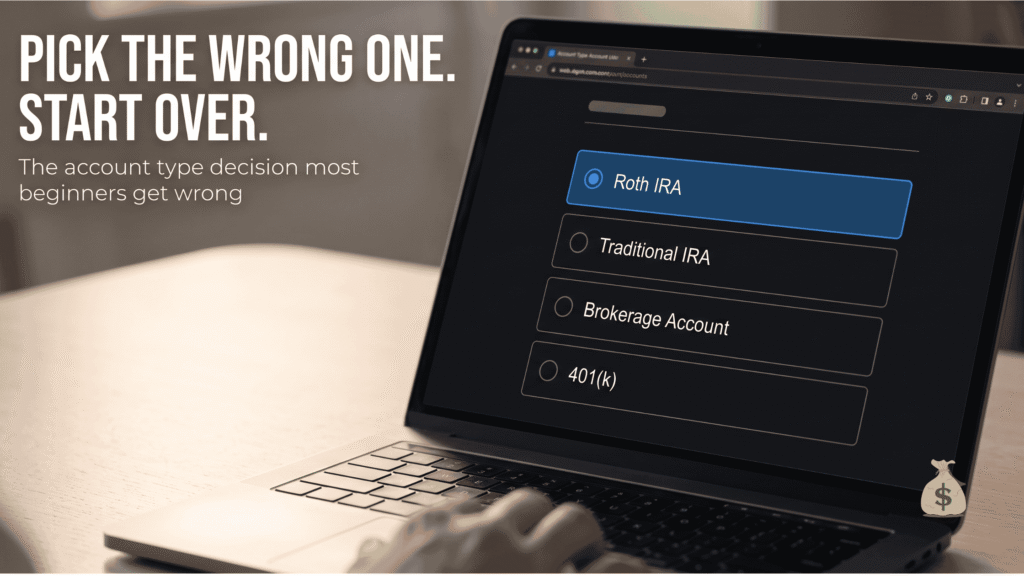
Before you open anything: which account type do you actually need?
This is where people get stuck. You go to Fidelity’s website and immediately see 12 account options. Here’s the honest version of what matters.
Roth IRA. If you have earned income and you’re in the US, start here. Not a regular brokerage account. A Roth IRA. Contributions go in after-tax, everything grows completely tax-free, and withdrawals in retirement cost you nothing. The 2026 limit is $7,500 a year (or $8,600 if you’re 50+). We covered how a Roth IRA works in detail, but the short version: it’s the best account for most beginners, full stop.
Regular taxable brokerage account. You’ve already maxed your Roth IRA, or you need access to the money before retirement, or you earn above the Roth income limits. This is the account for those situations. No contribution limits, no restrictions on withdrawals, but profits are taxed as capital gains.
Traditional IRA. Contributions reduce your taxable income now, but you pay income tax on withdrawals later. Makes sense if you expect to be in a lower tax bracket in retirement than you are today.
401(k). Not something you open yourself. Your employer sets it up. If your employer offers a match, contribute enough to get all of it before opening anything else. That match is the highest guaranteed return available anywhere.
For most first-time investors reading this: open a Roth IRA. If you’ve already done that, open a taxable brokerage account alongside it.
How to open a brokerage account for the first time: which broker should you use?
When you want to open a brokerage account for the first time, 3 brokers cover 90% of what beginners need. All 3 have zero account minimums, no annual fees, and no commissions on US stock and ETF trades.
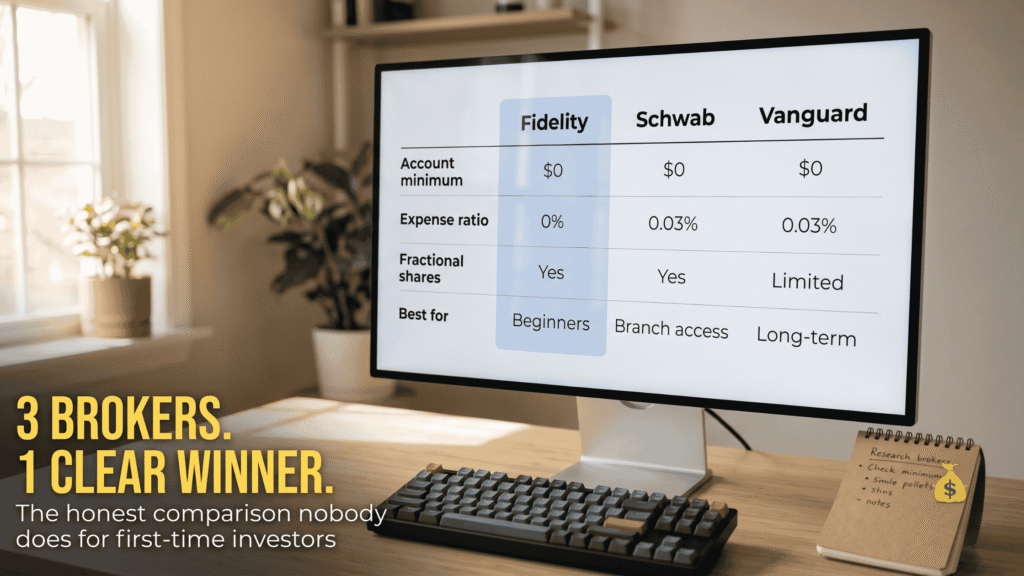
Fidelity. The best all-around choice for beginners in 2026. Motley Fool named it Best Stock Broker Overall this year. No minimums. No maintenance fees. Fractional shares from $1. 2 index funds with 0% expense ratios: FZROX (total US market) and FZILX (total international). The app is clean. Customer service is solid. If you don’t know where to go, go here.
Charles Schwab. Effectively the same as Fidelity at the account level. Zero minimums, zero commissions, strong index fund lineup. 400+ physical branches across the US if you want to walk in and talk to someone. Schwab Intelligent Portfolios is a robo-advisor option, but it requires $5,000 to start and holds a cash position that drags returns. Skip it for now.
Vanguard. The original index fund company. Slightly clunkier interface than Fidelity or Schwab, and fractional shares aren’t as seamless. Better suited for investors who already know what they’re buying (VTI, VXUS, BND) and want to hold long-term. If you want simple, Fidelity is easier.
Robinhood, M1, Betterment. Robinhood has no mutual fund options and a thinner product set. M1 Finance adds complexity beginners don’t need. Betterment manages everything for 0.25% annually, which is unnecessary if you’re willing to spend 15 minutes a year rebalancing.
Pick Fidelity and move on. The broker matters less than actually opening the account.
What you need to have ready
Opening a brokerage account is basically the same process as opening a bank account online. Have these ready:
- Social Security number (required for identity verification, legally mandated)
- A US mailing address
- Your date of birth
- Employment information (employer name, occupation, annual income range)
- Bank account details for your initial transfer (routing number and account number)
- Email address and phone number
You don’t need any documents uploaded in most cases. The identity check runs automatically through a third party during the application. Takes seconds.
One thing worth knowing: if you’re under 18, you can’t open a brokerage account in your own name in the US. A parent or guardian would need to open a custodial account on your behalf.
How to open a brokerage account at Fidelity: step by step
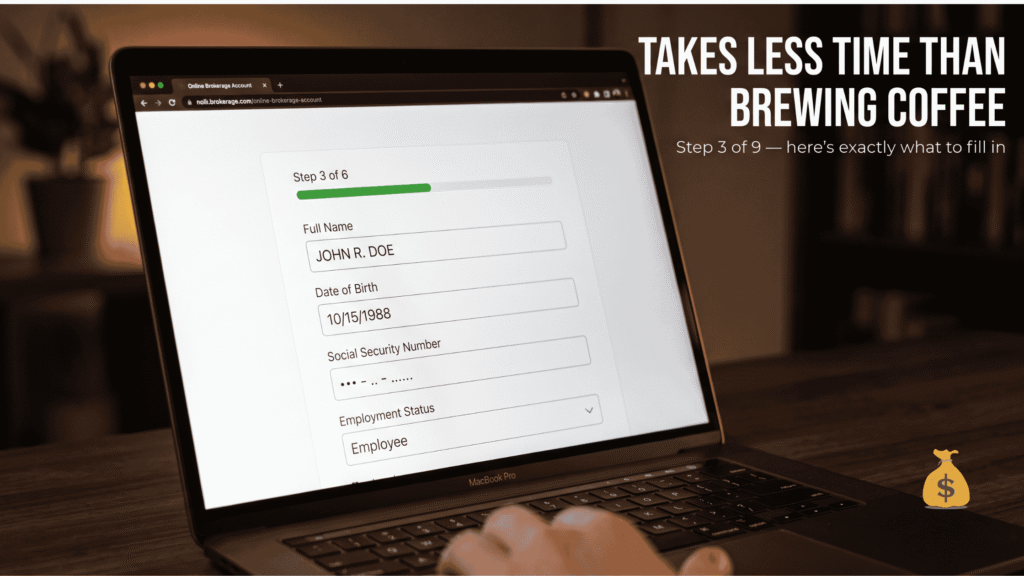
Here’s the exact process, using Fidelity as the example.
Step 1: Go to fidelity.com and click “Open an account.”
Right on the homepage. Hard to miss.
Step 2: Choose your account type.
Select Roth IRA if you’re starting your first investment account. Select Brokerage Account if you’ve already got a Roth IRA or if this is money you might need before retirement.
Step 3: Fill in your personal information.
Full legal name, date of birth, Social Security number, home address, email, phone number. Basic stuff. Exactly what you’d enter opening a bank account.
Step 4: Answer the investing profile questions.
Employment status, annual income, net worth range, investing experience level. These are legally required. There’s no wrong answer. Answer accurately. New investors should select “limited” for experience. You won’t get penalised for this.
Step 5: Skip the optional add-ons.
Margin trading, options trading. Both will be offered. Both require approval and add risk. Skip both for now. You can add them later if you decide you want them. You almost certainly won’t need them.
Step 6: Set up paperless statements.
Just enter your email. The default is electronic. Keep it.
Step 7: Review and submit.
Read through what you selected. Agree to the terms. Submit.
Approval takes minutes in most cases. Occasionally it takes 1-3 business days if manual verification is needed.
Step 8: Fund the account.
Link your bank account using your routing and account numbers. Choose a transfer amount. ACH transfers (standard bank transfer) take 1-3 business days to fully settle, but Fidelity lets you start buying certain securities immediately with pending funds.
Step 9: Buy your investment.
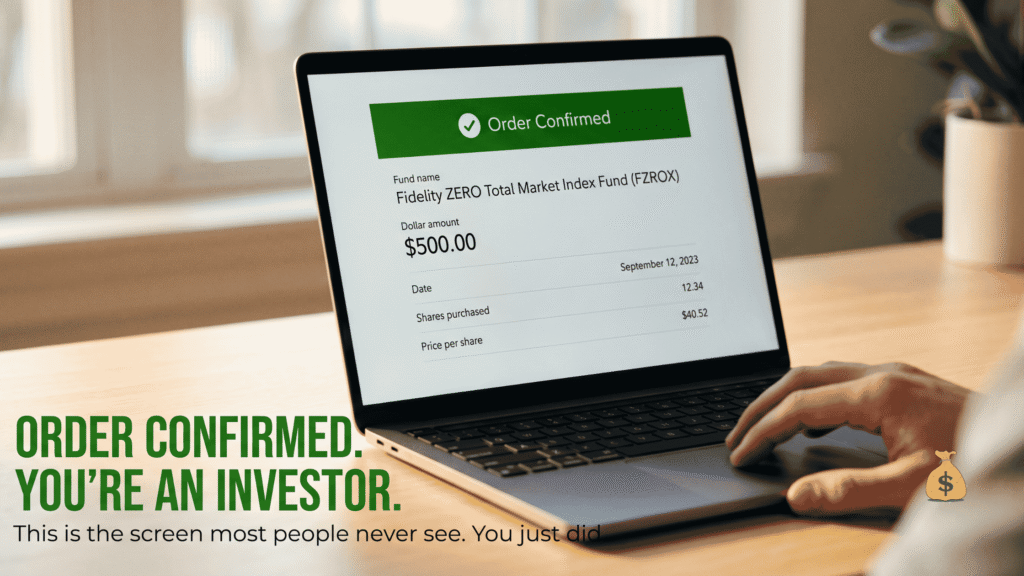
This is the step everyone misses. Money sitting in a brokerage account but not invested in anything earns almost nothing. Once your transfer lands, log in, search for your fund by ticker (FZROX for Fidelity’s total market fund), and buy it. Enter a dollar amount. Confirm.
Done. You’re invested.
The account is open. Now what?
Three things to do in the first week.
Set up automatic contributions. Go to the “Transfers” section of your account and schedule a recurring monthly transfer from your bank. Pick a date. Pick an amount. That’s your dollar cost averaging setup. Monthly, automatic, no decisions required after this.
Set your investment as your default. Some brokerages deposit cash into a money market fund by default before you invest it. At Fidelity, the core position (where uninvested cash sits) earns a reasonable yield. Still, don’t let cash pile up uninvested. Make sure every contribution goes into your chosen fund.
Turn off notifications you don’t need. Daily market alerts, price notifications, breaking news. All of it creates emotional noise. The goal is to check your account quarterly, not daily. More frequent check-ins lead to worse decisions in virtually every study on this.
Taxable brokerage account vs Roth IRA: which to fund first
If you can only fund one, fund the Roth IRA first. Tax-free compounding over decades is worth more than the flexibility of a taxable account for almost everyone in the early stages.
Once you’re maxing the Roth ($7,500 a year, $625 a month), put the rest into a taxable brokerage account. At that point you’re contributing above the IRA limit and need somewhere for it to go.
The order for most beginners:
- 401(k) up to the full employer match
- Roth IRA up to the $7,500 limit
- Taxable brokerage account for anything beyond
That sequence exists because 401(k) matching is free money, Roth growth is tax-free, and taxable accounts are fully flexible but taxable. Use the accounts in order of tax efficiency first.
What to buy after you open the account
The account is just the container. You still have to choose what goes in it.
For most first-time investors, the answer is simple: a total US market index fund. One fund. That’s it to start.
At Fidelity: FZROX (0% expense ratio, no minimum). At Schwab: SWTSX (0.03% expense ratio) or VTI as an ETF. At Vanguard: VTI or VTSAX.
Add an international fund when you want global exposure. At Fidelity that’s FZILX. At Vanguard, VXUS.
That 2-fund combination covers thousands of companies across dozens of countries. It’s the portfolio most financial advisors would build for a young long-term investor, and it costs almost nothing to hold. Read the full guide on what an index fund actually is before you buy anything else.
Don’t add more funds until you understand why you’re adding them. Complexity doesn’t improve returns. It usually reduces them.
The questions most beginners actually ask
Can I open more than one brokerage account?
Yes. There’s no limit. You can have a Roth IRA at Fidelity, a taxable brokerage at Schwab, and a 401(k) through your employer all running simultaneously. The $7,500 Roth IRA contribution limit applies across all your IRAs combined, not per account. Other than that, no restrictions.
What happens to my money if the brokerage goes out of business?
Your investments are protected up to $500,000 by SIPC (Securities Investor Protection Corporation), including $250,000 in cash. This covers the failure of the brokerage firm, not market losses. If Fidelity went under (essentially unthinkable given their size, but hypothetically), your shares would be transferred to another broker. The investments don’t disappear.
How long until I can start trading?
Most accounts are approved within minutes. Funding via ACH takes 1-3 business days to fully settle, but you can often start buying before the transfer clears. Wire transfers are faster (same day) but usually cost $15-30 from your bank. Not worth it for a regular contribution.
Do I have to pay taxes on a brokerage account?
On a taxable brokerage account, yes. Dividends and interest are taxed as income in the year they’re paid. Capital gains (profit from selling) are taxed at either short-term rates (ordinary income, if you held less than a year) or long-term rates (0%, 15%, or 20% depending on your income, if you held more than a year). A Roth IRA has zero tax on growth or withdrawals.
Can I withdraw money from a brokerage account any time?
From a taxable brokerage account, yes. Sell the investment, wait for the trade to settle (usually 1 business day for ETFs), then transfer to your bank. Takes 2-4 business days total. From a Roth IRA, contributions (what you put in) come out any time with no penalty. Earnings come out tax-free after 59½.
What’s the difference between a cash account and a margin account?
A cash account lets you invest money you actually have. A margin account lets you borrow against your investments to buy more. Margin amplifies both gains and losses. For beginners: open a cash account. Margin is something you can explore years from now, if ever.
Frequently asked questions
Frequently asked questions
How long does it take to open a brokerage account?
About 10-15 minutes online for the application. Most accounts are approved within minutes. Funding via bank transfer takes 1-3 business days. So realistically, you can be invested within 2-4 days of starting the process.
Do I need money to open a brokerage account?
No. Fidelity and Schwab both have $0 account minimums. You can open the account with nothing in it, then fund it when you’re ready. The account itself costs nothing to maintain.
What is the best brokerage account for a first-time investor?
Fidelity for most people who want to open a brokerage account for the first time. Zero minimums, no fees, fractional shares from $1, and 2 index funds with 0% expense ratios (FZROX and FZILX). Clean interface, solid customer service. If you have a strong preference for physical branches, Schwab has 400+ locations across the US.
Should I open a Roth IRA or a regular brokerage account first?
Roth IRA first, if you have earned income and your income is under $153,000 (single filer) or $242,000 (joint). The tax-free growth on a Roth IRA is worth more than the flexibility of a taxable account for most people starting out.
Is a brokerage account safe?
Your investments are protected up to $500,000 by SIPC (Securities Investor Protection Corporation) if the brokerage firm fails. The market value of your investments fluctuates, and that risk isn’t covered. Stick to major regulated brokerages like Fidelity, Schwab, or Vanguard. You can also check any broker’s registration status at investor.gov.
Can I open a brokerage account if I’ve never invested before?
Yes. That’s who these accounts are designed for. No prior investing experience required. The application asks about your experience level and you can honestly answer “limited” or “none” without any consequence.
Hi I am so excited I found your site, I really found you by
error, while I was searching on Digg for something else, Nonetheless I am here now and would just like to say thanks a lot for a marvelous post and a all round thrilling blog (I
also love the theme/design), I don’t have time to go through it all
at the moment but I have bookmarked it and also added
in your RSS feeds, so when I have time I will be back to read a great deal more, Please do keep up the excellent work.