

Most traders lose money. The failure rate for retail day traders sits somewhere around 70–80%, depending on which study you read. The strategy isn’t the problem. Most losing traders have a strategy. The problem sits between their ears.
How to develop a trading mindset is the foundation that every profitable system rests on. Get this wrong, and no amount of technical analysis will save you. Get it right, and even a simple strategy becomes a money-making machine over time.
This guide breaks down exactly how to build that mindset drawn from real patterns in how successful traders think, the neuroscience behind why traders self-destruct, and a clear framework for rewiring your mental approach to the markets.
What a Trading Mindset Actually Means
A trading mindset is not positive thinking. It’s a structured mental framework that lets you make rational decisions when money is on the line and your brain is screaming otherwise.
The markets generate two emotions in almost everyone: fear and greed. Fear when you’re losing. Greed when you’re winning. Both emotions make you take the wrong action at exactly the wrong time.
A developed trading mindset means those emotions are present but not in control. You follow your system regardless of how the last trade went.
The core components of a trader’s mindset:
- Commitment to process over outcome
- Belief in eventual success without a specific timeline
- Personal responsibility for every trade result
- Integrity with your own trading rules
- Knowing what you can and can’t control
These aren’t motivational phrases. They’re the actual decision-making filters that separate traders who last from traders who blow up.
The Real Cost of Becoming a Trader (Most People Skip This Part)
Before you can develop the right trading mindset, you need an honest cost-versus-reward calculation. Traders who go in unprepared for the actual costs are the ones who quit or blow up accounts early.
Time cost. Malcolm Gladwell’s 10,000-hour principle applies here. Becoming genuinely proficient at reading markets, executing strategy, and managing risk takes thousands of hours of deliberate practice. That’s not hours watching YouTube. That’s hours of actual chart analysis, trade journaling, reviewing setups, and backtesting.
Educational cost. Books, courses, software subscriptions, mentoring it adds up. The traders who treat education as optional spend far more on losses later than they would have spent learning upfront.
Capital cost. For US Day trading, the SEC’s pattern day trader rule requires at least $25,000 in a margin account. Swing traders can start smaller but starting with less than $5,000 makes it very hard to survive the learning curve mathematically. Prop trading firms now offer a path around these traders who pass an evaluation get funded but that still requires skill.
The psychological cost. Nobody talks about this one. The emotional wear of watching your account drop, second-guessing yourself, and fighting the urge to break your own rules is genuinely exhausting. Plan for it.
Then there are the rewards: financial independence, time freedom, the ability to work from anywhere, and intellectual challenge. The traders who make it know both sides of that ledger before they start.

The 9 Building Blocks of a Winning Trading Mindset
1. Commit to the process, not the payday
The biggest mental trap in trading is outcome-focused thinking. You place a trade and immediately fixate on whether it wins or loses, whether you’re up or down for the day.
That’s backwards. The trade outcome is largely beyond your control once you enter. What you control is whether you followed your system correctly.
Shift your measure of success. A trade you executed perfectly that lost money is a win. A trade you broke your rules on that happened to profit is a failure because the next 50 times you break your rules, the market will punish you for it.
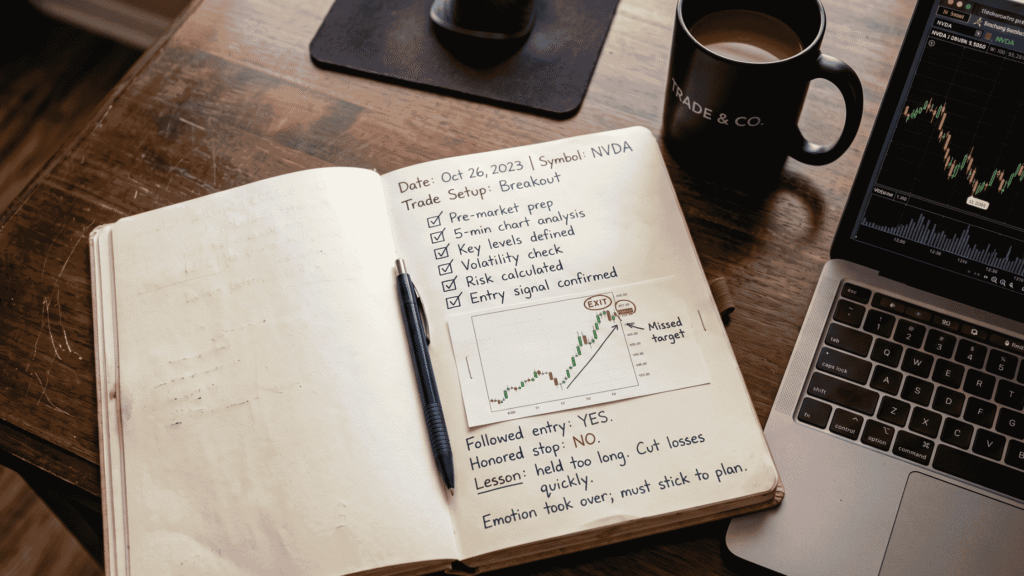
Successful traders track rule compliance as religiously as profit and loss. Daily questions to ask yourself:
- Did I follow my entry criteria?
- Did I honor my stop loss?
- Did I stick to my position sizing?
If yes, the session was a success. Let the edge work over hundreds of trades.
2. Believe in eventual success the right way
There’s a specific kind of belief that leads traders to blow up accounts. They’re convinced success is coming soon. This month. This quarter. And when it doesn’t, they push harder, risk more, and spiral.
Admiral James Stockdale was a prisoner of war in Vietnam for 7 years. He watched the optimists around him the ones who said “we’ll be home by Christmas” — deteriorate and die when Christmas passed and they were still in a cell. Stockdale survived because he held two thoughts simultaneously: I will eventually prevail, and my current situation is brutal, and I must face that honestly.
Applied to trading, this means believe you’ll get there, but don’t put a timeline on it. Face every losing streak, every mistake, every uncomfortable truth about your trading directly. The belief that keeps you going and the honest assessment of where you actually are both at the same time.
Traders who expect quick success take shortcuts, overtrade, and ignore risk management when the pressure builds. Traders with Stockdale’s mindset grind through the tough periods because they’ve already accepted the timeline is open-ended.
3. Take full ownership of your results
Losing traders have a list of explanations: the news came out, the indicator was wrong, the strategy has a flaw, the market was manipulated.
None of that matters. You placed the trade. You set the risk. You chose the entry. The outcome belongs to you.
This sounds harsh but it’s actually freeing. If everything is someone else’s fault, you’re powerless to improve. If everything is on you, every loss becomes a data point you can work with.
One practical exercise: review your last 20 trades. For each losing trade, ask specifically what happened. Did you follow entry criteria? Did you honor your stop? Did you size correctly? Most traders who do this honestly find that losses 2 and 3 in the list breaking entry rules and ignoring risk parameters are responsible for most of the damage.
The strategy didn’t fail. Execution did. And execution is fully within your control.
4. Develop trading integrity
Integrity in trading has a specific meaning: doing what you said you’d do, even when no one is watching.
You can make a commitment to another person and face social consequences for breaking it. But your trading plan is a private agreement with yourself. Break it and nobody knows. There are no immediate consequences except the slow erosion of your own ability to follow rules, and the compounding losses that follow.
The path to building trading integrity:
- Write down your rules explicitly, not just “follow the trend” but specific entry criteria, stop levels, and position size formulas
- Track rule compliance daily, separately from P&L
- Find an accountability partner another trader, a coach, someone who sees your actual trades, not just your highlight reel
Social media trading accounts post wins. Almost nobody posts losses. If you’re using other traders’ results as a mental benchmark, you’re measuring yourself against a curated fiction.
Real accountability means sharing both. The wins and the blown stops, the overtraded Fridays, the revenge trades that cost you twice what the original loss did.
5. Know what you can actually control
Most traders try to control the wrong things. They obsess over their win rate when the market determines that. They chase setups when the market produces them on its own schedule.
Here’s the short list of what a trader genuinely controls:
- When to enter a trade
- When to exit a trade
- How much to risk per trade
- How to respond emotionally after a trade closes
That’s it. Price direction after entry? Beyond your control. News events that hit your stop? Beyond your control. Market gaps? Beyond your control.
Every time you catch yourself stressing about market behavior after you’ve entered a trade, redirect that energy. Check your stop is in place. Check your position size is correct. Then close the platform and do something else.
Viktor Frankl a psychiatrist who survived a Nazi concentration camp where his entire family was killed wrote that forces beyond your control can take everything from you except one thing: the freedom to choose how you respond. If that principle holds in a concentration camp, it holds in trading.
6. Build specific trading habits
Good habits are the mechanical infrastructure of a trading mindset. They remove the need to make willpower-dependent decisions in real time.
The habits that actually matter for traders:
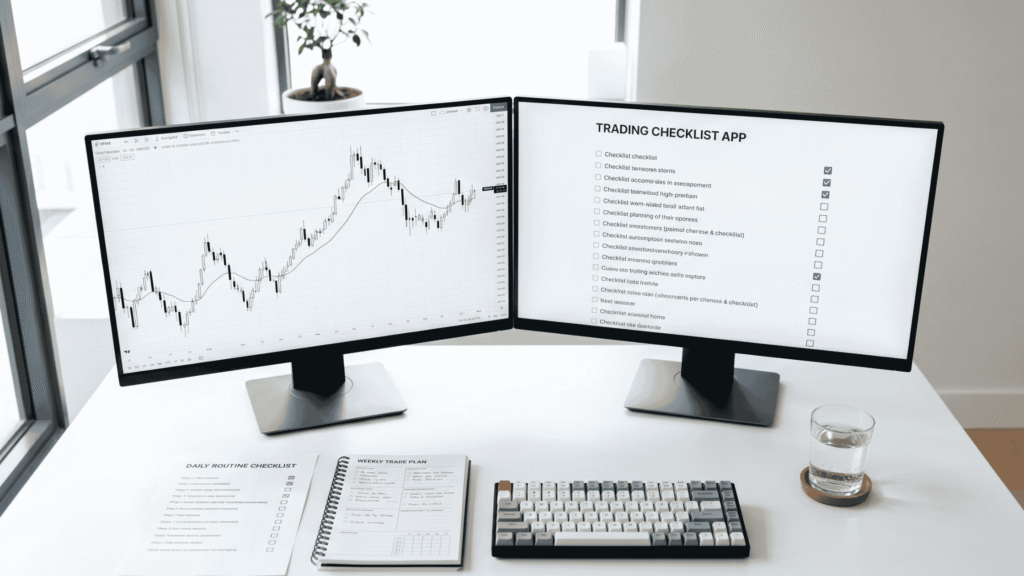
A pre-market routine. Before any trade, complete the same sequence: check the weekly trend using a 10 EMA on the weekly chart, mark the key support and resistance levels, check economic calendar for high-impact news, review yesterday’s trades and notes.
Position size calculation before every trade. Never enter without calculating your exact risk in dollar terms. If you’re risking $200 per trade on a $10,000 account (2% rule), that number should be computed, not estimated.
A daily loss limit. If you lose 3 trades in a row on a given day, stop. Review the trades. Determine if you followed your rules or if something is off. Forcing more trades after a bad run is how small losing days become account-destroying ones.
Physical resets between trades. After a loss, step away. Water, 10 push-ups, 5 minutes outside. This sounds trivial but the brain needs a circuit breaker between losses, otherwise the next trade is colored by the emotional residue of the last one.
Weekly and monthly reviews. What worked this week? What didn’t? Which rules did you break? Which setups were cleanest? Improvement only comes from deliberate review, not from just placing more trades.
7. Plan for failure before it happens
Every trader will have losing streaks. A .300 batting average in baseball means failing 70% of the time and baseball players with that average are considered elite. Trading is similar. Even excellent systems lose 40–60% of individual trades.
The traders who can’t handle this reality quit or blow up. The ones who planned for it stay solvent and eventually profitable.
Plan specifically for:
Losing streaks. Define in advance what happens after 5 consecutive losses. Do you reduce position size? Take a day off? Switch to paper trading temporarily? Decide this when you’re calm, not when you’re down $2,000 and emotional.
Drawdown periods. Every strategy has periods where it underperforms. If your system lost 20% from peak in its historical backtest, that period is coming. Know it. Have a rule that limits real-money trading during a drawdown of a certain size.
Emotional tailspin. Revenge trading where you blow a stop, then immediately double down to recover it is one of the most common ways traders destroy accounts. The fix is a hard rule: after any trade where you didn’t follow your system, mandatory break before the next entry.
8. Keep a trading journal (and actually use it)
The difference between traders who improve and traders who plateau is the journal.
A useful trading journal captures:
- The setup (what did you see that triggered the entry?)
- The entry price and stop level
- The emotional state at entry (calm? impatient? second-guessing?)
- The exit and why you exited
- Rule compliance yes or no for each criterio
- What you’d do differently
Over 50 trades, patterns emerge. Maybe you consistently enter too early and get stopped out before the move. Maybe you exit winning trades too fast from impatience. Maybe you hold losing trades too long hoping they’ll recover.
A journal surfaces these patterns. You can’t fix what you can’t see.
One honest note: most traders start a journal and abandon it within a week. The ones who stick with it treat it as a business record, not homework. Your trading journal is the data that will eventually make you money. Treat it accordingly.
9. Understand the dopamine trap
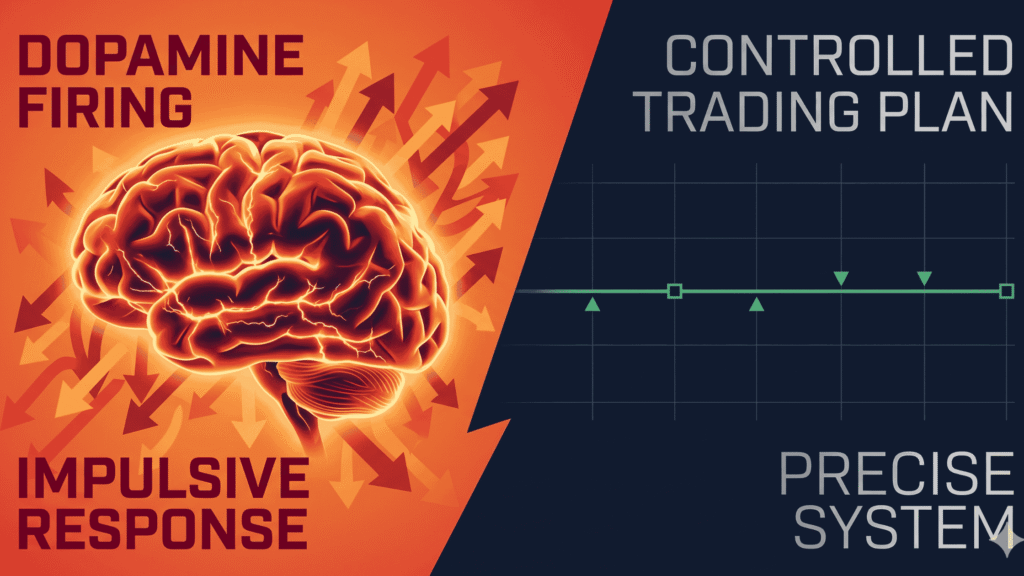
Trading triggers dopamine release the brain’s reward chemical. This happens when you win a trade. It also happens when you lose one. The action itself, the having-money-on-the-line, produces a chemical response.
This is why some traders keep making trades long after they should stop for the day. The activity is neurologically rewarding independent of the financial outcome. The same mechanism drives gambling addiction.
Signs you may be trading for the dopamine rather than the edge:
- Entering trades that don’t meet your criteria because you’re bored
- Feeling restless or irritable on low-volatility days when there are no setups
- Increasing your position size after losses to feel the intensity
- Checking your trading app repeatedly when you’re not in a trade
The solution is structural. Set maximum trades per day. Set maximum hours at the screen. Remove trading apps from your phone if needed. Build non-trading activities into your day that also produce genuine satisfaction.
The Shiny Object Problem
One of the biggest destroyers of trader development is system-hopping: trying a strategy, seeing it fail, assuming the strategy is broken, finding a new one, repeat.
Richard Dennis, who created the Turtle Traders experiment, once said you could publish every rule of a profitable strategy and most people still wouldn’t follow them. He was right.
The strategy usually isn’t broken. The trader isn’t following it consistently enough to see the edge play out over hundreds of trades. A strategy needs at minimum 100 trades back tested or paper traded before you can assess whether it works. Most traders abandon systems after 5 or 10 trades.
If you find yourself constantly searching for a new system, stop. Look in the mirror. The problem isn’t your entry method. It’s discipline, consistency, and the willingness to stick with something long enough to let it work.
Pick one system. Backtest it across 100 historical setups. Paper trade it live for at least a month. Then trade it with small real money until you’ve built confidence in it. Only after that process should you consider modifications.
How Trading Mindset and Technical Skill Work Together
Building a trading mindset doesn’t mean ignoring technical analysis. The two work together psychological discipline without a sound method loses money slowly instead of fast, and a great method without psychological stability falls apart under real market pressure.
The technical skills that matter most for building systematic confidence:
Trend identification. A clean trend on a weekly chart removes a lot of ambiguity about direction. If price is above a 10-period exponential moving average on the weekly chart and making higher highs and higher lows, the bias is long. This simple filter prevents a lot of countertrend losses.
Support and resistance levels. These are where buyers and sellers concentrate orders. Trading off these levels gives you a concrete entry logic that you can evaluate objectively either price reacted at the level or it didn’t. That objectivity is good for your mindset because the analysis has clear rules.
Entry confirmation. Candlestick patterns, momentum confirmation, or volume signals at your key levels give you a second reason to enter. This reduces impulsive entries that feel right but have no systematic basis.
Risk management as non-negotiable. Every trade needs a stop loss. Every trade needs a pre-defined risk amount. A 2:1 reward-to-risk ratio means you can be wrong half the time and still make money. This math is what allows a trader to stay in the game through losing stretches because losing streaks with disciplined risk management are survivable. Losing streaks without it aren’t.
Trading Mindset for Beginners: Where to Start
If you’re new to trading, the mindset work is actually easier to do now than later. You haven’t yet built bad habits. You haven’t yet experienced the emotional damage of a blown account. Start right.
Step 1. Paper trade for 30–60 days. This isn’t optional padding it’s the phase where you learn your system without real financial stress distorting your decisions.
Step 2. Start your trading journal on day one. Don’t wait until you’re trading real money. The habit needs to be established during paper trading so it carries over automatically.
Step 3. Write your trading plan as a document. Entry criteria, stop placement, take profit targets, maximum daily loss, rules for stopping. If it’s not written, it doesn’t exist.
Step 4. Start with a small live account $1,000 to $2,000 and trade minimum size. The psychological experience of real money is different from paper trading. Small amounts let you feel the real emotions without catastrophic consequences while you adjust.
Step 5. Review your trades weekly. Look for patterns in where you follow rules and where you don’t. Fix the one biggest rule-breaking pattern before moving on to the next.
Common Mistakes in Developing a Trading Mindset
Trying to trade out of financial desperation. Traders who need money from the markets are under pressure that distorts every decision. The market doesn’t care about your rent. Trading from a position of desperation produces the worst decision-making. If you’re in financial trouble, get that sorted first.
Using social media as a benchmark. Trading Twitter, Instagram, and TikTok are curated highlight reels. Nobody posts the 4-trade losing day. Measuring yourself against other traders’ public wins produces unrealistic expectations and unnecessary self-criticism.
Quitting before the breakthrough. The failure rate for trading is high partly because most people quit before they complete the learning curve. Every skill has a phase where you’re putting in real effort and seeing no results what some call the “pre-breakthrough plateau.” The traders who make it are often not the most talented. They’re the ones who didn’t stop.
Confusing complexity with edge. A more complicated system doesn’t win more trades. Some of the most profitable approaches are also the simplest trend following with a moving average, level trading off support and resistance, basic candlestick confirmation. Simplicity is easier to follow consistently, and consistency is where the edge actually lives.
FAQ: Trading Mindset Questions
How long does it take to develop a proper trading mindset?
Most traders need 12–24 months of active, deliberate practice to build genuinely consistent mindset and execution habits. Some get there faster. Some need longer. The variable that matters most is how systematically you review and fix your mistakes not how many trades you place.
Can someone with emotional trading habits actually change?
Yes. The patterns that cause emotional trading revenge trading, overtrading, holding losers too long are habits, not personality traits. Habits can be rewired with consistent rules, journaling, and accountability. The process takes months, not days.
What’s the relationship between trading mindset and win rate?
They’re mostly independent. A good trading mindset doesn’t raise your win rate it raises your consistency in executing the trades your strategy calls for. A 45%-win rate executed perfectly is far more profitable than a theoretical 65%-win rate executed erratically.
Is psychological help useful for traders?
For traders who recognize patterns like addiction tendencies, extreme loss aversion, or emotional spirals that they can’t address through self-work alone, yes. Working with a trading coach or a psychologist familiar with performance psychology is a legitimate tool.
What’s the single biggest mindset mistake traders make?
Treating a strategy failure as a strategy problem when it’s almost always an execution problem. Before changing or abandoning any system, do an honest audit of 20 trades and assess whether the system was actually followed correctly. Most of the time, it wasn’t.
How do I stop revenge trading?
One hard rule: after any trade where you didn’t follow your written plan, you are done trading for the day. No exceptions. The rule needs to be pre-committed when you’re calm, not decided in the heat of the moment after a loss.
The Road Map: Building Your Trading Mindset Over Time
Developing a trading mindset is a long game. Here’s a realistic framework for what that looks like across 12 months:
Months 1–2: Write your trading plan. Paper trade your system. Start your journal. Focus on understanding your emotional patterns.
Months 3–4: Small live account. Minimum position size. Track rule compliance as the primary metric. Expect losses. Expect to break rules sometimes. The job is to identify why and fix it.
Months 5–8: Review your journal data. Identify your 2 biggest execution problems and work on them specifically. One at a time. Don’t try to fix everything simultaneously.
Months 9–12: Increase position size only if rule compliance is consistently above 85% and your strategy is producing positive expectancy. Scale up on discipline, not on hope.
The traders who follow something close to this path have a fundamentally different experience than those who jump in with full capital, no plan, and expectations of immediate profit.
Expert Insight: What Separates Traders Who Last
The traders who build lasting careers in the markets share a specific pattern: they stopped chasing the next great strategy and started working on themselves.
The best technical setup in the world fails in the hands of someone who breaks their stop loss under pressure, overtrades when bored, or abandons their system after 3 consecutive losses. The most average-looking strategy produces steady profits in the hands of someone who executes it with consistency and discipline over hundreds of trades.
The mindset is the strategy. Build it first.
Related Articles to Build Topical Authority
- How to create a daily trading plan that actually gets followed
- Risk management strategy for traders: position sizing and stop loss placement
- How to backtest a trading strategy: 100-trade minimum framework
- Trading journal template: what to track and how to use the data
- Support and resistance trading strategy for consistent entries
1 thought on “How to Develop a Trading Mindset: The Psychology Behind Consistent Profits”