

Trading on margin sounds like free extra money the moment you first hear about it. Double your buying power, double your potential profit what’s not to like? The part almost nobody explains clearly until it’s too late is the other half of that equation.
This guide covers exactly how margin works, the math behind why it’s appealing, the specific mechanism that burns beginners, and a related decision every investor faces that has nothing to do with margin at all: whether to chase cheap stocks or buy established ones.
What Margin Actually Is
Margin is a loan from your broker that lets you trade with more money than you actually have in your account.
The standard margin allowance for a personal stock trading account in the US is 50%. That means if you deposit $5,000, your broker will let you trade with $10,000 double your actual cash. Some instruments go much further. Futures traders sometimes pay as little as 1-2% margin, meaning $5,000 could control over $1,000,000 worth of commodities. Stock margin is far more conservative than that, but the underlying risk mechanism is identical.
The appeal is straightforward math. If you have $1 and turn it into $2, that’s a 100% return enormous, and genuinely unlikely to repeat consistently. If you have $5 and make $1, that’s only a 20% return, which is a far more achievable, realistic outcome. Margin exists because having more capital to deploy makes reasonable returns easier to actually hit. That’s the entire appeal in one sentence.
What You Can and Can’t Buy on Margin
Not every stock is marginable. The Securities and Exchange Commission (SEC) restricts margin trading on certain stocks specifically to prevent excessive speculation, particularly in low-priced or highly volatile names. Your broker may also impose its own additional requirements before allowing margin trading on your account at all typically a minimum account balance and a completed margin agreement.
Table 1: Standard Margin Requirements
| Account Type | Typical Margin Allowance | Practical Meaning |
|---|---|---|
| Standard stock margin account | 50% | $5,000 deposit = $10,000 buying power |
| Futures margin account | 1-2% (varies by contract) | $5,000 deposit can control $250,000+ notional value |
| Pattern Day Trader margin account | Higher intraday leverage permitted | Requires $25,000 minimum equity in the US |
| Cash account (no margin) | 0% — none | You can only trade what you’ve actually deposited |

How Margin Actually Burns You
Margin isn’t free money. It’s a loan, and loans come with interest. Every dollar of margin you use accrues interest charged by your broker, calculated daily and typically billed monthly. If your trading profits aren’t larger than the interest and fees you’re paying to borrow, using margin actively makes you poorer, not richer, even on trades that would have been profitable in a cash account.
Before ever using margin, check your broker’s specific margin interest rate. It’s usually listed in the account fee schedule, and it varies meaningfully between brokers. This single number determines whether margin is a genuine tool or a silent drag on every trade you make.
The Margin Call: The Investor’s Nightmare
This is the mechanism that catches beginners completely off guard, because it’s rarely explained until they’re already living through one.
Margin accounts require a minimum balance commonly around $2,000 to remain in good standing. If the value of your account falls below that minimum (because your positions lost value, or because losses combined with margin interest eroded your balance), your broker issues a margin call.
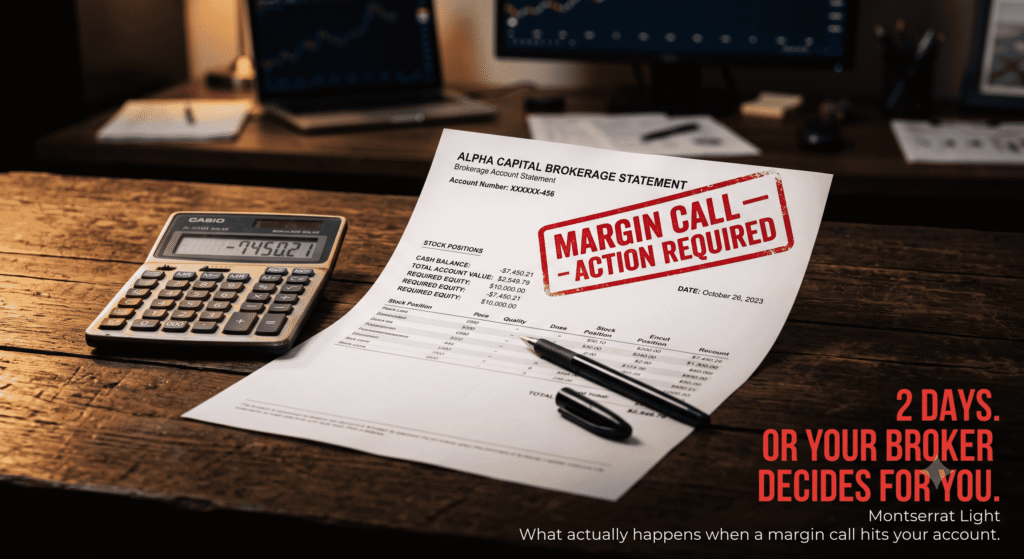
A margin call is a formal notice: sell enough of your margined position within a short window, usually 1-2 days, to bring your account back above the minimum. If you don’t act, your broker has the legal right to sell positions in your portfolio on their own without asking you, without waiting for your preferred timing, and without regard for your longer-term investment strategy.
Table 2: What Happens During a Margin Call
| Step | What Occurs |
|---|---|
| 1. Account value drops | Losses or interest push your equity below the minimum maintenance requirement |
| 2. Broker issues margin call | Formal notice, typically giving 1-2 days to respond |
| 3. You have 2 choices | Deposit more cash to restore the minimum, or sell positions yourself |
| 4. If you do nothing | Broker liquidates positions in your account at their discretion |
| 5. Result | You may be forced to sell at the worst possible moment, locking in losses you never chose |
This is the real danger of margin trading. It’s not that you might lose money on a bad trade — every investor does that occasionally. It’s that margin can force you out of a position at exactly the wrong time, removing your ability to wait for a recovery that might otherwise have come. A position you genuinely believed in, that might have worked out over months, gets closed involuntarily during the worst week of a downturn.
The Real Question Margin Doesn’t Answer: What Are You Actually Buying?
Margin changes how much buying power you have. It says nothing about what you should do with that buying power. That’s a completely separate decision, and it’s one every investor has to make regardless of whether they ever touch margin at all: do you chase cheap stocks hoping for a huge multiple, or buy established companies expecting smaller, steadier gains?
Buy Low, Sell High: The Dreamer’s Approach
Everyone has heard the story of the person who bought a company like Microsoft for a few dollars a share decades ago and became wealthy. These stories get told because they’re rare and dramatic which is exactly why they’re a poor model to build a strategy around.
There are hundreds of thousands of low-priced and penny stocks available at any given time. Pick the right one and the return can be extraordinary. Pick the wrong one statistically the far more likely outcome and you lose most or all of what you put in. The realistic math isn’t “I might find the next Microsoft.” It’s “I will very likely lose small amounts repeatedly until my capital is significantly depleted, chasing a low-probability outcome.”
The investors who did make real money on companies like early Microsoft typically held for a decade or more, through significant volatility and plenty of reasons to sell early. Ask most of them how they picked it, and the honest answer usually involves some genuine luck combined with real patience patience that’s much harder to sustain in practice than it sounds in hindsight.
Buy High, Sell Higher: The Base Hit Approach
Here’s the less exciting, statistically more reliable alternative.
Instead of hunting for a $2 stock that might become $20, this approach targets established, profitable companies trading at reasonable valuations relative to their own trading history — not at dot-com-bubble extremes, but simply solid, stable businesses with a track record.

The math behind why this works better than it sounds:
Table 3: Why Established Stocks Are Easier to Predict
| Stock Price | Move Required | Percentage Move | Predictability |
|---|---|---|---|
| $2 stock rising to $7 | $5 move | 250% | Very hard to predict or repeat consistently |
| $50 stock rising to $55 | $5 move | 10% | Far more realistic and repeatable |
Both examples involve the exact same $5 price movement. But a 10% move in an established stock happens constantly, in ordinary market conditions, without requiring anything extraordinary. A 250% move in a penny stock requires something close to a miracle, or information nobody else has yet neither of which you can reliably plan around.
If you can consistently capture $100-$200 gains trading a stable, established stock every few weeks, month after month, that adds up to a genuinely meaningful sum by year’s end. It won’t make for an exciting story at a dinner party. It will make you money with far greater reliability than chasing the next dramatic multi-bagger.
Why “Base Hits” Beat “Home Runs” for Most Investors
The dramatic, one-big-trade story is memorable precisely because it’s unusual. For every person who tells you about the stock that made them rich overnight, there are far more who lost consistently chasing the same dream and simply don’t share that part of the story.
Consistent, modest, repeatable gains in stable companies compound in a way that occasional huge wins mixed with frequent losses usually don’t. Greed is the emotional trigger that pulls people away from this approach the appeal of a home run is always going to feel more exciting than a base hit, even when the base hit strategy produces better actual results over time.
This connects directly back to margin trading. If margin gives you more buying power, and you use that extra power to chase low-priced speculative stocks rather than established ones, you’ve combined 2 sources of risk simultaneously: leverage risk and speculative-stock risk. That combination is exactly how large, fast losses happen, and exactly the scenario most likely to trigger a margin call at the worst possible time.
If you do choose to use margin, the safer application is on the established, “base hit” side of investing where price movements are more predictable and the leveraged position is less likely to swing violently enough to trigger a forced liquidation.
A Practical Framework Before You Ever Use Margin
Check your broker’s margin interest rate first. If your expected returns don’t clearly exceed that rate plus trading costs, margin subtracts value rather than adding it.
Know your maintenance minimum. Ask your broker exactly what balance you need to maintain and what happens procedurally if you fall below it. Don’t learn this for the first time during an actual margin call.
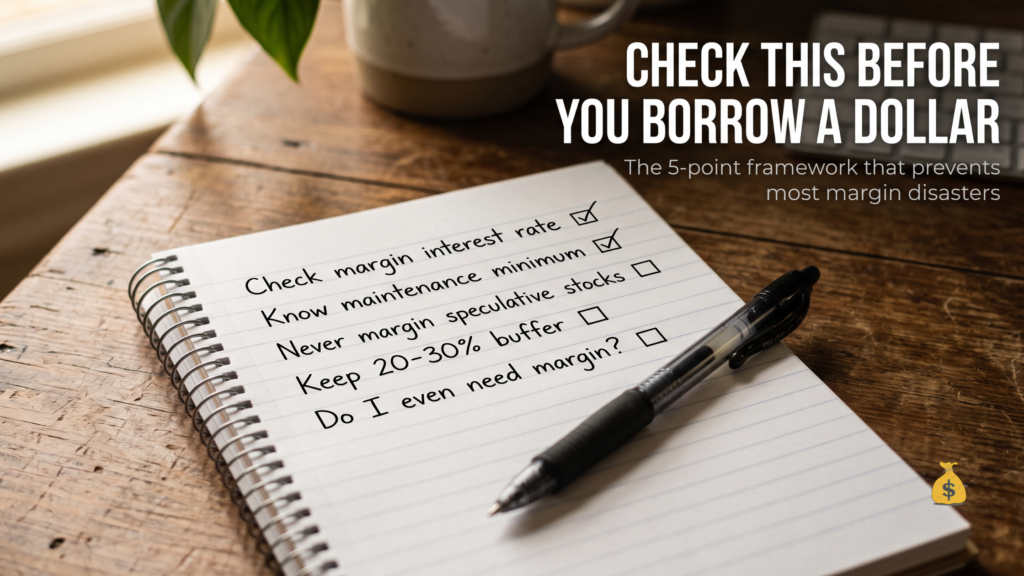
Never combine margin with your most speculative positions. Leverage on an already-volatile penny stock multiplies risk in both directions, and the downside multiplication is the one that actually threatens your account.
Keep a cash buffer above the maintenance minimum. Trading right at the edge of a margin call means any ordinary market dip can trigger one. A buffer of 20-30% above the minimum gives you room to ride out normal volatility.
Consider whether you need margin at all. Many of the “base hit” gains described above are entirely achievable in a standard cash account, without any of margin’s added risk. Margin amplifies outcomes in both directions it doesn’t make a mediocre strategy good, and it makes a genuinely good strategy riskier than it needs to be.
Frequently Asked Questions
What is margin trading in simple terms?
Margin trading means borrowing money from your broker to buy more stock than your own cash would allow. A standard margin account lets you trade with roughly twice your actual account balance. The broker charges interest on the borrowed amount, and if your account value falls too low, they can force the sale of your positions to cover the loan.
What is a margin call?
A margin call happens when your account balance falls below the broker’s required minimum (commonly around $2,000). Your broker will demand you either deposit more money or sell positions within a short window, typically 1-2 days. If you don’t respond, the broker can sell your holdings without your permission or input on timing.
Is trading on margin a good idea for beginners?
Generally not. Margin adds a layer of risk and cost (interest) on top of whatever risk already exists in the underlying stocks. Beginners are often still learning to manage the risk of ordinary cash-account trading; adding borrowed money and the threat of forced liquidation on top of that learning curve significantly raises the chance of a costly mistake.
What’s the difference between buying low to sell high and buying high to sell higher?
Buying low to sell high means targeting cheap, often speculative stocks hoping for a dramatic multiple gain — statistically unlikely and high-risk. Buying high to sell higher means targeting established, reasonably priced companies for smaller, more consistent, and more predictable gains. The second approach produces less exciting stories but historically more reliable results for most investors.
Can margin trading force me to sell at a loss?
Yes, this is one of margin’s biggest hidden risks. If your account falls below the maintenance minimum during a market downturn, your broker can liquidate your positions to cover the shortfall, regardless of whether you believe the position will recover. This removes your ability to simply wait out a temporary decline, which is often the very thing that would have made the trade work out.
What margin percentage is standard for stock trading?
Most standard US brokerage margin accounts allow 50% margin, meaning you can trade with double your actual cash balance. Futures accounts often allow far higher leverage, sometimes requiring only 1-2% margin, which means significantly higher risk relative to the capital actually deposited.
About the Author — Jamaluddin K.A.
Jamaluddin is the founder of The First Time Investor, a US and UK-focused personal finance and investing education site. He covers stock market fundamentals, risk management, and trading strategy for people who want to invest confidently without a finance degree.
Disclosure: This article is for educational purposes only and does not constitute financial advice. Trading on margin involves significant risk, including the potential loss of more money than initially invested. Consult a licensed financial advisor before making investment decisions.