
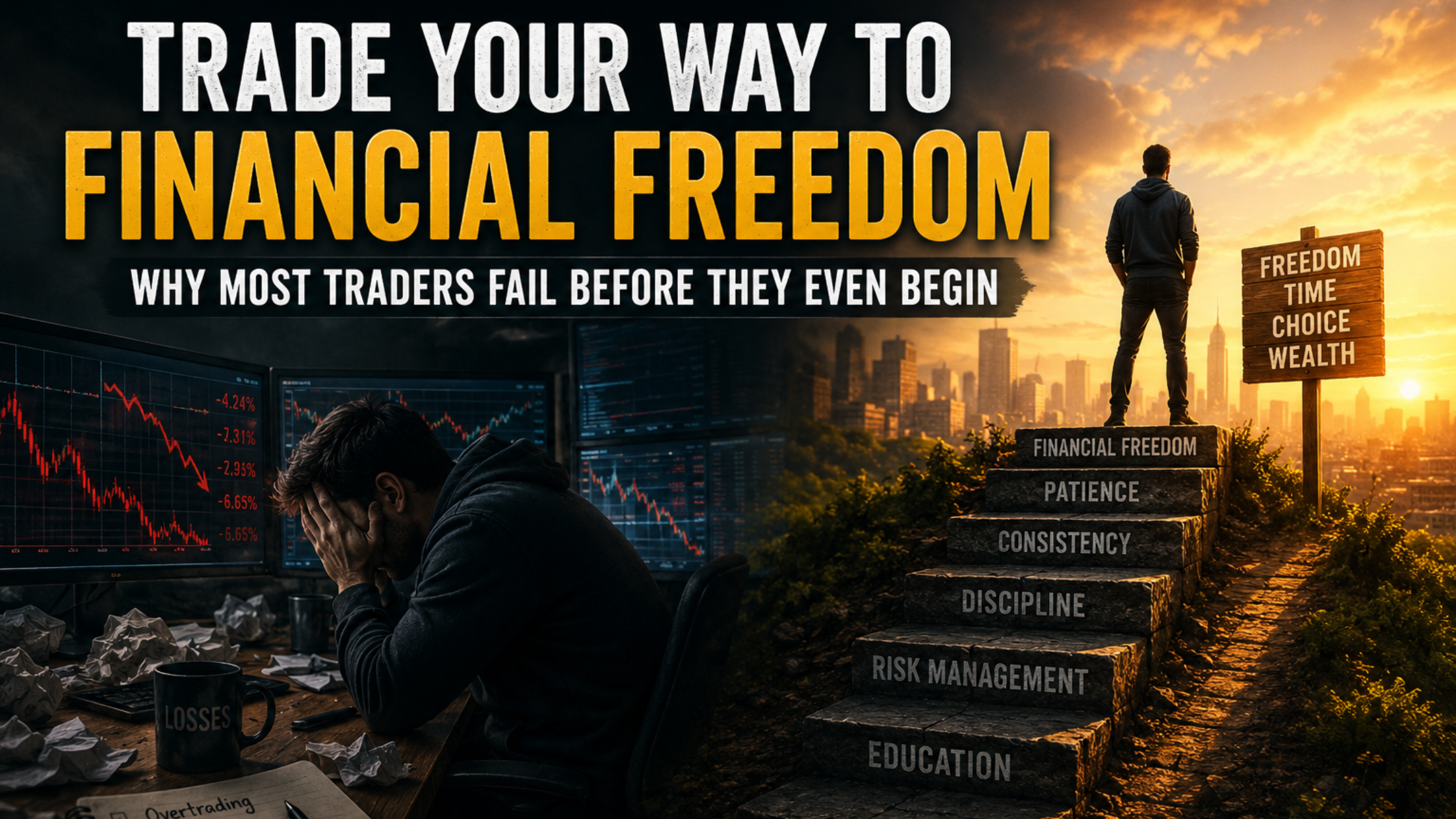
Trade Your Way to Financial Freedom is not about finding a magical indicator or predicting the next stock market rally. Real trading success comes from psychology, risk management, discipline, and building a system that survives market uncertainty over the long term.
Most traders enter the market dreaming about quick money. But after a few losses, they realize trading is far more emotional and difficult than social media makes it look. The good news is that consistent profitability is possible when you stop chasing shortcuts and start focusing on the principles that actually matter.
Trade Your Way to Financial Freedom by Understanding Real Wealth
Most people think financial freedom means:
- luxury cars,
- expensive watches,
- private jets,
- or becoming a millionaire overnight.
That is social media fantasy.
Real financial freedom is simpler.
Financial freedom means:
Your money earns enough to support your lifestyle without depending completely on active work.
For example:
- If your monthly expenses are ₹50,000,
- and your investments or trading income consistently generate ₹50,000+ monthly,
- you are financially free.
Notice something important:
Financial freedom is not about showing off.
It is about:
- control,
- flexibility,
- time,
- and peace of mind.
Trading can help create that freedom but only if approached professionally.
Unfortunately, most people approach trading like gambling.
And that is exactly why they fail.
The Biggest Lie in Trading
The biggest lie in trading is:
“You must predict the market correctly to make money.”
This sounds logical.
But it is completely misleading.
Many profitable traders are wrong almost half the time.
Some successful systems win only 35%–45% of trades.
So how do they still make money?
Because trading success depends on:
- Risk management
- Position sizing
- Emotional control
- Reward-to-risk ratio
- Consistency
not prediction.
This is one of the hardest concepts for beginners to accept.
Humans naturally want certainty.
We want to feel “right.”
But markets do not reward ego.
Markets reward discipline.
Why Most Traders Lose Money
Let’s be brutally realistic.
Most traders lose because they:
- overtrade,
- risk too much,
- refuse to take losses,
- keep changing strategies,
- copy others blindly,
- and chase fast profits.
A beginner usually follows this cycle:
Step 1: Discover Trading
They see someone posting profits online.
It looks easy.
They think:
“I can do this too.”
Step 2: Search for the Perfect Strategy
They binge-watch trading videos.
Every strategy suddenly looks magical.
Step 3: Ignore Risk
This is where damage begins.
They use:
- high leverage,
- oversized positions,
- emotional entries.
Step 4: Experience Losses
Losses create panic.
Instead of improving discipline, they:
- switch indicators,
- buy expensive courses,
- or blame the market.
Step 5: Blow Up the Account
Eventually, emotions take over.
The account disappears.
This cycle repeats for thousands of traders every year.
The Hidden Secret of Professional Traders
Professional traders think differently from retail traders.
Retail traders ask:
- “Which stock will go up?”
- “What’s the next multibagger?”
- “Which indicator is best?”
Professionals ask:
- “How much can I lose?”
- “What is my risk?”
- “Does this trade fit my system?”
- “What is the probability?”
- “How do I survive long term?”
That difference is massive.
Amateurs focus on profits.
Professionals focus on survival.
And ironically, survival creates profits.
Trading Psychology: The Real Battlefield

The market is not your biggest enemy.
Your mind is.
This is why two traders using the same strategy can get completely different results.
One trader:
- follows rules,
- cuts losses,
- stays calm.
Another trader:
- panics,
- revenge trades,
- exits early,
- doubles down emotionally.
Same strategy.
Different psychology.
Different outcome.
Common Psychological Mistakes Traders Make
1. Fear of Missing Out (FOMO)
You see a stock rising rapidly.
You enter late.
The market reverses instantly.
2. Refusing to Accept Losses
Many traders hold losing positions because accepting loss hurts their ego.
But small losses are normal.
Large losses destroy accounts.
3. Overconfidence
A few winning trades create dangerous confidence.
Suddenly:
- rules disappear,
- risk increases,
- discipline vanishes.
The market eventually punishes this behavior.
4. Revenge Trading
After a loss, traders try to recover quickly.
This emotional state creates irrational decisions.
Professional traders understand:
One trade means nothing.
Consistency over hundreds of trades matters.
Why Position Sizing Is More Important Than Strategy
This idea shocks beginners.
But it is true.
A mediocre strategy with excellent risk management can survive.
A brilliant strategy with terrible position sizing can collapse.
What Is Position Sizing?
Position sizing means deciding:
How much capital to risk on each trade.
For example:
- ₹1 lakh account
- Risk per trade = 1%
- Maximum risk = ₹1,000 per trade
This simple concept changes everything.
Why?
Because no single trade can destroy you.
Most beginners risk emotionally.
Professionals risk mathematically.
The 1% Rule That Saves Traders
One of the simplest trading survival techniques is:
Never risk more than 1%–2% of capital on one trade.
This prevents catastrophic losses.
Imagine losing 50% of your account.
You now need 100% returns just to recover.
That is why risk management matters more than finding “the perfect setup.”
Why Entries Matter Less Than You Think
Most trading content online focuses only on entries.
- breakout entries,
- candle patterns,
- moving averages,
- RSI signals.
But entries alone mean almost nothing.
You can enter randomly and still become profitable if:
- risk management is strong,
- losses stay small,
- winners are allowed to grow.
This idea feels strange initially.
But experienced traders understand it deeply.
Exits Create Wealth
Many traders know how to enter.
Very few know how to exit.
And that is why most never become consistently profitable.
Bad Exit Habits
Taking Profits Too Early
Fear causes traders to exit winning trades quickly.
Small profits feel emotionally safe.
Holding Losers Too Long
Hope replaces logic.
Losses become larger.
This destroys reward-to-risk balance.
The Power of Reward-to-Risk Ratio
Suppose:
- your average loss = ₹1,000
- your average profit = ₹3,000
Even if you win only 40% of trades, you can still be profitable.
That is the power of asymmetry.
Professional trading is not about being right constantly.
It is about:
- keeping losses controlled,
- while allowing winners to outperform losers.
Why Most Trading Gurus Mislead Beginners
The internet is filled with:
- fake P&L screenshots,
- rented luxury lifestyles,
- unrealistic promises,
- “90% accuracy” systems.
Be careful.
Real trading is boring.
Professional traders:
- manage risk,
- journal trades,
- follow systems,
- think statistically.
They are not screaming on YouTube thumbnails.
If someone promises:
- guaranteed profits,
- no losses,
- instant wealth,
run away immediately.
No strategy wins forever.
No trader avoids drawdowns.
Trading Is a Probability Game
This is one of the most important lessons in trading.
Trading is not certainty.
It is probability.
Think like a casino.
A casino does not panic after one loss.
Why?
Because it understands long-term edge.
Professional traders think the same way.
One trade means nothing.
The next 100 trades matter.
This mindset removes emotional pressure.
Building a Trading System That Fits YOU
One of the biggest mistakes traders make is copying others blindly.
A strategy that works for someone else may fail for you.
Why?
Because:
- personalities differ,
- risk tolerance differs,
- patience differs,
- time availability differs.
Questions You Must Ask Yourself
Are you comfortable with high volatility?
Some traders panic during drawdowns.
Others remain calm.
Can you hold positions overnight?
Swing trading may not suit everyone.
Do you enjoy fast decisions?
Scalping requires intense focus.
How much time can you dedicate daily?
A working professional may prefer swing trading over intraday trading.
Your system must match your personality.
Otherwise, emotional conflict destroys discipline.
The Dangerous Obsession With Being Right
Most traders secretly want validation.
They want the market to prove them correct.
This ego becomes expensive.
Professional traders accept being wrong quickly.
They understand:
Small losses are business expenses.
This mindset separates professionals from gamblers.
Why Simplicity Often Wins
Many beginners overcomplicate trading.
They use:
- 10 indicators,
- multiple screens,
- dozens of signals.
But complexity often creates confusion.
Simple systems are easier to:
- follow,
- test,
- improve,
- and trust.
Some of the best traders in the world use surprisingly simple methods.
The Importance of Journaling
If you are not journaling your trades, you are trading blindly.
A trading journal helps identify:
- emotional mistakes,
- repeated patterns,
- strengths,
- weaknesses.
Track:
- entry reason,
- exit reason,
- emotions,
- mistakes,
- market conditions.
Over time, patterns become obvious.
Self-awareness improves performance.
How to Develop a Professional Trading Mindset
1. Think Long Term
Do not judge yourself based on one trade.
Focus on consistency.
2. Respect Risk
Survival comes first.
3. Accept Uncertainty
No one knows what the market will do next.
4. Avoid Emotional Trading
Your feelings are not trading signals.
5. Stay Process-Oriented
Good process matters more than short-term outcomes.
Can You Really Trade Your Way to Financial Freedom?
Yes but not in the way social media sells it.
Trading is not:
- easy money,
- guaranteed income,
- instant success.
It is a performance skill.
Like:
- sports,
- business,
- or entrepreneurship.
It requires:
- discipline,
- emotional control,
- continuous learning,
- risk management.
The traders who survive long enough often realize something surprising:
Trading becomes less about money and more about mastering yourself.
That transformation changes everything.
Practical Steps Beginners Should Follow
Step 1: Learn Risk Management First
Before strategies.
Before indicators.
Before predictions.
Step 2: Start Small
Trade tiny positions initially.
Protect capital.
Step 3: Focus on Process
Do not obsess over daily profits.
Step 4: Build One System
Avoid strategy hopping.
Step 5: Keep a Journal
Track every trade honestly.
Step 6: Control Emotions
This takes time and experience.
Step 7: Think in Probabilities
No setup is guaranteed.
Best Resources to Improve Trading Knowledge
Here are some genuinely useful educational resources:
- Investopedia Trading Guide
- Trading Psychology Articles by BabyPips
- Risk Management Basics by CME Group
These are beginner-friendly and focus on practical understanding rather than hype.
Final Thoughts
Most people enter trading searching for shortcuts.
But the real edge is rarely hidden inside indicators or secret formulas.
The real edge comes from:
- discipline,
- psychology,
- position sizing,
- emotional stability,
- and consistency.
The market constantly tests human behavior.
Fear.
Greed.
Ego.
Impatience.
Those who learn to manage themselves often outperform those obsessed with predicting the market.
Financial freedom through trading is possible.
But it usually arrives slowly, quietly, and through discipline not excitement.
And perhaps that is the biggest trading lesson of all.
Frequently Asked Questions (FAQ)
Is trading a good way to achieve financial freedom?
Trading can help create financial freedom if approached professionally with strong risk management, discipline, and realistic expectations. It is not a shortcut to instant wealth.
What is the biggest mistake beginner traders make?
Most beginners risk too much money per trade and focus only on finding perfect entry signals while ignoring psychology and position sizing.
How much should I risk per trade?
Many professional traders risk only 1%–2% of their total trading capital per trade to protect themselves from major drawdowns.
Is trading mostly psychology?
Psychology plays a massive role in trading success. Emotional control, discipline, and consistency often matter more than technical indicators.
Can I become profitable with a low win rate?
Yes. If your winning trades are much larger than your losing trades, you can still be profitable even with a win rate below 50%.
Why do traders fail despite good strategies?
Many traders fail because they:
- break rules,
- overtrade,
- revenge trade,
- ignore risk management,
- or cannot control emotions.
What matters more: entries or exits?
Exits usually matter more than entries because they determine:
- how losses are controlled,
- and how profits are protected.
How long does it take to become consistently profitable in trading?
For most traders, becoming consistently profitable takes years of learning, mistakes, emotional development, and system refinement.